
Thyme Essential Oil Benefits, Uses & Recipes

Katie Veldkamp
Certified Aromatherapist
Fact Checked & Approved
Thyme is the herb in your roast chicken and the oil on the shelf is a very different thing — steam-distilled from the same plant, and concentrated enough that Simply Earth gives it a special dilution rate of 1%. That single number is the most useful thing on this page, because thyme is a hot oil and almost nothing written about it online tells you where the line is. Here is what thyme actually does, the number to get right before it touches skin, and six recipes that already use it.
In this Guide
Free Cheat Sheet
Not sure how much to dilute?
Get the free Essential Oil Cheat Sheet and use every oil in your cabinet with confidence.
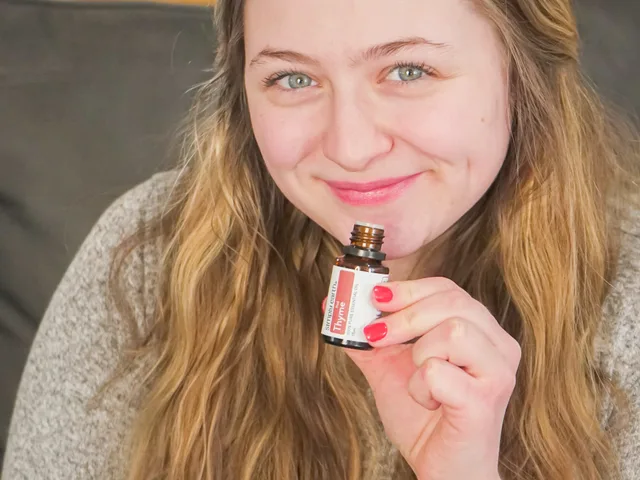
BEST FOR: DIFFUSING THROUGH A STUFFY WEEK
Supporting respiration is the first use Simply Earth lists for thyme, and it is the one the oil is best known for. Thymol, the compound that dominates this oil, has been studied for its effect on the symptoms of respiratory tract infections — one review of combined natural actives including thymol looked specifically at cough. That is research on a compound rather than a promise about a bottle, but it is why thyme has been a cold-months oil for as long as anyone has been distilling it.
KATIE'S TIP
Diffusing is the easiest way to use thyme, because it carries none of the skin-irritation risk that topical use does. One drop is genuinely enough in a small room.


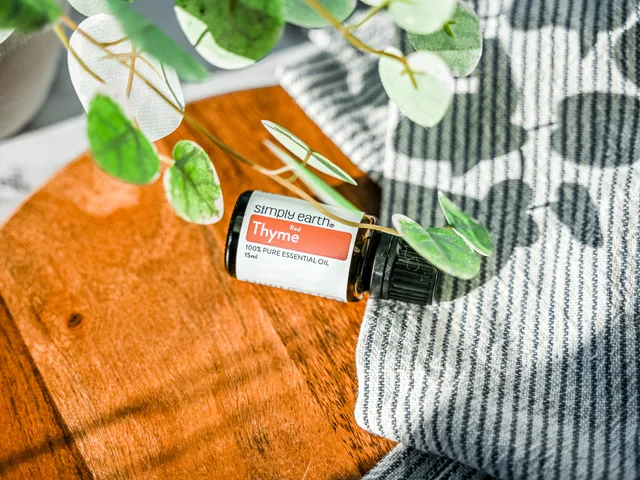
BEST FOR: SURFACE SPRAYS AND LAUNDRY
Thyme is on Simply Earth's list as a cleaning oil, and thymol is one of the most studied antimicrobial compounds in the whole essential oil cabinet — research on thyme oil and thymol against moulds from damp dwellings is a good example. It also smells sharp and herbal rather than perfumed, which is exactly what you want in a linen spray.
KATIE'S TIP
Two drops is the usual amount in an SE cleaning recipe, not twenty. Thyme is assertive enough that more does not make the spray work harder, it just makes it smell medicinal.


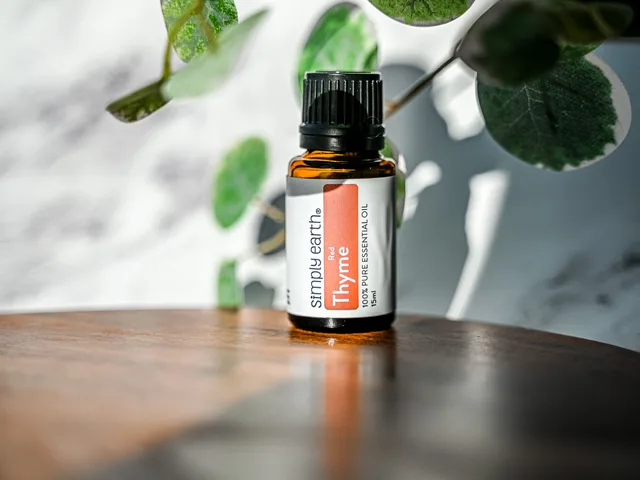
BEST FOR: SUMMER EVENINGS ON THE PORCH
Deterring insects is one of Simply Earth's listed uses and it is the benefit with the most direct evidence behind it. A study of essential oils and monoterpenes against Culex pipiens pallens — a common house mosquito — measured thyme among the more effective oils tested. It is the reason thyme sits in SE's own mosquito blend alongside Bug Fighter and Grapefruit.
KATIE'S TIP
Diffusing on a covered porch works better than you would expect. For skin, remember the 1% rule still applies — thyme does not get a pass because it is going on for bugs.
Use it in

Promotes Circulation
The warming one — and the one that needs the carrier oil.
 Shop Thyme Essential Oil
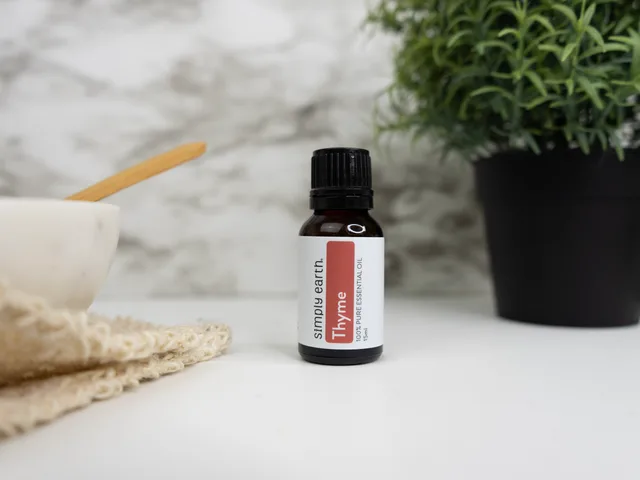
BEST FOR: DILUTED WARMING MASSAGE BLENDS
Promoting circulation is on Simply Earth's own list of thyme's uses, and it is the traditional reason thyme turns up in cold-weather massage blends — applied at a safe dilution it has a warming feel on skin. This is also the benefit where the 1% rule stops being advice and starts being the whole instruction, because a warming oil used neat is simply an irritating one.
KATIE'S TIP
One drop of thyme per teaspoon of carrier oil puts you at roughly 1%. Patch test on the inner forearm and wait a day before you use it on a larger area.

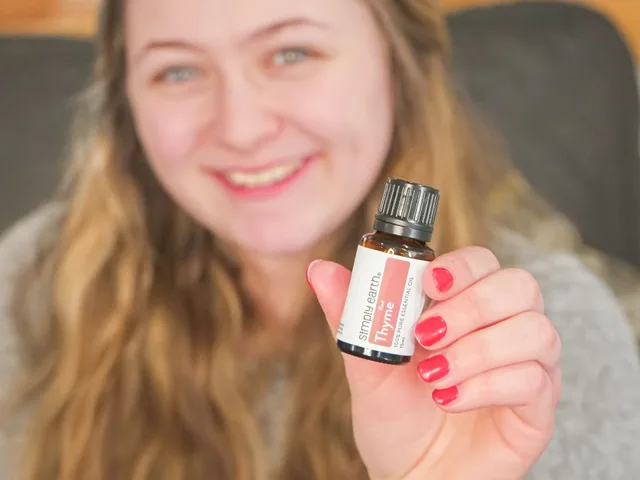
BEST FOR: SHORT DIFFUSER SESSIONS AT THE END OF A LONG DAY
Calming is the seventh use on Simply Earth's list for thyme and it is the one that never made it into the original article. Thyme is not a sleep oil in the way lavender is — it is sharp, herbal and fairly bracing — but a low, short diffuse of something this grounding is genuinely settling when you are wound up. Treat it as an evening wind-down oil rather than a bedtime one.
KATIE'S TIP
Pair one drop of thyme with something softer — Lavender and Sandalwood both appear on SE's blends-well-with list for it — rather than diffusing it on its own.
Use it in
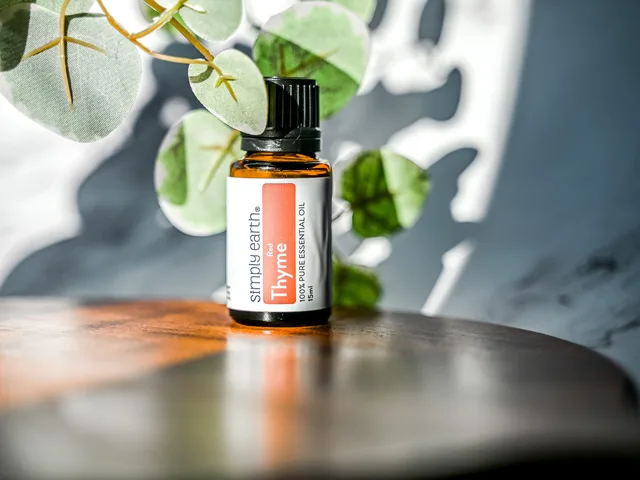
BEST FOR: FRESH-START CLEANING AND DIFFUSER ROUTINES
Simply Earth lists detoxifying among thyme's uses, and the research behind that word is antioxidant chemistry rather than anything to do with a cleanse — one study measured the effect of thyme essential oil on antioxidative metabolism in serum and liver tissue. Worth knowing what that is and what it is not, because thyme gets attached to some very large detox claims it cannot carry.
KATIE'S TIP
This is the benefit most often oversold. If a page tells you thyme flushes toxins from your body, close the tab — the real literature is about antioxidant activity measured in a laboratory.
Promotes Brain Health
The newest research, and the furthest from your kitchen.
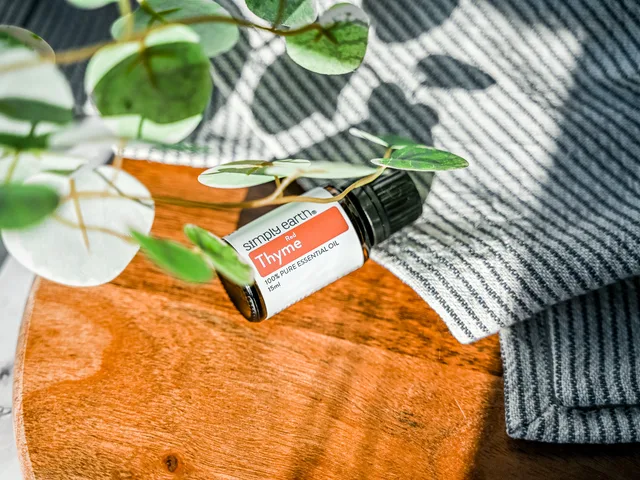 Shop Thyme Essential Oil
BEST FOR: DESK-SIDE DIFFUSING
Promoting brain health is the last use on Simply Earth's list, and it is the one with the most recent research attached — a 2020 study in zebrafish looked at Thymus vulgaris essential oil and cognitive function via cholinergic and antioxidant systems. Animal research is a long way from a human claim, and it is worth being plain about that, but it is why this use is on the list at all.
KATIE'S TIP
Thyme is a middle note with a blending factor of 1, so it does not shout over a blend the way oregano does. One drop with citrus is a good desk diffuser.
Put It to Work
How to Use Thyme Essential Oil
Diffuse
- • 1–2 drops is plenty — thyme is sharp and carries a long way
- • Pair with Lemon, Tangerine or Tea Tree to soften the edge
- • The easiest way to use thyme, with no skin-irritation risk
Topical
- • 1% is thyme's special dilution rate — about one drop per teaspoon of carrier
- • Patch test on the inner forearm and wait a day
- • Never apply it undiluted, and keep it off mucous membranes
Household
- • Two drops in a linen or surface spray
- • Reusable dryer sheets with vinegar and Clean & Fresh
- • Shake before every use — oil and water separate
DIY
- • Air-purifying and mosquito-repelling diffuser blends
- • Warming massage oils at 1% dilution
- • Anchor it with Sandalwood, Pine or Vetiver
Know the Difference
Thyme Chemotypes, and Which One We Sell
Thyme is unusual among essential oils in that the same botanical species produces several genuinely different oils, called chemotypes, depending on where and how the plant grows. They share a name and a Latin binomial and then behave differently in the bottle. Simply Earth sells the thymol type — the one commonly labelled Red Thyme — which is the most phenol-rich of the three and the reason this page keeps coming back to dilution.
Swipe to compare →
Thyme (Red), Thymol Type Thymus vulgaris ct. thymol | Thyme, Linalool Type Thymus vulgaris ct. linalool | Thyme, Thujanol Type Thymus vulgaris ct. thujanol | |
|---|---|---|---|
| Same plant? | Yes — Thymus vulgaris | Yes — Thymus vulgaris | Yes — Thymus vulgaris |
| Dominant compound | Thymol, with para-cymene and carvacrol | Linalool | Thujanol |
| Aroma | Spicy and herbal, pale yellow oil | Softer and sweeter, less medicinal | Warm and herbal, the mildest of the three |
| How gentle is it on skin? | The strongest of the three — phenol-rich and dilution-critical | Generally regarded as gentler | Generally regarded as the gentlest |
| Special dilution rate | 1%, printed on Simply Earth's own record | Varies by supplier — check the label | Varies by supplier — check the label |
| Sold by Simply Earth | Yes — Thyme (Red) Essential Oil | No | No |
| This article | The one Simply Earth sells | — | — |
Perfect Pairs
Thyme Blends Well With…
Thyme is a middle note with a blending factor of 1, which makes it far easier to blend than its reputation suggests — it adds a herbal backbone without taking a blend over. These are the pairings Simply Earth lists for it. Oregano is its closest relative here, sharing both thymol and carvacrol, while Lemon and Grapefruit lift it and Sandalwood gives it something to sit on.
From the Spice Rack
What Is Thyme Essential Oil?
Thyme essential oil is steam-distilled from the herb of Thymus vulgaris — the same plant as the jar in your kitchen cupboard. It takes a surprising amount of plant material to fill a small bottle: roughly three pounds of herb for 15mL of oil. What comes out is a pale yellow oil of medium consistency with a spicy, herbal aroma, sitting as a middle note with a blending factor of 1.
The herb has been valued far longer than the oil has existed. Thyme was burned and bathed in across ancient Rome as a symbol of courage, used by the Ancient Egyptians in embalming, and tucked under pillows by medieval herbalists to keep nightmares away. Whatever you make of the folklore, it tells you the plant has been treated as a protective, clearing herb for a very long time — which is roughly where its modern reputation as a cleaning and cold-months oil comes from too.
The distinction worth holding onto is that distillation concentrates. A spoonful of dried thyme on a roast and a drop of thyme essential oil are not the same quantity of the same thing, and that gap is the reason this oil comes with a number attached.
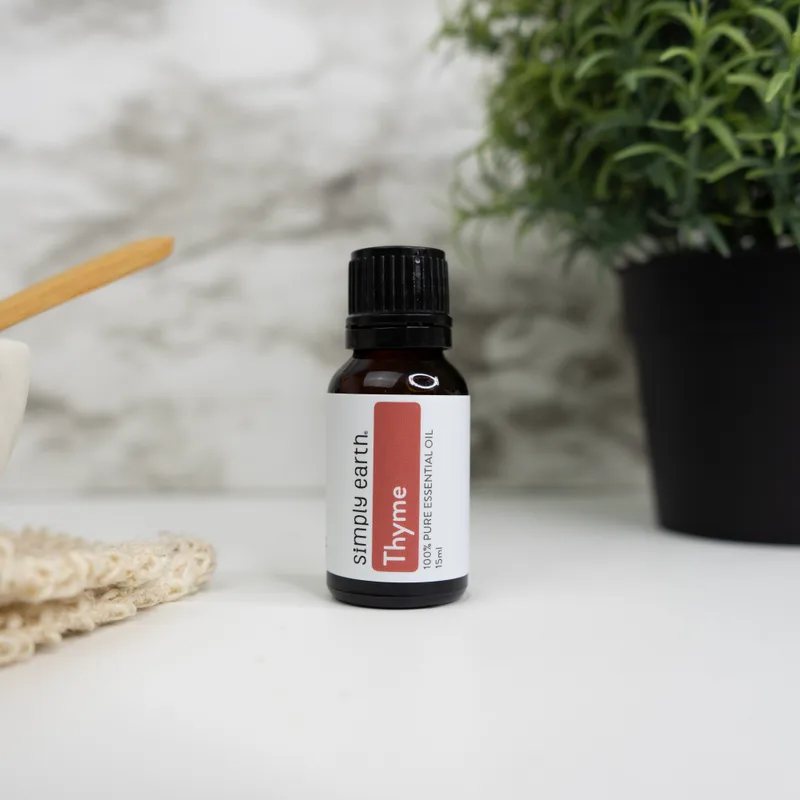
The Chemistry
The Science Behind This Oil
Simply Earth lists thymol, para-cymene and carvacrol as this oil's main constituents. What follows is chemistry about those compounds, not claims about what this product will do for a person.
Thymol
The dominant compound · Antiseptic literature
A white crystalline substance with a strong aromatic odour, and the compound that gives this chemotype its name. Thymol has a long history in disinfectants and oral-care products and turns up throughout the antimicrobial and antifungal literature. It is also the compound behind the 1% dilution rate — phenols are what make this oil hot.
Para-cymene
Also found in cumin · Synergist
A naturally occurring aromatic compound found across a number of essential oils, most commonly cumin and thyme. On its own it is not especially active; its interest in the literature is as a synergist that appears to enhance what the phenols around it are doing. It also shows up in cleaning products and fragrance in its own right.
Carvacrol
Shared with Oregano · Pungent and warm
The compound thyme shares with oregano, carrying that same characteristic warm, pungent odour. It appears in the antimicrobial chemistry literature alongside thymol and is the second reason this oil needs diluting properly rather than the first.
Simply Earth's Thyme (Red) Essential Oil is steam-distilled from the herb of Thymus vulgaris, grown in Spain. We third-party GC/MS test our oils and publish the results, and we never blend them with synthetic fragrance, fillers or extenders. A batch GC/MS report is not linked for Thyme yet — the oil has no Spec Sheets relation in Simply Earth's Ingredient Info database to cite here, though a batch-specific report ships with every bottle. Shop Thyme Essential Oil →
Where It Comes From
Where Our Thyme Comes From
Simply Earth's Thyme (Red) Essential Oil is steam-distilled from the herb of Thymus vulgaris grown in Spain. Spain and the wider western Mediterranean are the traditional home of thymol-type thyme, and that is not an accident of trade routes — the chemotype a thyme plant expresses depends heavily on where it grows. Hot, dry, stony ground pushes the plant toward thymol, which is exactly the oil this page is about.
That is also why sourcing and testing matter more for thyme than for most oils. Two bottles both honestly labelled Thymus vulgaris can be chemically quite different, and the difference changes how the oil should be used on skin. A GC/MS report is the only way to know which one is in your hand. Simply Earth third-party tests every batch and ships a batch-specific report with every bottle.
Use It Right
Things to Remember When Using This Oil
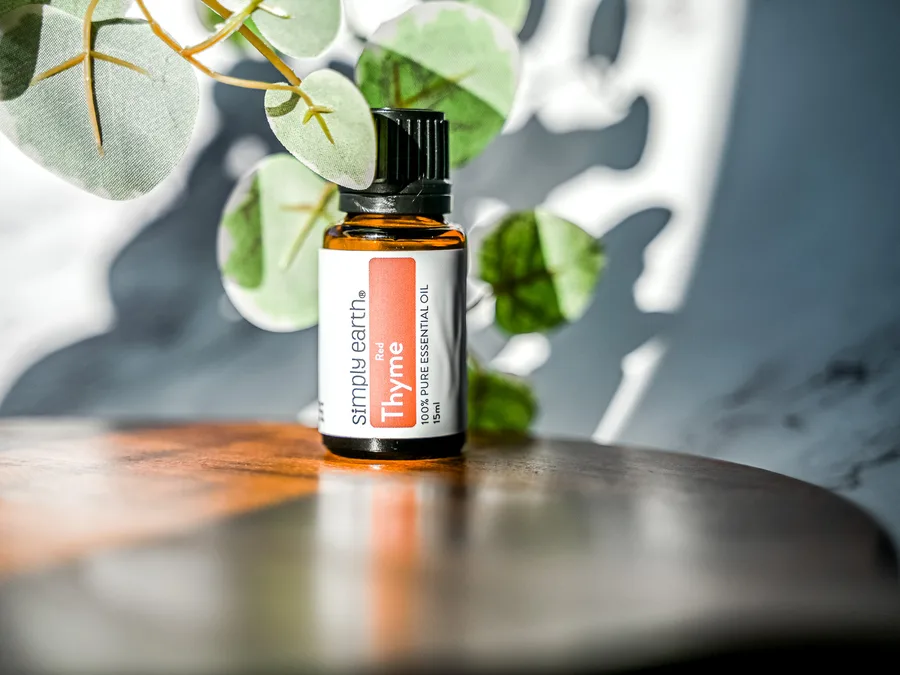
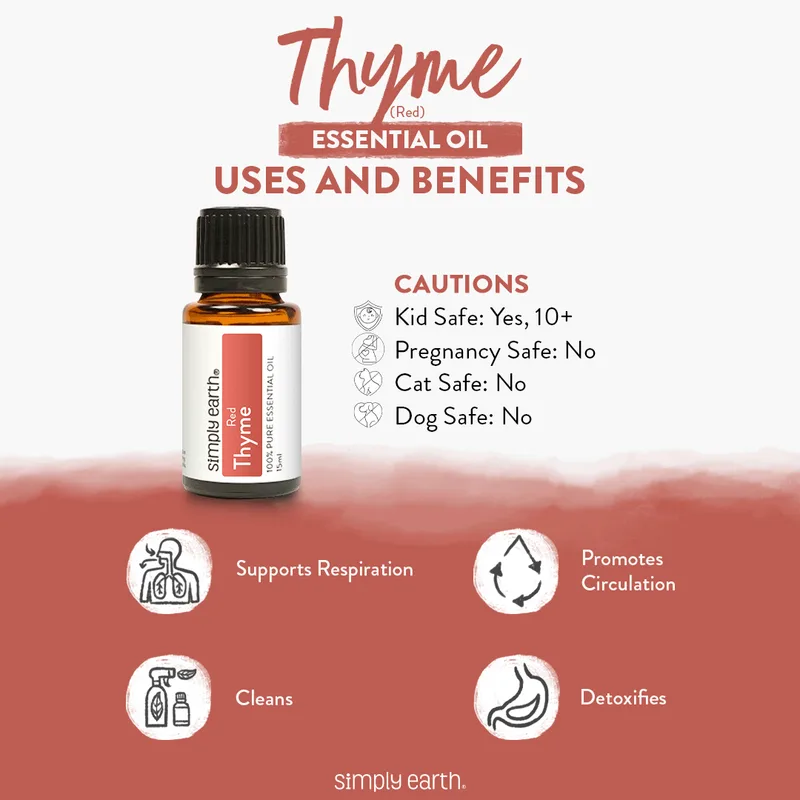
🔥 Thyme is a hot oil with a special dilution rate of 1% — roughly one drop per teaspoon of carrier oil. This is Simply Earth's own figure for this oil, not a general guideline.
Simply Earth's record is specific about why: Red Thyme contains a high amount of phenols — carvacrol and thymol — that can irritate mucous membranes and must be diluted well before use.
Patch test on the inner forearm and wait a day before using it more widely. Oxidised oil, left with the cap off, is more likely to irritate.
May be used by children aged 10 and over, at dilution. Keep it out of reach of younger children.
Not pregnancy safe and not breastfeeding safe. Consult your doctor before use if either applies to you.
Not cat safe and not dog safe. Avoid diffusing it where a pet cannot leave the room.
If you are receiving treatment or taking any medication, talk to your doctor before using this oil.
Sun safe — thyme is not phototoxic, so treated skin does not need to stay out of daylight.
Shelf life is about four years. Store it sealed, in the dark, away from heat.
We don't recommend ingesting essential oils unless under the direction of a doctor certified in aromatherapy.
Not sure how much carrier to use? Simply Earth publishes a free dilution chart you can keep next to your oils.
These statements have not been evaluated by the Food and Drug Administration. This product is not intended to diagnose, treat, cure, or prevent any disease.
Real Results
What Earthies Are Saying About It
"I love the thyme EO! I mix it with a carrier oil and rub on my feet and legs to help decrease cramps."
Nancy H.
Verified Buyer • Thyme Essential Oil (Red)
"I love Simply Earth Thyme. It is a great product. I use it in many of my blends. I am very satisfied."
Gina L.
Verified Buyer • Thyme Essential Oil (Red)
"EXCELLENT experience as always with Simply Earth! Thank you Simply Earth for all your help in learning about essential oils and making it fun and exciting! Great customer service and care!"
Diana
Website Review • Thyme Essential Oil (Red)
Certified 100% Pure
No fillers, no synthetics. Just pure oil.
GC/MS Third-Party Tested
Every batch independently verified.
Ethically Sourced from Quality Farms
Responsibly harvested. People and planet first.
15mL
Bottle Size
MLM brands: 10mL
$10–16
Per Oil
MLM brands: $25–55+
Public
GC/MS Tests
MLM brands: Rarely
Your Order Changes Lives: 13% of profits fight human trafficking globally.
Thyme Essential Oil FAQ
The questions Earthies ask most about thyme — starting with the one that matters for safety.
How do I dilute thyme essential oil safely? +
Simply Earth gives thyme a special dilution rate of 1%, which works out at roughly one drop of thyme per teaspoon of carrier oil such as almond, jojoba or fractionated coconut. That is lower than the general-purpose dilution many people default to, because thyme is phenol-rich. For sensitive skin start weaker, patch test on the inner forearm, and wait a day before applying more widely. Never apply thyme essential oil undiluted.
Is red thyme the same as regular thyme essential oil? +
They are the same plant and usually the same product. Red Thyme is the common trade name for the thymol chemotype of Thymus vulgaris, which is what Simply Earth sells and lists simply as Thyme. Other chemotypes exist — linalool and thujanol types are the ones you will see most often — and they are generally regarded as gentler on skin. If a recipe calls for thyme without saying which type, it is usually assuming the thymol one.
Why is thyme essential oil considered a hot oil? +
Because of its phenol content. Simply Earth's own record notes that Red Thyme contains a high amount of carvacrol and thymol, which can irritate mucous membranes and must be diluted well before use. Those same compounds are behind most of what the oil is valued for, so the answer is not to avoid thyme but to respect the 1% figure and patch test.
Can children use thyme essential oil? +
Simply Earth lists thyme as suitable for children aged 10 and over, at dilution. It is not recommended for younger children, and the bottle should be stored out of their reach. If you want an oil for a younger child, ask an aromatherapist for a gentler alternative rather than diluting thyme further.
Is thyme essential oil safe during pregnancy? +
No. Simply Earth lists thyme as neither pregnancy safe nor breastfeeding safe, so we do not recommend it in either case. Consult your doctor before using any essential oil if you are pregnant, nursing, receiving treatment or taking medication.
Is thyme essential oil safe around cats and dogs? +
Simply Earth lists thyme as neither cat safe nor dog safe, so we do not recommend using it around either. Cats in particular lack the liver enzymes needed to process many essential oil compounds. If you diffuse in a shared space, make sure pets can leave the room, and talk to your vet before using any essential oil on an animal.
What does thyme essential oil blend well with? +
Simply Earth lists Basil, Sweet Fennel, Geranium, Ginger Root, Pink Grapefruit, Bulgarian Lavender, Lemon, Sweet Marjoram, Oregano, Pine, Sandalwood, Tea Tree and Vetiver. Thyme has a blending factor of 1, so it is more cooperative in a blend than its strong reputation suggests — it adds a herbal backbone rather than dominating.
What recipes actually use thyme essential oil? +
Six Simply Earth recipes list it — the Clean Linen Spray, Fresh Reusable Dryer Sheets, the Clean & Crisp air-purifying diffuser blend, the Summer Nights mosquito-repellent blend, the Headache Relief diffuser blend and the Citrus & Herbs diffuser blend. Most call for one or two drops, which is a fair guide to how little thyme a recipe needs.


About the Author: Katie Veldkamp
Katie Veldkamp
Certified Aromatherapist · Co-Founder, Simply Earth
Katie Veldkamp is a Certified Aromatherapist and co-founder of Simply Earth. Her mission is to cut through the noise around essential oils so you can use them with confidence. Everything in this article has been reviewed and approved by Katie.
Learn essential oils the easy way
Every month we ship four pure essential oils, six natural recipes, and everything you need to make them. No guesswork.
No spam. Unsubscribe any time.

Learn by doing
Make your own natural products every month.
The Simply Earth Recipe Box ships 4 full-size essential oils, 6 natural recipes, and everything you need to make them. No guesswork.
Start My Recipe Box$39.99 for your first box, then $49.99/month. Skip, pause, or cancel anytime.