
Geogard ECT: The Natural Preservative for Water-Based DIY

Katie Veldkamp
Lead Certified Aromatherapist
Fact Checked & Approved
Anything you make with water in it will eventually go bad. Not "might" — will. A lotion, a toner, a foaming hand soap, a room spray: the moment water is in the jar, so is an environment where bacteria, yeast and mold can grow, and they do it long before the product looks or smells wrong. In a genuinely sanitary kitchen a distilled-water recipe might hold for six weeks. In a real one, two weeks is the honest number, and that drops further the first time you scoop out lotion with your fingers. Geogard ECT is the preservative Simply Earth sells to solve exactly that, and it is one of the few DIY ingredients where the numbers really matter — 0.6 to 1% of your recipe's weight, a pH between 3 and 8, and added only once the mixture has cooled below 113°F. This guide covers what is actually in the bottle, the seven things it does for a formula, the method step by step, how it differs from the things people wrongly use in its place, and the fourteen Simply Earth recipes built on it.
Free Cheat Sheet
New to Essential Oils? Start With the Free Guide
One printable page covering the oils most worth owning first — including the ones you will be scenting your preserved recipes with.
Start Here
What Geogard ECT Actually Is
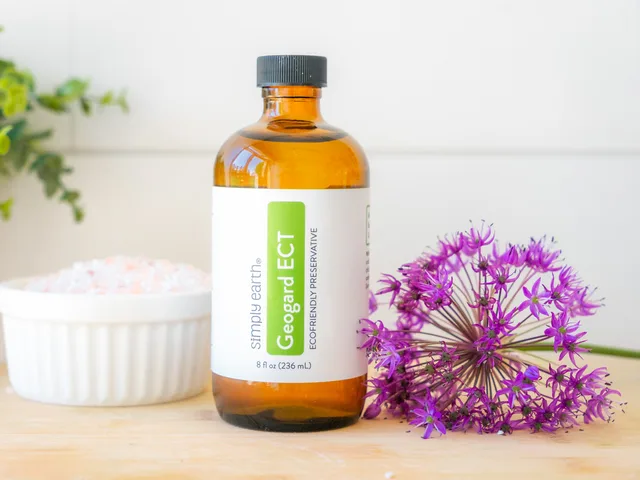
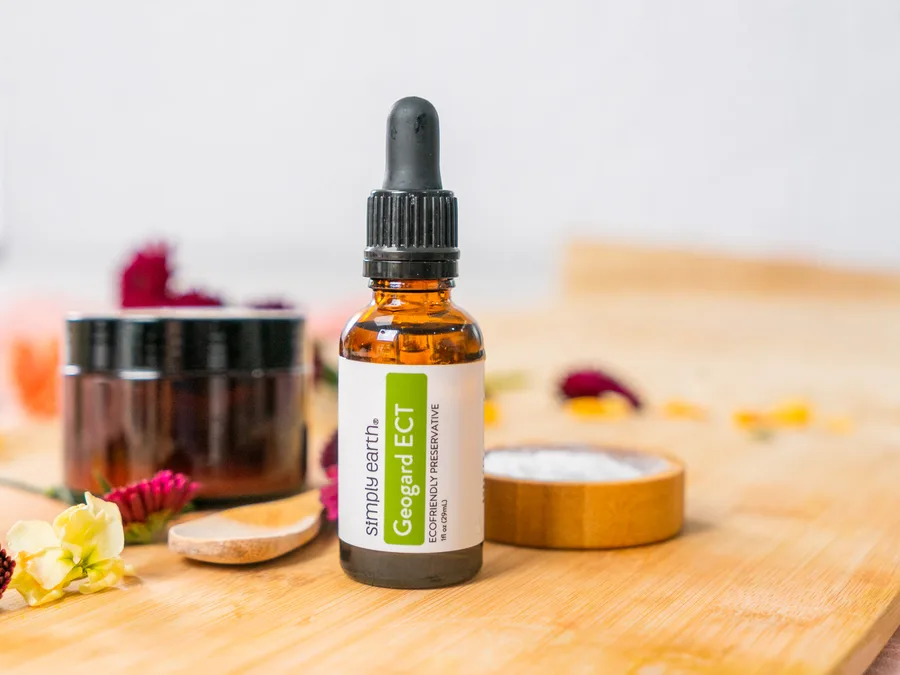
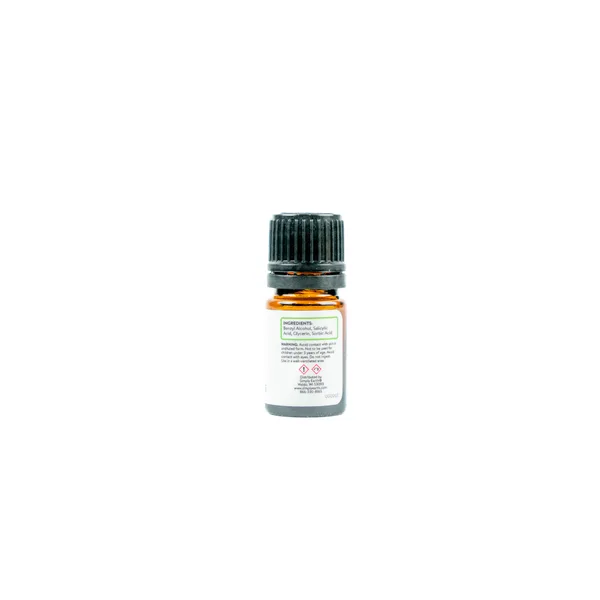
Geogard ECT is a broad-spectrum preservative system, and the label lists four ingredients in order of quantity: Benzyl Alcohol, Salicylic Acid, Glycerin and Sorbic Acid. Every one of them occurs in nature and every one is in common use across personal care. It is not an essential oil, it is not an extract, and it is not doing anything aromatic — it is a functional ingredient with one job, which is to stop microbes growing in the water phase of whatever you have made.
"Broad-spectrum" is the part worth slowing down on, because it is the whole reason this bottle exists. It means the system covers bacteria, yeast and mold, rather than one of the three. That matters because a preservative that only handles bacteria leaves you with a lotion that grows mold instead, and you would not know until it was visible.
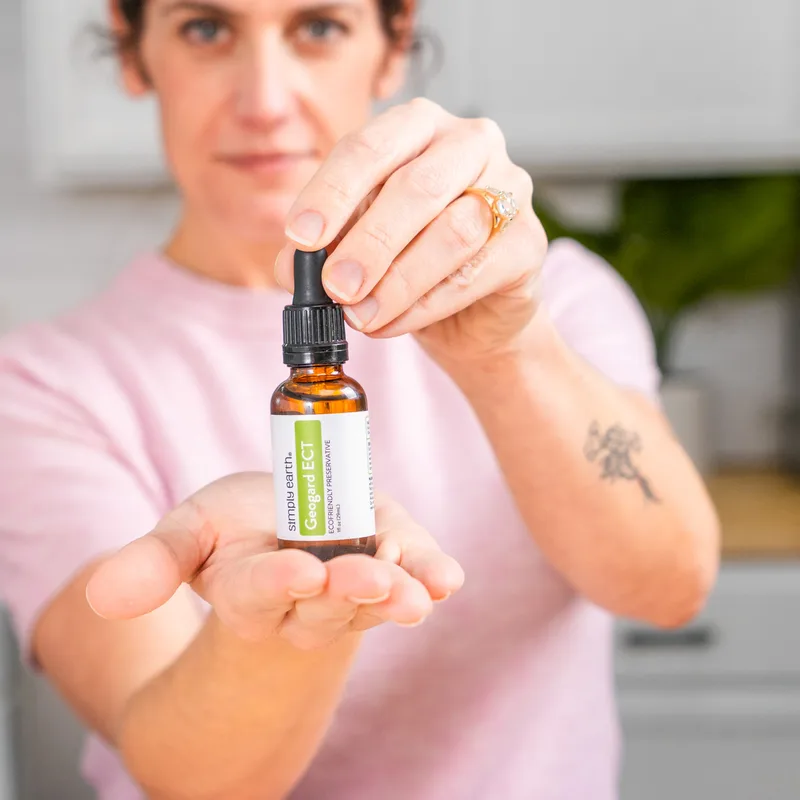
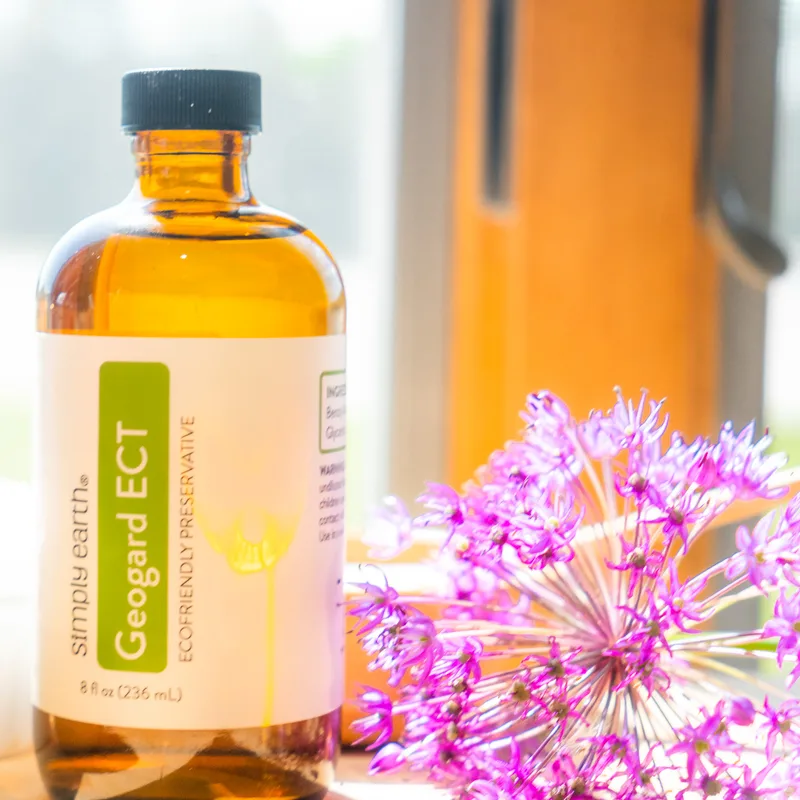
Simply Earth sells it in three sizes — a 5 mL for trying it, a 1 oz that will preserve a long run of small batches, and an 8 oz for people making at volume. The 1 oz is the one most makers end up with, and it is the size the 9,053 sales on this product are mostly made of. It arrives as a clear liquid in a dropper bottle, which is deliberate: the dosing is small enough that drops are a practical unit, and roughly 6 drops per 1 oz of finished product lands you in the right range.
BEST FOR: ANY RECIPE WITH WATER IN IT
This is the benefit everything else on the page rests on. Geogard ECT is a broad-spectrum system, which means it is active against bacteria, yeast and molds rather than covering one category and leaving the others open. In a home-made lotion that distinction is not academic — the three spoil a product in visibly different ways, and a partial preservative simply changes which one you get. Simply Earth's own support team puts it plainly: used at the proper rate, Geogard ECT is a complete preservative, and it should not need refrigeration to do its job.
Katie's Tip
A product can be badly contaminated and still look, smell and feel completely normal. That is exactly why you preserve at the point of making rather than waiting for a sign that something is wrong.
Use it in


It Works Across pH 3 to 8
A wide enough window to cover most of what you make.
 Shop Geogard ECT Preservative
BEST FOR: TONERS, MISTS, GELS & CLEANSERS
Preservatives are fussy about acidity, and a narrow one rules out half of what a home formulator wants to make. Geogard ECT is effective between pH 3 and 8, which is broad enough that almost every Simply Earth water-based recipe falls inside it without adjustment. The exception is worth naming: recipes built on a lot of vinegar, like some of the cleaning ones, can sit below the range. Simply Earth's support team adds one refinement to the label figure — aim for the lower half of that window, ideally under pH 7, rather than treating 8 as a target.
Katie's Tip
Check the pH before the preservative goes in, not after. Botanical ingredients like aloe and plant extracts move pH around more than people expect, and it is far easier to correct the batch than to rescue it.


BEST FOR: SCENT-LED RECIPES
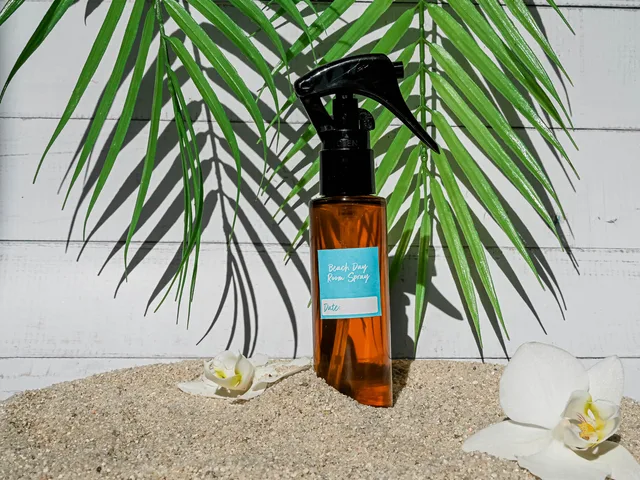
A preservative with a strong smell of its own is a real problem in a recipe whose entire point is the essential oils in it. Geogard ECT has very little aroma, which is why a room spray or a linen spray made with it still smells like the blend you chose rather than like a chemistry set. It is not literally odourless — one reviewer describes a faint "new car" note and says it shifted the scent of her recipe slightly — but at 0.6 to 1% of the total weight it sits far enough back that most makers never notice it.
Katie's Tip
If you are sensitive to it, add your essential oils after the preservative and give the batch a day before you judge the scent. Freshly mixed is never how a recipe finally smells.


It Is Actually Certified
COSMOS and Soil Association approved, not just "natural".
 Shop Geogard ECT Preservative
BEST FOR: MAKERS WORKING TO A STANDARD
"Natural" is a word anyone can print on a bottle. Certification is not. Geogard ECT is COSMOS and Soil Association approved and meets ECOCERT standards, which means it can be used in products being made to those organic and natural standards. If you sell what you make, or you are building toward a certification of your own, that is the difference between an ingredient you can document and one you simply like the sound of.
Katie's Tip
Keep the label or a photo of it with your batch records. If you ever need to evidence what went into a product, the certification claims live on the packaging, not in your memory.


Vegan, Non-GMO, Cruelty-Free
The three claims most makers are asked about.
 Shop Geogard ECT Preservative
BEST FOR: PRODUCTS YOU GIVE AWAY OR SELL
Geogard ECT is vegan, non-GMO and cruelty-free — not tested on animals. For a lot of people making their own products, those three are the whole reason they stopped buying off the shelf in the first place, and a preservative that quietly undoes any of them is not a workable ingredient. It is also the answer to the question every maker eventually gets asked when they hand someone a jar of something, which is some version of "but what is actually in it?"
Katie's Tip
Write the four ingredients on the bottom of anything you gift. Benzyl Alcohol, Salicylic Acid, Glycerin, Sorbic Acid. It takes ten seconds and it answers the question before it gets asked.


BEST FOR: BIG BATCHES, GIFTS & SELLING
This is the practical reason to bother. An unpreserved water-based recipe is a two-week product in most real kitchens, and six weeks at the absolute best in sterile conditions. With Geogard ECT used correctly, Simply Earth's product record puts the expectation at up to 9 months when the product is made in a sterile environment. That single change is what makes it reasonable to double a recipe, to make a batch of gifts in November for December, or to sell what you make at all.
Katie's Tip
Shelf life is set by how clean the making was, not only by the preservative. Sanitised jars, sanitised tools and a wiped-down surface are doing as much work here as the drops are.


One Bottle Covers Your Whole Shelf
About 6 drops per ounce, and no second preservative.
 Shop Geogard ECT Preservative
BEST FOR: YOUR FIRST PRESERVED RECIPE
Preserving properly sounds like it should require a shelf of inputs. It does not. Geogard ECT is used at 0.6 to 1% of your recipe's total weight, which works out at roughly 6 drops per 1 oz of finished product, and Simply Earth's support team is explicit that when it is used correctly it does not need to be paired with a second preservative — adding one is usually unnecessary and can make a formula less stable rather than more. One small bottle, one scale, and every water recipe you make is covered.
Katie's Tip
Weigh the recipe without the preservative, multiply by 0.01, and add that. That one calculation lands you inside the 0.6 to 1% range almost every time, whatever you are making.

Put It to Work
How to Use Geogard ECT
1. Check Your pH First
- • Measure the pH of the recipe before the preservative goes anywhere near it
- • Geogard ECT only works if the finished product sits between pH 3 and 8
- • Aim for the lower half of that window — ideally under pH 7
- • pH test strips are fine; a pH meter is better if you make often
- • Aloe, botanical extracts and powders all shift pH, so test the actual batch
2. Weigh and Calculate
- • Weigh your recipe WITHOUT the preservative in it
- • Geogard ECT should be 0.6 to 1% of the product's total weight
- • The shortcut — multiply the weight by 0.01 and add that amount
- • Roughly 6 drops of Geogard ECT per 1 oz of finished product
- • Under-dosing is the most common cause of a preserved product still spoiling
3. Wait for the Cool-Down
- • If the recipe was heated or melted, let it cool before adding
- • Add Geogard ECT only once the product is at 113°F (45°C) or below
- • Adding it while the mix is hot reduces how well it works
- • A cheap kitchen thermometer removes all the guesswork here
- • This is the step people skip on emulsions, and it costs them the batch
4. Add and Stir
- • Add the measured preservative and stir it fully through
- • Geogard ECT is water-soluble, so it disperses into the water phase
- • Stir steadily until it is properly incorporated, not just floating on top
- • Recheck the pH after adding; the legacy guidance is to land around 5 to 5.5
- • Citric acid or baking soda will move the pH if it has drifted
5. Sanitation and Storage
- • Sanitise jars, bottles, tools and work surfaces before you start
- • A preservative protects a product; it does not undo a dirty starting point
- • Package in something you do not put fingers into — a pump or flip cap beats a jar
- • Expect up to 9 months when the product was made in sterile conditions
- • Store the Geogard ECT bottle closed, out of reach of children
Know the Difference
What Is and Is Not a Preservative
This table exists because two of these columns get used as preservatives all the time, and neither one is. Essential oils and Vitamin E both have real jobs in a formula — scent and oxidation control respectively — but Simply Earth's support team is direct about it: they are not true preservatives and cannot replace a broad-spectrum system. If your recipe contains water, only the first column is doing that work.
Swipe to compare →
Geogard ECT Broad-spectrum preservative | Essential Oils Aromatic plant extracts | Vitamin E Tocopherol T-50, an antioxidant | No Preservative Small batch, used fast | |
|---|---|---|---|---|
| What it actually does | Stops microbes growing in the water phase | Adds aroma, and the properties the oil is chosen for | Slows oils and butters going rancid | Nothing — the clock starts when you add water |
| Covers bacteria, yeast and mold | Yes — all three, which is what broad-spectrum means | No. Not a true preservative | No. Not a true preservative | No |
| Right for a water-based recipe | Yes — this is exactly the job | Only as the scent, never as the protection | Only alongside a real preservative, for the oil phase | Only if you will use it within about two weeks |
| How much you use | 0.6 to 1% of total weight, about 6 drops per 1 oz | Varies entirely by recipe | Per its own label, in the oil phase | N/A |
| Realistic shelf life it gives you | Up to 9 months when made in sterile conditions | None on its own | None against microbes | About 2 weeks, or up to 6 in a very sanitary setup |
| Needs a second preservative | No — used correctly it is complete on its own | N/A — it was never the preservative | N/A — it was never the preservative | N/A |
| Sold at Simply Earth | Yes — 5 mL, 1 oz and 8 oz | Yes — the whole essential oil range | Yes — Vitamin E (Tocopherol T-50) | N/A |
| Simply Earth | We carry this | — | — | — |
Where It Belongs
Recipes That Need It
A preservative has no companion-oil list the way an essential oil does — what it pairs with is formats. These are the kinds of Simply Earth recipe that contain water and therefore want Geogard ECT in them. More than 40 recipes in the Simply Earth catalogue list it as an ingredient.
Where It Comes From
Where Geogard ECT Comes From
On most Simply Earth ingredient pages this is where a farm appears, along with the family who run it and the season the harvest came in. Geogard ECT has none of that, and pretending otherwise would be inventing a story. It is a manufactured preservative system — four naturally occurring compounds blended to a specification — and what stands in for a farm here is that specification, printed in full on the label.
What we can tell you is what is in it and in what order. Benzyl Alcohol, Salicylic Acid, Glycerin, Sorbic Acid, largest to smallest. All four occur in nature and all four are in routine use across personal care products. The bottle is distributed by Simply Earth from Waldo, Wisconsin, and comes in three net weights — 5 mL, 1 fl oz and 8 oz.
Two things we are deliberately not putting on this page, because no Simply Earth record holds them: the specific supplier behind the blend, and any years-partnered or farm-direct figure of the kind we publish for our oils. Those numbers exist for crops we buy from growers; they do not exist for a manufactured input, and a plausible-sounding one would be worse than none. Both have been flagged to our sourcing team, and this section gets updated when there is something real to say.
The Chemistry
The Chemistry, and the pH Rule
Four ingredients, two of them weak acids — which is the entire explanation for why this preservative cares so much about the pH of your recipe.
Benzyl Alcohol
First on the ingredient panel
The largest component of the blend by quantity. Benzyl alcohol occurs naturally in a range of plants and essential oils and is widely used in personal care. In a preservative system it is the broad workhorse, and its position at the top of the panel is why the bottle behaves the way it does across such a wide pH range.
Salicylic Acid
Second on the panel
Naturally associated with willow bark, salicylic acid is the component that gives the system much of its reach against yeast and mold rather than bacteria alone. Its activity is pH-dependent, which is a large part of why Geogard ECT has a stated window at all instead of simply working anywhere.
Glycerin
Third on the panel
Glycerin is the carrier here rather than an active. It is what keeps the blend pourable, dropper-friendly and easy to disperse into the water phase of a formula. Worth knowing because the product's web description lists only the three actives — the printed label, which is the authority, lists all four.
Sorbic Acid
Fourth on the panel
Sorbic acid occurs naturally in rowan berries and is one of the most established mold and yeast inhibitors in use. Like salicylic acid its performance falls away as pH climbs, which is the technical reason behind the advice to aim under pH 7 rather than at the top of the stated 3 to 8 range.
Why pH decides everything
The 3 to 8 window, and why lower is better
Two of the four actives are weak acids, and a weak acid is only an effective preservative while enough of it stays in its undissociated form. As pH rises, less of it does, and the system quietly loses strength without anything visible changing. That is the whole reason the label asks you to measure pH first — and why Simply Earth's support guidance tightens the practical target to under 7.
GC/MS report
N/A — not an essential oil
Simply Earth publishes GC/MS reports for its essential oils because those are distilled plant extracts whose constituent profile shifts with each harvest. Geogard ECT is a manufactured blend to a fixed specification, so there is no harvest-to-harvest variation to test for. The ingredient panel is the equivalent document here.
Protect the Batch
Things to Remember
Geogard ECT is a concentrated functional ingredient, not something to be casual with. Handle the bottle with the same care you would any concentrate, and dose the recipe with the same care you would any measurement that matters.
From the Simply Earth label — for external use only. Avoid contact with eyes. Keep out of reach of children. If irritation, redness or discomfort occurs, discontinue use.
Wear gloves when handling it, work in a well-ventilated space, and clean up any spills straight away.
Some people are sensitive to Geogard ECT. Patch-test your finished product on a small area of skin before using it more widely.
Never use less than 0.6% of total weight. Under-dosing is the single most common reason a preserved product still spoils, and an under-preserved lotion is less safe than an honestly unpreserved one you use in two weeks.
Confirm the finished product sits between pH 3 and 8, ideally under 7. Outside that range the preservative may not perform as intended, however correctly you measured it.
If the recipe was heated, add it only below 113°F (45°C). Heat reduces its effectiveness.
Essential oils and Vitamin E are not preservatives. They will not protect a water-based product from bacteria, yeast or mold, and using them as though they will is how a batch goes wrong.
Sanitise everything before you start. Fresh aloe, herbal infusions and powders all bring a higher microbial load in with them, and no preservative is a substitute for clean equipment.
These statements have not been evaluated by the Food and Drug Administration. This product is not intended to diagnose, treat, cure, or prevent any disease.
Real Results
What Earthies Are Saying
"Don't hesitate. I've been making my own hair and skin care products from scratch for about a year now. Everything — shampoo, conditioner, cleansers, toners, masks, gels, you name it. And this is the only preservative I need. Nothing has ever gone bad when properly preserved and made in a sanitized area. And I love love love that it's all natural. Couldn't recommend it any higher!"
Kimberly
Verified Buyer • Geogard ECT Preservative (1oz)
"I've always avoided preservatives in the past. Since I've been using Simply Earth products I've started using the Geogard ECT preservative. Now my items last a long time and I know that I've only added natural ingredients! Thanks Simply Earth!"
Gayle
Website Review • Geogard ECT Preservative (1oz)
"Thank you Simply Earth for sourcing such a versatile preservative that makes it easy for me to protect my products. I love that I can use with a variety of pH ranges and in general, this isn't as sensitive as some other preservatives out there. Good stuff!"
Emelia Koehler
Website Review • Geogard ECT Preservative
OUR SIMPLY PURE PROMISE
What Goes Into Your Products Matters
Four Ingredients, Listed
Benzyl Alcohol, Salicylic Acid, Glycerin, Sorbic Acid. Printed on the bottle.
Certified, Not Just Claimed
COSMOS & Soil Association approved, meets ECOCERT standards.
Vegan & Cruelty-Free
Non-GMO, and never tested on animals.
Your Order Changes Lives: 13% of profits fight human trafficking globally.
Questions
Geogard ECT, Answered
Is Geogard ECT natural? +
It is a naturally derived preservative system rather than a single plant extract. The four ingredients on the label — Benzyl Alcohol, Salicylic Acid, Glycerin and Sorbic Acid — all occur in nature and are in common use across personal care products. It is also COSMOS and Soil Association approved and meets ECOCERT standards, so it can be used in products made to those natural and organic standards.
What pH does Geogard ECT need? +
Your finished product needs a pH between 3 and 8 for it to work at all, and Simply Earth's support guidance is to aim under pH 7 rather than at the top of that range. Measure the pH before you add the preservative, because ingredients like aloe, botanical extracts and powders move it around. After adding, it is worth rechecking — the long-standing Simply Earth guidance is to land around 5 to 5.5.
How much Geogard ECT do I use? +
0.6 to 1% of your recipe's total weight, which is roughly 6 drops per 1 oz of finished product. The practical method is to weigh the recipe without the preservative, multiply that weight by 0.01, and add that amount — it puts you inside the range nearly every time. Using less than 0.6% is the most common reason a preserved product still spoils.
Do I need a second preservative alongside it? +
No. Simply Earth's support team is explicit that Geogard ECT is a complete, broad-spectrum preservative and, used at the proper rate, does not need to be paired with another one. Adding a second preservative is usually unnecessary and can cause instability rather than improving shelf life. Geogard ECT is also the only preservative Simply Earth currently carries.
How long will my product last with it? +
Up to 9 months when the product is made in a sterile environment, according to the Simply Earth product record. The honest caveat is that shelf life depends heavily on the conditions you made it in — sanitised equipment and containers do as much work here as the preservative does. Without any preservative, a water-based recipe is realistically a two-week product, or up to six weeks in a genuinely sanitary setup.
Can I use essential oils or Vitamin E as a preservative instead? +
No. Both are useful in a formula — essential oils for scent and their own properties, Vitamin E as an antioxidant that slows oils going rancid — but Simply Earth's support team is clear that neither is a true preservative. Neither will protect a water-based product from bacteria, yeast or mold, and neither can replace a broad-spectrum system.
When exactly do I add it to a heated recipe? +
Once the product has cooled to 113°F (45°C) or below. This matters most for emulsions and anything melted, where it is tempting to add everything while the mix is still fluid. Adding Geogard ECT while the product is too hot reduces how well it works, and you will not be able to tell by looking.
My preserved lotion still went bad. What went wrong? +
Simply Earth's support team points to four usual causes before the preservative itself. Check that you used a full 0.6 to 1% of total weight; that the finished pH really is between 3 and 8, ideally under 7; that it was added below 113°F (45°C); and that your equipment, containers and utensils were properly sanitised. Fresh aloe, herbal infusions and powders all raise the microbial load going in.
About the Author: Katie Veldkamp
Katie Veldkamp
Certified Aromatherapist · Co-Founder, Simply Earth
Katie Veldkamp is a Certified Aromatherapist and co-founder of Simply Earth. She personally formulates and reviews Simply Earth's DIY ingredient line and verifies product claims on Simply Earth content before it goes live. The usage rate, pH window and cool-down temperature on this page come from the Simply Earth product label and the company's own formulation guidance.
Join 20,000+ Earthies Making Their Homes Natural
New recipes, usage guides, and DIY tips — delivered free.
No spam. Unsubscribe any time.
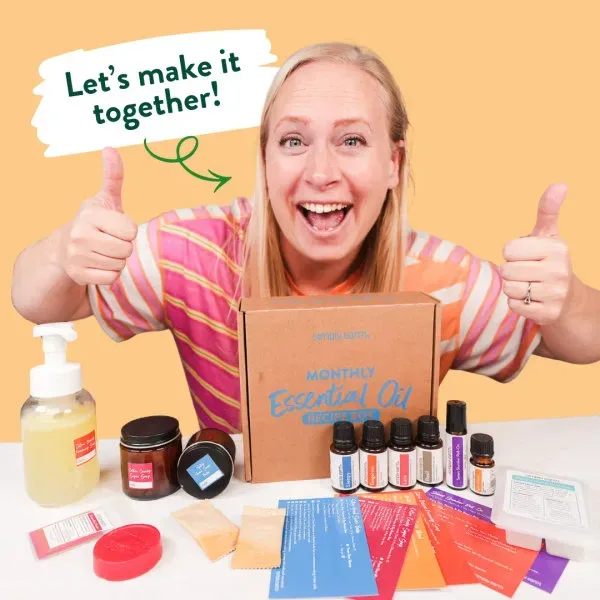
Learn by doing
Make your own natural products every month.
The Simply Earth Recipe Box ships 4 full-size essential oils, 6 natural recipes, and everything you need to make them. No guesswork.
Start My Recipe Box$39.99 for your first box, then $49.99/month. Skip, pause, or cancel anytime.