
Glycerin Soap Base: All You Need to Know Before Your First Batch

Katie Veldkamp
Lead Certified Aromatherapist
Fact Checked & Approved
Most people who want to make soap never actually make soap. They read one article about lye, learn that it burns skin and has to be measured to a tenth of a gram, and quietly close the tab. Glycerin soap base exists for exactly that person. It is real soap that has already been through the chemistry — the saponification is done, the lye is spent, the curing is finished. What is left is a solid block you cut into cubes, melt in a bowl, stir your essential oils into, and pour into a mould. Twenty minutes later you are holding a bar you made, and nothing in the process could have hurt you. This guide covers what the base actually is, every one of the twelve ingredients on the label and what each one does, the seven things it does better than a standard bar, how to melt and pour it without ruining a batch, and the sixteen Simply Earth recipes that are built on it.
In this Guide
Free Cheat Sheet
New to Essential Oils? Start With the Free Guide
One printable page covering the oils most worth owning first — including the ones that behave well in soap.
Start Here
What Is Glycerin Soap Base?
Start with the glycerin itself. Glycerin — known scientifically as glycerol — is a colourless, odourless compound found in plant oils and animal fats. It is released whenever fats are split during soap or biodiesel production, which is why it turns up in soap-making conversations so often. It is also a humectant, meaning it pulls moisture out of the air and holds it against whatever it is on. That single property is why glycerin appears in lotions, toothpaste and a long list of skincare products, and why a soap built around it behaves differently on skin than a standard bar does.
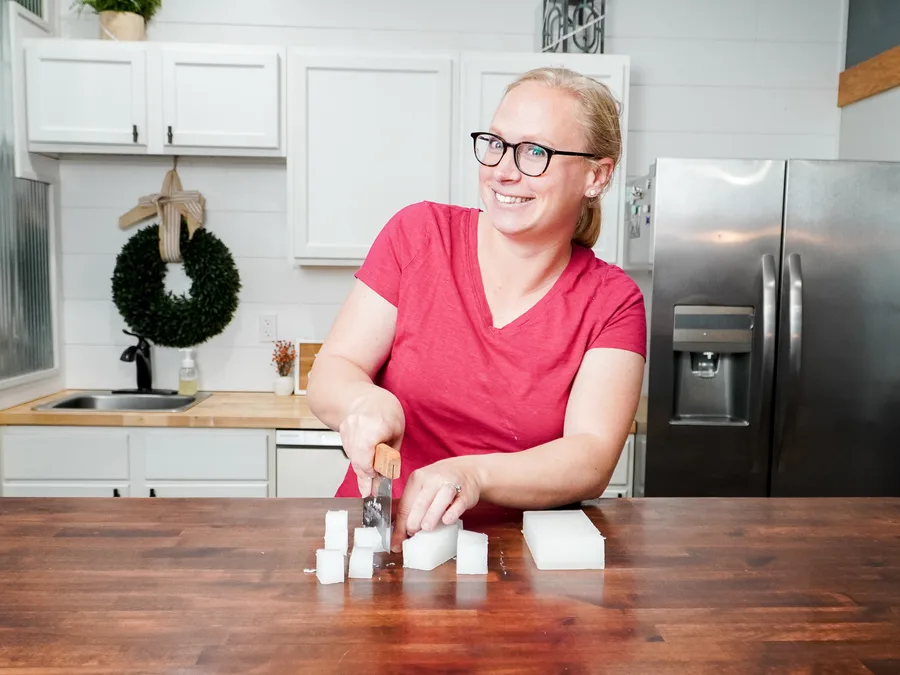
Glycerin soap base is that idea turned into a working material. It is a pre-made, pre-saponified soap block: the reaction between fats and lye has already happened in a factory, the lye is fully consumed, and the block has already cured. Nothing caustic is left. Because the chemistry is finished, you are not making soap from scratch so much as re-shaping soap that already exists — melt it, scent it, colour it, pour it, let it set. This is what the industry calls melt-and-pour, and it is the reason a first-time soaper can produce a genuinely good bar on their first attempt instead of their fifth.
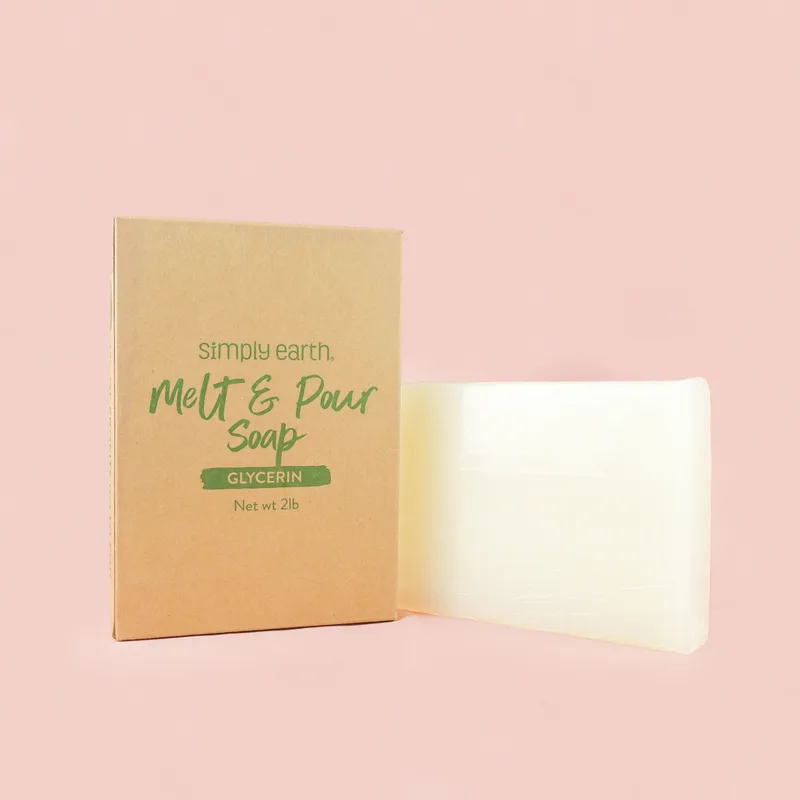
Simply Earth's version is a clear glycerin base sold in a 2 lb block, and it is deliberately plain: SLS free, PEG free and paraben free, with twelve ingredients on the label and nothing else. Clear matters more than it sounds. An opaque base hides whatever you put into it, while a clear base lets colour read as colour and lets embeds — dried flowers, loofah, oatmeal, a layer of a different shade — actually show. If you want a bar that looks like the picture you had in your head, the clear base is the one that gets you there.
It's Softer on Your Skin
Gentler than a standard bar, and it shows after a week.
 Shop Glycerin Melt & Pour Soap Base
BEST FOR: SENSITIVE & EASILY IRRITATED SKIN
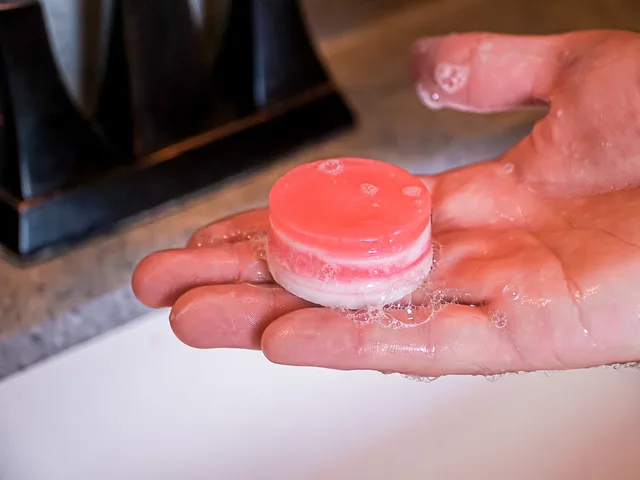
Glycerin soap is noticeably gentler on skin than a conventional bar, and the reason is the glycerin itself — a natural humectant that draws moisture toward skin instead of pulling it away. Glycerin soap is also non-comedogenic, which means it will not clog pores, so it suits faces as well as hands. The practical difference is the feeling afterwards. A harsh bar leaves skin feeling tight and slightly squeaky, which people often read as clean when it is really the first sign of a stripped moisture barrier. A glycerin bar leaves skin feeling soft and unremarkable, which is what you actually want.
Katie's Tip
If you are making soap for someone with reactive skin, keep the recipe short. Base, one essential oil at a low rate, and nothing else. Every extra additive is another thing to react to, and the plain bar is genuinely lovely.


It's More Moisturizing
The humectant does the work, not a marketing claim.
 Shop Glycerin Melt & Pour Soap Base
BEST FOR: DRY SKIN & WINTER MONTHS
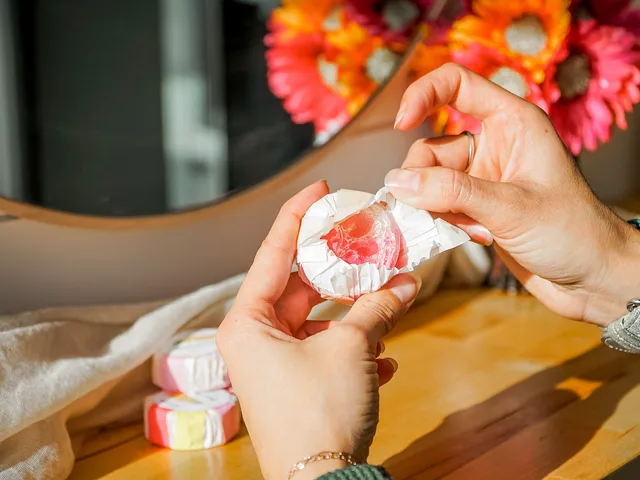
Because glycerin soap is more moisturizing than a standard bar, it is the obvious choice for dry skin. The glycerin attracts moisture to skin and holds it there, so the bar hydrates while it cleans rather than cleaning at the expense of hydration. It is also less likely to irritate skin than regular soap. This is also the reason commercial soap makers often remove glycerin from their bars and sell it separately — it is a valuable ingredient, and leaving it in makes a better-feeling but less profitable bar. In a melt-and-pour base, it stays in.
Katie's Tip
In winter I add a loofah slice or a spoon of oatmeal to the mould before pouring. You get gentle exfoliation on top of the moisturizing base, which is the combination dry skin actually wants.


It Won't Strip Your Skin's Natural Oils
Cleans without taking the barrier with it.
 Shop Glycerin Melt & Pour Soap Base
BEST FOR: DAILY HAND & FACE WASHING
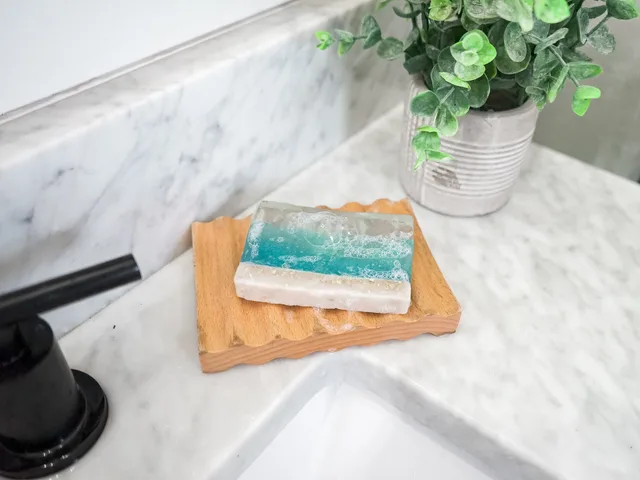
Regular soap can strip skin of its natural oils and leave it dry and irritated. Glycerin soap does not — it cleans without carrying off the oils your skin barrier is made of. That makes it a good choice for anyone with sensitive skin, and for anyone who washes their hands many times a day and has watched the backs of them crack in January. It is the difference between a bar you can use every day and a bar you have to recover from.
Katie's Tip
Make a batch specifically for the kitchen sink. That is the soap that gets used fifteen times a day, and it is where a gentle bar earns its keep fastest.


BEST FOR: ANYONE AVOIDING HARSH SURFACTANTS
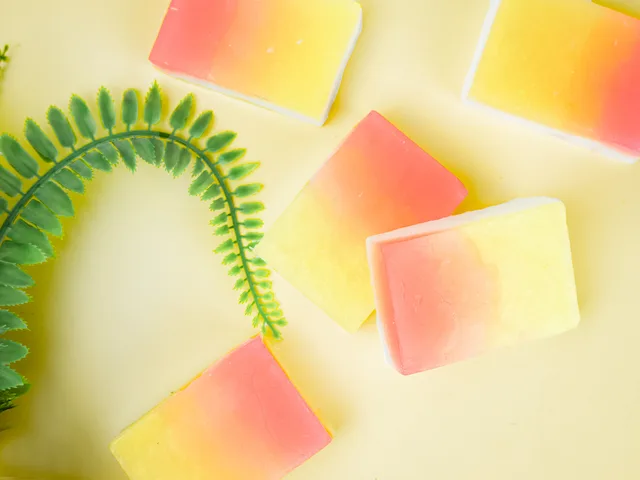
Sulfates are the harsh detergents found in a lot of soaps and shampoos, and for some people they cause dryness, irritation and even allergic reactions. Glycerin soap is sulfate-free, so those side effects are off the table. Simply Earth's base goes further and is labelled SLS free, PEG free and paraben free — and because the full ingredient list is printed on the box and reproduced in full further down this page, you can check that for yourself rather than taking it on trust. That is the whole point of making your own — you know what is in it.
Katie's Tip
Read the label on any base before you buy it, mine included. Twelve ingredients you can look up is a good sign. A base that will not tell you what is in it is not a base worth melting.


BEST FOR: GIFTING & EVERYDAY USE
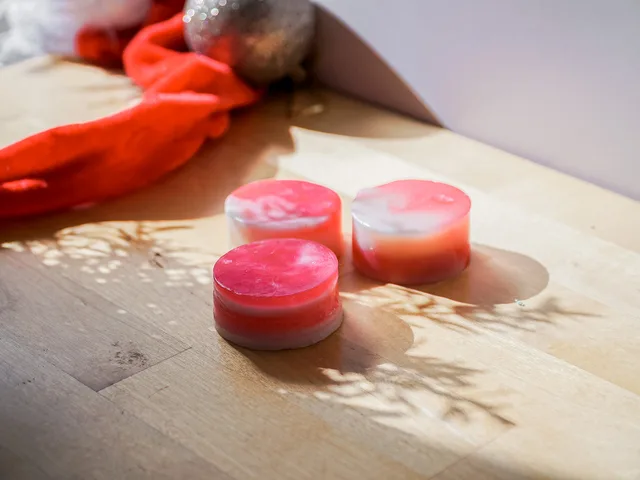
Glycerin soap lasts longer than regular soap because it does not dissolve as quickly in water, so you get more uses out of a single bar. That matters twice over when you are the one making it — a 2 lb block goes a long way, and the bars you give away do not vanish in a fortnight. A hardening trick helps here too — a pinch of salt stirred into the melted base firms the finished bar up, which is exactly why sodium chloride is on the ingredient list already.
Katie's Tip
Keep finished bars out of standing water. A soap dish that drains is worth more to a bar's lifespan than anything you can add to the recipe.


It's Crystal Clear, So Colour Actually Shows
The reason to choose glycerin over an opaque base.
 Shop Glycerin Melt & Pour Soap Base
BEST FOR: LAYERS, OMBRE & EMBEDS
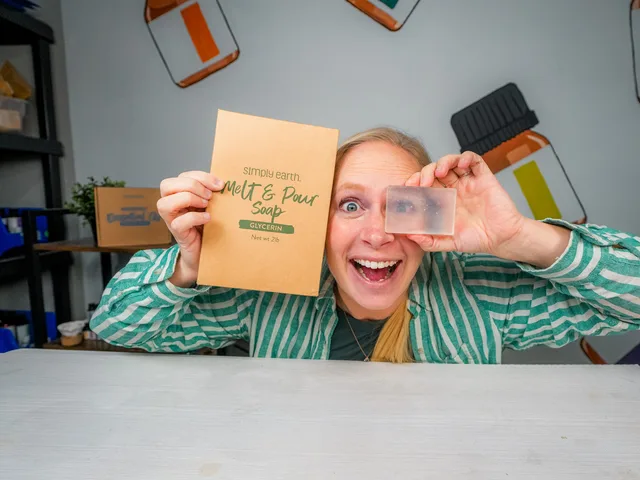
This is the functional difference between the glycerin base and every opaque base, and it is the one people underestimate. Simply Earth describes this base as easy-to-use and super clear, and clear is what makes design possible. Mica colour reads as true colour instead of a pastel version of itself. Layers stay visibly separate. Ombre gradients work. Anything you suspend in the bar — a loofah slice, dried petals, a contrasting embed — is actually visible instead of buried. Earthie Cora put the practical version of this well after testing the base — it doesn't take much mica powder to color the soaps. A clear base is efficient as well as pretty.
Katie's Tip
For clean layers, let each pour set until it is firm to a light touch, then spritz the surface before adding the next one. Skipping the spritz is the single most common reason layers separate later.


It's Beginner-Friendly — No Lye, No Cure Time
Soap you can make and use the same afternoon.
 Shop Glycerin Melt & Pour Soap Base
BEST FOR: FIRST-TIME SOAPERS & MAKING WITH KIDS
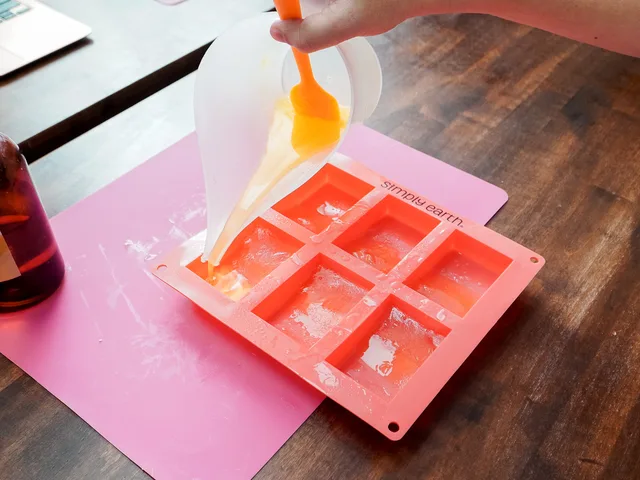
Cold-process soap means handling sodium hydroxide, working in ventilation with gloves and goggles, and then waiting four to six weeks for the bar to cure before anyone can touch it. Melt-and-pour removes both halves of that problem. The lye is already spent, so there is nothing caustic in your kitchen, and the bar is already cured, so it is usable as soon as it is cool. Simply Earth's own instruction for the base is three steps long — melt, mix, pour — and the whole thing fits in an afternoon. Earthie Clara Dechant described being a little intimidated at first as this was her first time making a melt and pour soap, then planning to make all five recipes. That arc is the normal one.
Katie's Tip
This is the one craft I genuinely recommend doing with children. Nothing in the process burns except the melted soap itself, so an adult handles the bowl and the mould and the kids do the colour and the stirring.


Put It to Work
How to Use Glycerin Soap Base
1. Melting
- • Cut the amount of base you need into roughly 1-inch cubes — smaller cubes melt more evenly
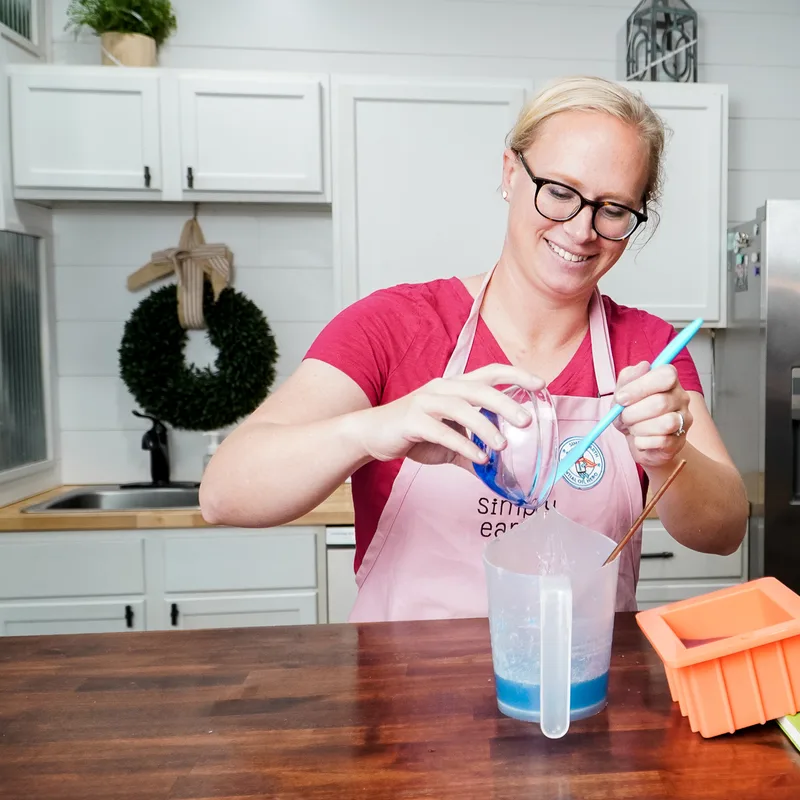
- • Microwave in a bowl in 30-second intervals, dropping to 10-second intervals as it gets close
- • Stir between every single interval, without exception
- • Or melt in a double boiler over medium heat, which is slower and much harder to overheat
- • Stop as soon as the last lumps disappear — melted base is not meant to boil
2. Adding Colour & Fragrance
- • Let the melted base cool slightly before adding anything — scorching hot base flashes off scent
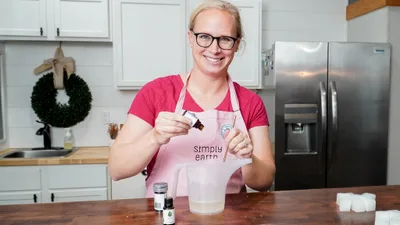
- • Stir in your Simply Earth essential oils and mica colorants, then mix thoroughly
- • Add colour a little at a time; a clear base needs far less mica than an opaque one
- • Stir slowly to avoid whipping air bubbles into the bar
- • A pinch of salt at this stage hardens the finished bar
3. Pouring & Setting
- • Pour into your mould in one steady motion and let it cool completely
- • For layers, let each pour firm up to the touch, then spritz before the next
- • Do not move or tilt the mould while it is setting
- • Unmould once fully cool — the bar is ready to use immediately, with no cure time
- • Silicone moulds release best; a flexible mould saves a stuck bar
4. Storage
- • Keep unused base sealed and away from humidity — glycerin draws moisture from the air
- • Store finished bars somewhere dry and out of direct sun
- • Wrap bars you plan to gift, so they do not sweat in the open
- • Keep bars out of standing water between uses to make them last
- • For external use only, and avoid contact with eyes
Know the Difference
Glycerin vs. Shea, Goat's Milk & Cold Process
The honest summary: if you want a clear bar, choose glycerin. If you want a creamy white bar, choose shea. Only choose cold process if the chemistry is the part you want.
Swipe to compare →
Glycerin Base Clear melt & pour | Shea Butter Base Opaque white melt & pour | Goat's Milk Base Opaque melt & pour | Cold Process Made from scratch with lye | |
|---|---|---|---|---|
| Appearance | Transparent — colour and embeds stay visible | Solid white, slightly creamy | Solid off-white, creamy | Whatever you formulate, usually opaque |
| Best for | Layers, ombre, embeds, bright colour, clear bars | Moisturizing bars where a soft white look is wanted | Creamy, gentle bars with a traditional look | Full control of every oil and fat in the recipe |
| Lye handling | None — the saponification is already done | None | None | Required, with gloves, goggles and ventilation |
| Cure time | None — usable as soon as it cools | None | None | Four to six weeks before the bar is safe to use |
| Skill needed | Beginner — three steps, hard to get wrong | Beginner | Beginner | Advanced — precise measurement matters |
| Availability | Yes — 2 lb and 2 oz sizes | Yes — 2 lb size | Not currently stocked | Not a base; we stock ingredients and a starter recipe |
| Simply Earth | We carry this | — | — | — |
Perfect Pairs
Essential Oils That Work in Melt & Pour
Every oil here is one Simply Earth actually uses in a glycerin-base recipe. Citrus and mint read bright and clean in a clear bar; ginger, cardamom and amyris give it warmth and hold their scent longer. Beyond oils, the additives that behave well in this base are mica powders for colour, and loofah, oatmeal and sugar for texture.
Where It Comes From
Where Glycerin Soap Base Comes From
This is the part of an ingredient page that usually tells you about a farm, and here it honestly cannot. Glycerin soap base is a manufactured material, not a harvested one. There is no single-origin field behind it and no grower to introduce, and inventing one would be worse than saying so. What it has instead is a specification — a defined ingredient list, a defined set of things left out, and a manufacturer held to both.
The raw glycerin at the heart of it does begin with plant oils and fats. Glycerin is what separates out when those fats are split during soap production, so in that sense the base starts in the same place every bar of soap does. From there it is a factory process: fats are saponified under controlled conditions, the resulting soap is combined with glycerin, humectants and a small amount of surfactant, and the mixture is set into solid blocks. What arrives at Simply Earth is a finished, cured, lye-free soap in solid form.
Our base is manufactured to Simply Earth's specification and distributed from Waldo, Wisconsin, and the box states plainly that it is made in China — which is where the manufacturing capability for melt-and-pour bases at this quality and price currently sits. The specification is the part we control, and it is the part that matters on your skin: twelve named ingredients, SLS free, PEG free, paraben free, and printed in full on the packaging so that you can check it against this page.
What's Inside
What's Actually In It — All 12 Ingredients
This is the full ingredient list printed on the box, in order, with the EWG hazard score shown on each. The EWG scale runs 1 to 10 and reflects known and suspected hazards; every ingredient in this base is considered safe and non-toxic under EWG's strictest criteria for transparency and health.
Sodium Stearate
EWG 1 · The structural ingredient
The key ingredient in glycerin soap base. Sodium stearate is the sodium salt of stearic acid, a naturally occurring fatty acid, and it is what makes the block a solid block. It adds a layer of protection and moisture to your soap while keeping the lather foamy and luxurious at the same time.
1.3 Butylene Glycol
EWG 1 · Solvent & conditioner
An organic alcohol that goes by several names, including 1.3 BG. It adds a certain sleekness and a boost of cleaning power, acting as both a solvent and a conditioning agent. It is also an efficient antimicrobial agent, which helps keep the base stable in storage.
Glycerin
EWG 1–2 · The reason the bar works
Glycerol, also called glycerine, is colourless, odourless, non-toxic and carries genuine antimicrobial and antiviral capability. As a humectant it draws moisture toward skin and holds it there. This is the ingredient the whole base is named for and the one responsible for most of the benefits above.
Sucrose
EWG 1 · Humectant
A naturally occurring sugar harvested from plants such as fruits, and used in skincare since ancient times. It contributes a pleasant, faintly sweet character to the base, and its humectant properties help the finished bar retain moisture against skin.
Sorbitol
EWG 1 · Thickener & conditioner
A sugar alcohol that thickens the base and conditions skin, adding an extra moisturizing margin. Modern cosmetics lean on sorbitol heavily as both humectant and thickener because it does several jobs at once without complicating a formula.
Sodium Alpha-Olefin Sulfonate
EWG 1 · Anionic surfactant
The surfactant in the base, and the ingredient doing the actual lifting of oil and dirt off skin. It is a multipurpose anionic surfactant used across bathroom products and shampoos to get things properly clean. Worth naming plainly — this is a sulfonate, not a sulfate, and it is not SLS.
Sodium Laurate
EWG 1 · Emulsifier & lather
The sodium salt of lauric acid, and one of the more versatile ingredients on the list. It works as an anticaking agent, a lubricant, a release agent and an emulsifier — which is part of why the base unmoulds as cleanly as it does.
Water
The carrier
Easy to overlook and structurally essential. Without water none of the surfactants, humectants or salts in the base could dissolve, distribute or do anything at all. It is the medium that lets every other ingredient reach your skin evenly.
Myristic Acid
EWG 1 · Foam stabilizer
Naturally present in palm oil, coconut oil and butterfat. Myristic acid cleanses and helps create a fluffy, generous lather, and it doubles as an emulsifier and foam stabilizer — so the lather you work up does not collapse halfway through washing.
Coconut Oil
EWG 1 · Lather & moisture
The underrated one. The coconut oil in glycerin soap base provides a rich, cleansing lather and adds a real measure of moisture back into the bar. It is a large part of why the base feels good rather than merely functional.
Sodium Chloride
EWG 1 · Hardener
Table salt, doing structural work. Sodium chloride helps the finished bars hold their shape and stay solid. It is also the reason the hardening trick in benefit five works — you are simply adding more of something already in the formula.
Denatonium Benzoate
EWG 1 · Bittering agent
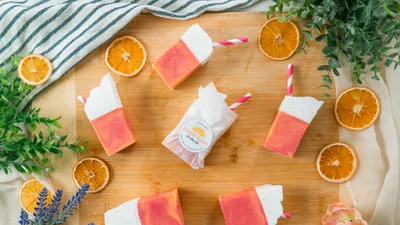
The ingredient people ask about, so here it is directly. Denatonium benzoate is a bittering agent, added to give a non-edible product an unpleasant taste so it is harder to swallow by accident. In a bar of soap that looks convincingly like a lemon cupcake, that is a deliberate and sensible safety measure rather than a strange additive.
Use It Right
Things to Remember
The real hazard in melt-and-pour is heat, not chemistry. Melted soap base is hot enough to burn — treat the bowl like a bowl of hot sugar syrup.
Microwave in 30-second intervals, then 10-second intervals as it approaches melting, and stir between each one. Long unattended bursts are how base scorches and boils over.
A double boiler on medium heat is the more forgiving method and the one to use if you are making soap with children nearby.
Stop heating as soon as the last solid lumps disappear. Overheated base loses scent, yellows, and can develop a rubbery texture.
Keep water out of the base while melting. Splashes cause the bar to sweat, develop soft spots, or refuse to set properly.
Pour on a stable, heat-safe surface and do not move the mould until the soap has cooled completely.
Store unused base sealed and away from humidity — glycerin pulls moisture from the air, which is exactly what it is meant to do.
For external use only. Avoid contact with eyes.
These statements have not been evaluated by the Food and Drug Administration. This product is not intended to diagnose, treat, cure, or prevent any disease.
Real Results
What Earthies Are Saying
"I was able to try the new melt & pour soap base recipes BEFORE they were released and they are AMAZING! I made the Unicorn Confetti & the Pine Forest recipes and they turned out beautifully! I was a little intimidated at first as this was my first time making a melt & pour soap but it was so fun that I am planning on making all 5 recipes in the near future!"
Clara Dechant
Website Review • Glycerin Melt & Pour Soap Base
"I tried the Fresh Coast and Lava Ombre recipes. The soap bases were easy to melt and pour. It doesn't take much mica powder to color the soaps. The molds released easily. The essential oils smell lovely. I had fun creating this fun soaps. I'll be making gifts for friends."
Cora
Website Review • Glycerin Melt & Pour Soap Base
"I absolutely LOVED working with this melt & pour soap base! I got both the glycerin and shea butter soap bases to create this fun ombre design. It was super easy to melt the soap base and pour it back into my design. The finished soap holds up well, and lathers nicely, which is awesome to see for a DIY project."
Emma Carter
Website Review • filed under Shea Butter Melt & Pour Soap Base
OUR SIMPLY PURE PROMISE
What Goes Into Your Products Matters
Sulfate-Free
SLS free, PEG free and paraben free.
12 Ingredients, All Listed
Printed on the box. Nothing hidden.
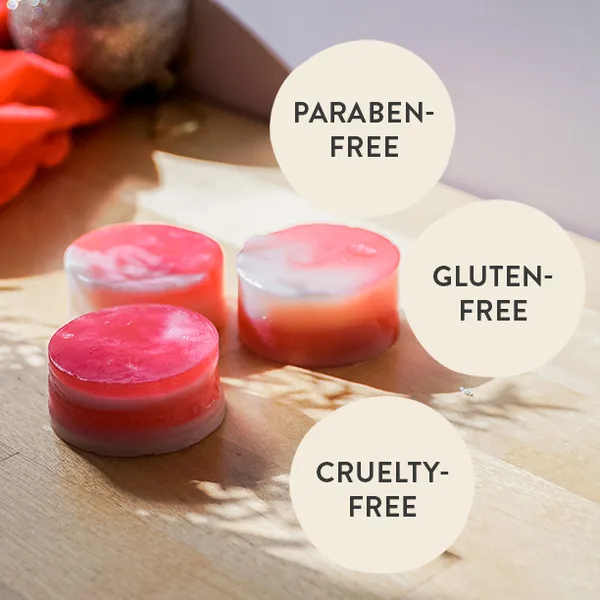
Cruelty-Free & Gluten-Free
As stated on the product's own quality panel.
Your Order Changes Lives: 13% of profits fight human trafficking globally.
Glycerin Soap Base FAQ
The questions people actually ask before their first batch — ingredients, lye, set time, and why the bar sweats.
What is glycerin soap base made of? +
Twelve ingredients, printed on the box in this order — sodium stearate, 1.3 butylene glycol, glycerin, sucrose, sorbitol, sodium alpha-olefin sulfonate, sodium laurate, water, myristic acid, coconut oil, sodium chloride and denatonium benzoate. Each one is broken down in the ingredients section above, with its EWG hazard score.
Is glycerin soap base real soap? +
Yes. It is fully saponified soap — the reaction between fats and lye has already happened during manufacturing and the lye is entirely consumed. You are melting and reshaping finished soap rather than making it from scratch, which is why there is nothing caustic to handle and no curing to wait for.
Do I need lye to use a melt and pour soap base? +
No, and that is the main reason melt-and-pour exists. All the lye chemistry is done before the base reaches you. Cold-process soap making does require handling sodium hydroxide with gloves, goggles and ventilation, plus a four to six week cure. Melt-and-pour needs none of that.
How long does glycerin soap base take to set? +
Until it is completely cool, which for a standard bar in a silicone mould is usually an hour or two at room temperature. There is no cure time beyond that — once it is cool and unmoulded, the bar is ready to use.
Why is there denatonium benzoate in my soap? +
It is a bittering agent, added deliberately so the bar tastes unpleasant and is therefore harder to swallow by accident. Handmade soap frequently looks like food — cupcakes, candy, citrus slices — so a bitterant is a sensible safety measure rather than an odd additive.
What's the difference between glycerin and shea butter soap base? +
Clarity. The glycerin base is transparent, so colour reads true and layers, ombre effects and embedded objects stay visible. The shea butter base is an opaque creamy white, chosen for a soft solid look and extra moisturizing feel. Simply Earth stocks both in a 2 lb size, and several Earthies use them together in one bar.
Can I melt glycerin soap base in the microwave? +
Yes, and it is the method on the box. Cut the base into roughly 1-inch cubes, microwave in 30-second intervals, drop to 10-second intervals as it gets close to melting, and stir between every interval. A double boiler on medium heat is slower but harder to overheat.
Why did my melt and pour soap sweat or turn soft? +
Almost always moisture. Glycerin is a humectant, so it pulls water out of the air — which is what makes the bar good for skin and also what makes it sweat if it is stored somewhere humid or left unwrapped. Keep unused base sealed, store finished bars somewhere dry, and wrap anything you plan to give away.
About the Author: Katie Veldkamp
Katie Veldkamp
Certified Aromatherapist · Co-Founder, Simply Earth
Katie Veldkamp is a Certified Aromatherapist and co-founder of Simply Earth. She personally formulates and reviews SE's DIY ingredient line and verifies all benefit claims on Simply Earth content before it goes live.
Join 20,000+ Earthies Making Their Homes Natural
New recipes, usage guides, and DIY tips — delivered free.
No spam. Unsubscribe any time.
Learn by doing
Make your own natural products every month.
The Simply Earth Recipe Box ships 4 full-size essential oils, 6 natural recipes, and everything you need to make them.
Start My Recipe Box$39.99 first box, then $49.99/month. Cancel anytime · 365-day money-back guarantee.