
Clean Burn Soy Wax: Benefits, Uses & Recipes

Katie Veldkamp
Lead Certified Aromatherapist
Fact Checked & Approved
Most first candles fail in the same three ways. The top sets like a cratered moon, the scent vanishes somewhere between the pour and the first burn, and a tunnel forms down the middle that never recovers. None of those are talent problems — they are temperature, timing and patience problems, and all three are fixable. Clean Burn Soy Wax is Simply Earth's candle-making wax, and its ingredient list is one line long: hydrogenated soybean oil. Nothing else. That simplicity is the point, because it means the only variables left in your candle are the ones you control. This guide covers what the wax actually is, the seven things it does well, the melt-and-pour method step by step, how soy compares to paraffin and beeswax, the safety rules that matter when you are handling molten wax, and the six Simply Earth recipes built on it.
In this Guide
Free Cheat Sheet
New to Essential Oils? Start With the Free Guide
One printable page covering the oils most worth owning first — including the ones that hold their scent in a candle.
Start Here
What Is Clean Burn Soy Wax?
Soy wax starts as soybean oil, which is liquid at room temperature and no use at all for holding a wick upright. Hydrogenation changes that. Hydrogen is added to the oil's fatty acids, the molecules straighten and pack together, and what was a pourable oil becomes a soft solid that melts back to liquid with gentle heat. That is the whole transformation, and it is why the ingredients panel on the bag reads Soybean Oil (Hydrogenated) and stops there.
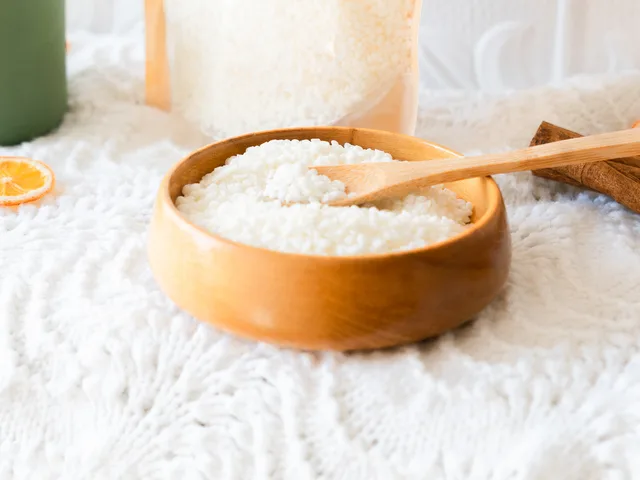
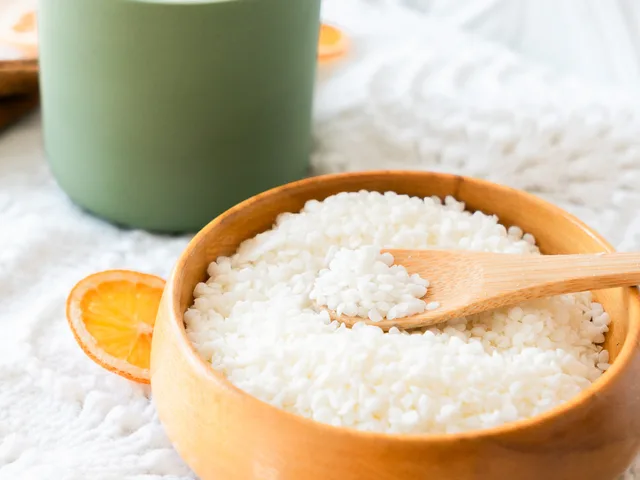
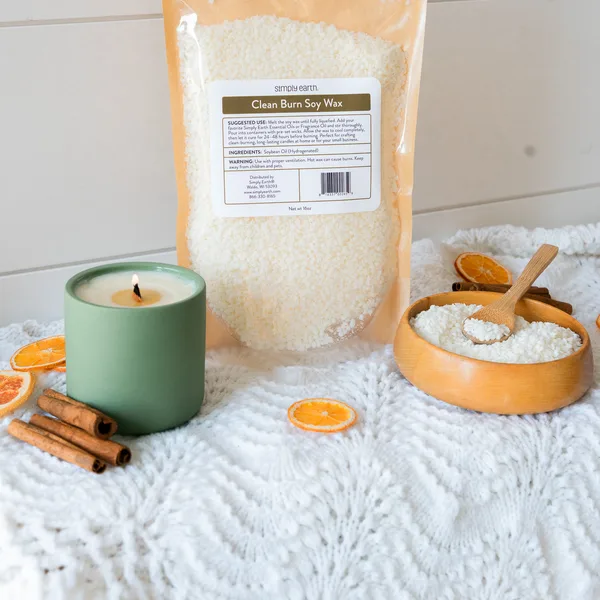
Clean Burn Soy Wax arrives as small white flakes rather than a solid block, which matters more than it sounds. Flakes melt faster and far more evenly than a slab, they are easy to measure by eye into a jug, and they do not need to be chopped before they go anywhere near heat. Simply Earth sells it in a 16 oz bag for home makers and a 45 lb case for people who have moved past the kitchen table and started selling.
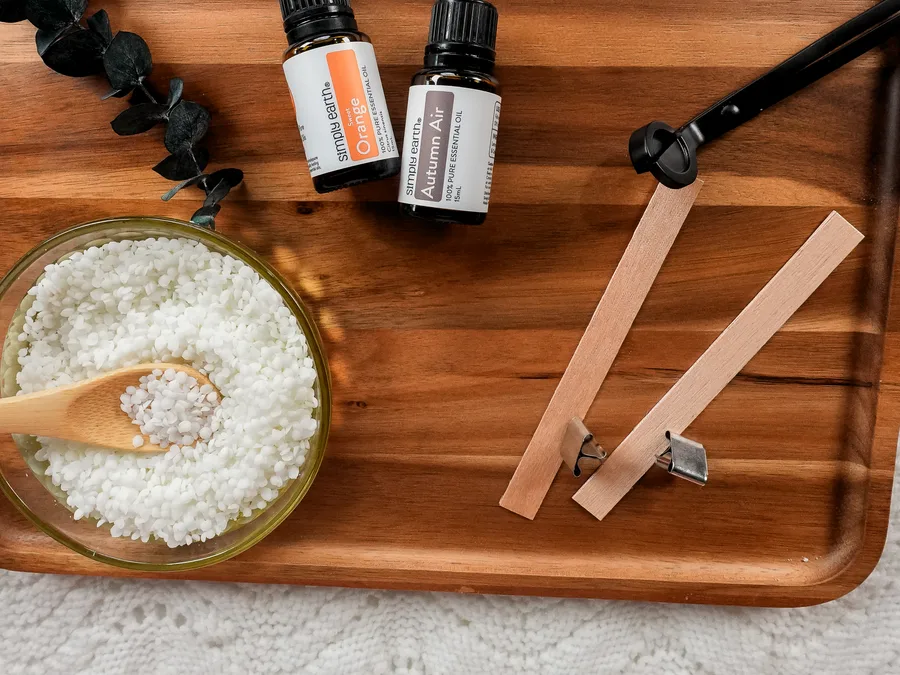
The method it is built around is melt and pour, the same idea as a melt-and-pour soap base: the material is already finished, so you are shaping it rather than making it. Melt the flakes until fully liquefied, stir in Simply Earth essential oils or Safer Fragrance Oils, pour into a container with the wick already set, let it cool, then leave it alone for 24 to 48 hours before you light it. That last instruction is the one people skip, and it is the one that decides whether the candle smells like anything.
BEST FOR: EVERYDAY INDOOR CANDLES
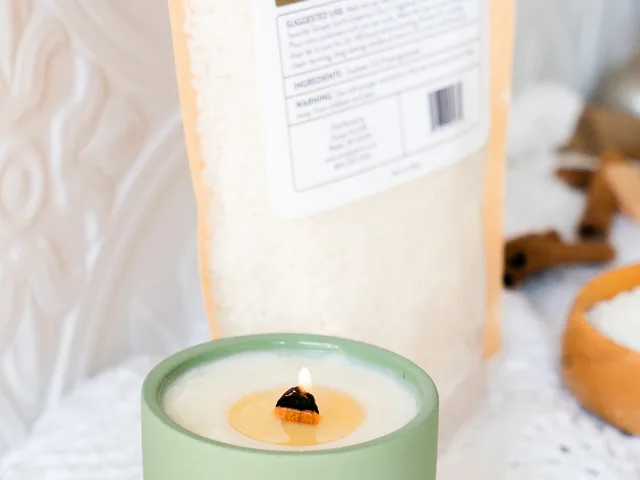
This is the benefit the name is built on. Clean Burn Soy Wax is formulated to give you a bright flame without the heavy smoke or soot often associated with traditional candles, and the product record puts it plainly — candles that burn longer with less soot. The practical version is what you see on the wall above the shelf where the candle lives. A sooty wax leaves a grey shadow there within a month. A clean-burning one does not, and the jar itself stays clear instead of blackening around the rim as it burns down.
Katie's Tip
If your candle is sooting, look at the wick before you blame the wax. A wick left untrimmed grows a mushroom on the end, and that mushroom is what smokes. Trim it back before every burn and the problem usually disappears.


It's Genuinely Beginner-Friendly
Forgiving enough to get right the first time.
 Shop Clean Burn Soy Wax
BEST FOR: YOUR FIRST BATCH
Clean Burn Soy Wax melts smoothly and pours evenly, which is a quiet way of saying it does not punish small mistakes. There is no lye, no curing rack, no precise ratio you have to hit to a tenth of a gram, and no step where the material can hurt you if you get the chemistry wrong — because there is no chemistry to get wrong. The flake format helps here too: you can melt exactly as much as you need and reseal the rest. A first candle made with this wax looks like a candle, which is not something every craft material can promise.
Katie's Tip
Make your first candle in a jar you do not care about. It takes all the pressure off, and you will learn more from one imperfect candle than from reading about candles for an hour.


BEST FOR: CANDLES YOU WANT TO ACTUALLY SMELL
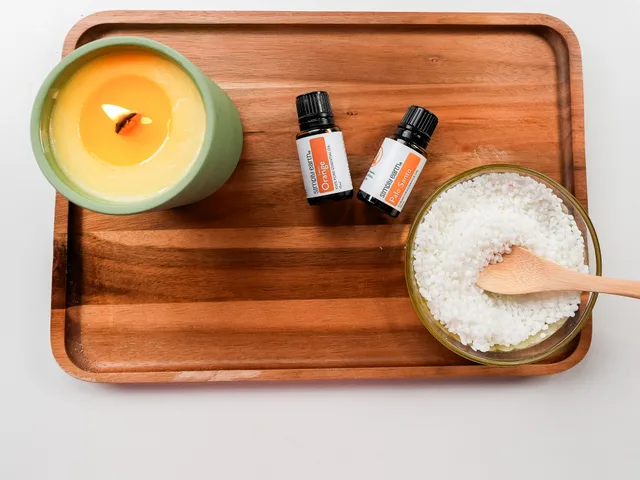
Scent throw comes in two kinds, and a good candle needs both. Cold throw is what you smell walking past an unlit candle; hot throw is what fills the room once it is burning. Clean Burn Soy Wax is designed to hold both Simply Earth essential oils and Simply Earth's Safer Fragrance Oils, and the product record describes it as perfect for holding fragrance. Essential oils and fragrance oils behave differently here — fragrance oils are built for throw and hold up better to heat, while essential oils bring the real plant aroma and often read softer. Many of Simply Earth's own candle recipes use one of each for exactly that reason.
Katie's Tip
Weak scent is more often an under-mixing problem than an under-dosing one. Stir for a full minute or two after the oils go in — if the oil has not fully bound to the wax it will separate out and sweat on the surface instead.

BEST FOR: MAKERS CHOOSING PLANT-BASED MATERIALS
Paraffin, the wax most mass-market candles are made from, is a petroleum product. Soy wax is not — it comes from soybeans, a crop that is replanted every season, and the product record describes this wax as 100% soy, renewable and eco-friendly. That is the honest extent of the claim, and it is worth being precise about it: choosing soy means choosing a plant-derived, renewable material over a petroleum-derived one. Anything beyond that would need a certification behind it, and we would rather tell you where the line is than blur it.
Katie's Tip
Keep the bag sealed between projects. Soy wax is stable — the label gives it two years from opening under proper storage — but an open bag in a warm kitchen picks up whatever is in the air around it.
BEST FOR: WAX MELTS, MOULDS & GIFTS
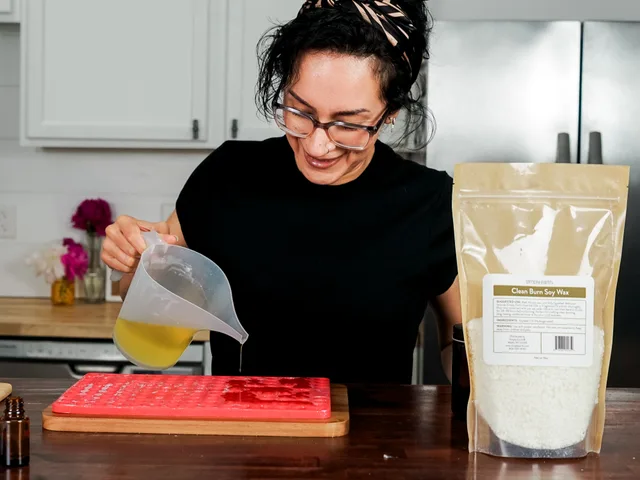
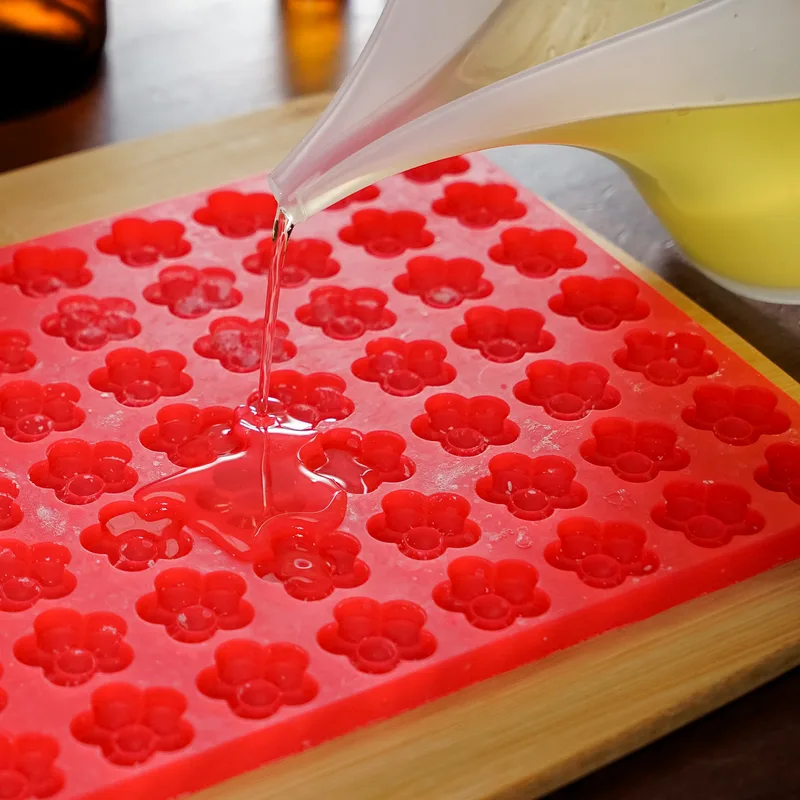
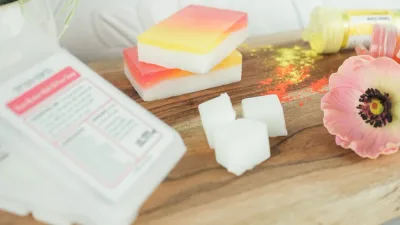
The same flakes that make a jar candle make wax melts, and wax melts are the obvious answer for anyone who wants scent without an open flame — a household with a curious toddler, a dorm room where candles are not allowed, an office desk. Poured into silicone moulds they set into shapes you can pop out and drop into a warmer, and because nothing burns away you can remelt the same melt many times. Simply Earth's own Desert Bloom Wax Melts recipe is built on this wax, and the method is shorter than the candle one: melt, scent, colour, pour, chill.
Katie's Tip
Wax melts are the best way to test a scent combination before you commit a whole jar to it. One mould tray costs you a few minutes and tells you whether the blend actually works in wax.

One Ingredient, Printed on the Bag
Hydrogenated soybean oil, and nothing else.
 Shop Clean Burn Soy Wax
BEST FOR: ANYONE WHO READS LABELS
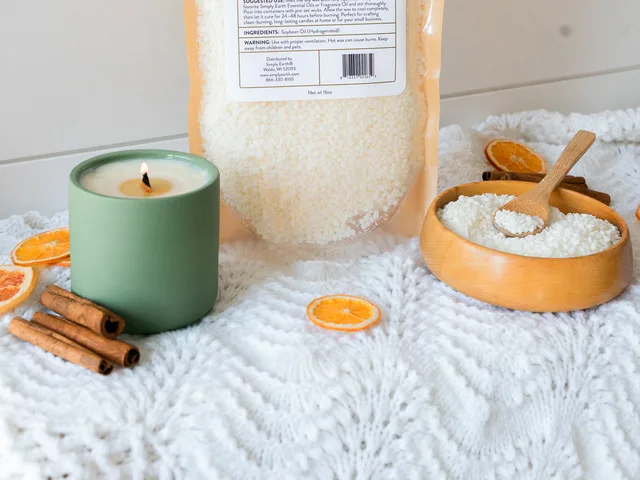
Turn the bag over and the ingredients line reads: Soybean Oil (Hydrogenated). That is the complete list. No blend of paraffin cut into the soy to improve the throw, no additives to harden the surface, no dye. For a category where "soy wax" on the front of a bag can legally mean a soy-majority blend, a single-line panel is a real difference, and it is the reason this page can tell you exactly what is in your candle. It also makes troubleshooting simpler: if something goes wrong with a batch, it was the technique or the oils, because the wax has only one variable in it.
Katie's Tip
If you sell your candles, the one-line panel makes your own labelling much easier. You can state what is in the wax without hedging, which is not something every maker can do.
It Sets With a Smooth, Creamy Finish
Designed for easy pouring and a professional look.
 Shop Clean Burn Soy Wax
BEST FOR: CANDLES YOU PLAN TO GIFT OR SELL
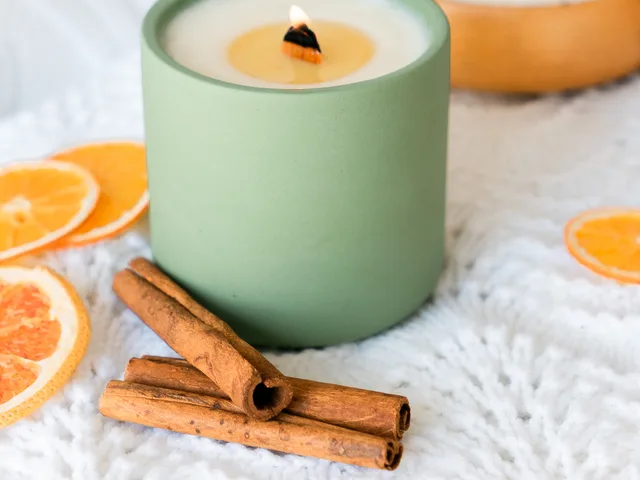
The product record describes this wax as designed for easy pouring and a beautiful creamy appearance in every candle, and appearance is most of what separates a candle you are happy to hand over from one you quietly keep. Soy sets to an opaque, slightly creamy white rather than the glassy look of paraffin, and a well-poured soy candle has a flat, even top with no crater around the wick. The variables that decide it are how hot the wax was when it went in and how slowly it cooled — which is why the technique section below spends as much time on cooling as on melting.
Katie's Tip
If the surface sets unevenly, you do not have to start over. A quick pass with a heat gun — or even a hair dryer — remelts just the top layer and lets it level itself.
Put It to Work
How to Use Clean Burn Soy Wax
1. Melting
- • Melt in a double boiler over medium heat, or in a heatproof jug in the microwave
- • In the microwave, start with 2 minutes, stir, then continue in 30-second intervals
- • Stir between every interval — this is what stops the wax scorching at the edges
- • Stop as soon as the last flakes disappear; melted wax is not meant to boil
- • Never leave melting wax unattended, and use a thermometer rather than guessing
2. Adding Your Oils
- • Let the wax cool slightly before the oils go in — very hot wax flashes scent off
- • Stir in Simply Earth essential oils or Safer Fragrance Oils for a full 1–2 minutes
- • Weak scent and oily "sweating" on the surface both usually trace back to under-mixing
- • A fragrance oil and an essential oil together is how most Simply Earth candle recipes are built
- • Stir steadily rather than fast, so you are not whipping air into the wax
3. Pouring & Cooling
- • Set your wick in the container first and hold it straight — a wick sticker keeps it centred
- • Pour in one steady motion into a container rated for candle making
- • Let the candle cool undisturbed on a level surface; do not move or tilt it
- • Cooling too fast is what causes sinkholes and frosting, so keep it away from draughts
- • If the top sets unevenly, a heat gun or hair dryer remelts just the surface
4. Curing & First Burn
- • Leave finished candles 24–48 hours before lighting — this is on the label, and it matters
- • Curing lets the wax and oils bind, which is where the scent throw comes from
- • On the first burn, let the melt pool reach the edge of the container
- • A short first burn sets a tunnel the candle will follow for the rest of its life
- • Trim the wick before every burn — about ¼ inch, or ⅛ inch for wooden wicks
5. Cleanup & Storage
- • Wipe tools and jugs with a paper towel while the wax is still warm
- • Then wash with hot, soapy water — cold water sets leftover wax straight back on
- • Store the unused bag sealed, away from heat and direct sun
- • Shelf life is 2 years from opening under proper storage conditions
- • Store finished candles somewhere cool and dark so the surface stays smooth
Know the Difference
Soy vs. Paraffin, Beeswax & Coconut Blends
The short version: soy is the neutral, plant-derived container wax that carries scent without adding any of its own. Beeswax is the one to choose when you want the honey aroma and a naturally golden bar — Simply Earth stocks that too. Paraffin is the petroleum option, and it is the one we do not carry.
Swipe to compare →
Soy Wax Clean Burn Soy Wax flakes | Paraffin Petroleum-derived wax | Beeswax Natural wax from bees | Coconut-Soy Blend Blended container wax | |
|---|---|---|---|---|
| Source | Soybeans — hydrogenated soybean oil, and nothing else | A by-product of petroleum refining | Secreted by honeybees; an animal product, so not vegan | Coconut oil blended with soy in varying proportions |
| Format | Small white flakes that melt fast and evenly | Usually pellets or slabs | Blocks, pellets or ready-made sheets for rolling | Usually pellets |
| Appearance set | Opaque, creamy white with a smooth top when poured well | Glassy and hard; holds sharp detail | Naturally golden, with a honey scent of its own | Creamy white, often softer than pure soy |
| Melt and pour | Yes — melt, scent, pour, cure | Yes | Yes, and it can also be rolled from sheets with no melting at all | Yes |
| Cure before burning | 24–48 hours, as stated on the label | Varies by formulation | Varies by formulation | Varies by formulation |
| Scent to work with | Neutral — it carries your oils rather than competing with them | Neutral | Has its own honey aroma, which blends with whatever you add | Neutral |
| Availability at Simply Earth | Yes — 16 oz bag and 45 lb case | Not stocked | Yes — sold for rolled and pillar candle recipes | Not stocked |
| Simply Earth | We carry this | — | — | — |
Perfect Pairs
Oils That Perform in Soy Wax
Every oil here is one Simply Earth actually uses with this wax in a real candle or wax-melt recipe. Woods and resins — Fir Needle, Timber, Palo Santo, Mountain Spruce — hold their scent through a burn particularly well. Citrus reads bright and clean but is lighter, which is why recipes often pair it with a fragrance oil to carry it. Beyond oils, the things that belong in this wax are wooden or braided wicks, wick stickers to hold them centred, heat-safe vessels, and mica powder if you are colouring wax melts.
Where It Comes From
Where Clean Burn Soy Wax Comes From
This is the section of an ingredient page that usually introduces a farm and the family who run it. For Clean Burn Soy Wax it honestly cannot, and saying so is better than inventing one. Soy wax is a processed agricultural commodity: soybeans are grown and crushed for oil, that oil is refined and hydrogenated at industrial scale, and the resulting wax is pelletised into flakes. There is no single field behind a bag of it in the way there is behind a bottle of single-origin essential oil.
What it has instead is a specification, and that specification is unusually short. The product carries one ingredient — Soybean Oil (Hydrogenated) — and the bag is distributed by Simply Earth from Waldo, Wisconsin. Because there is nothing else in it, there is nothing else to ask about: no blended paraffin, no hardening additive, no undisclosed fragrance carrier. The whole of what you are buying fits on one line.
Two things we are deliberately not telling you on this page, because we could not confirm them: the specific origin of the soybeans, and their GMO status. Neither is recorded anywhere we can cite, and both are reasonable questions for a maker who chose soy over paraffin on sustainability grounds. Rather than guess, we have flagged both to our sourcing team, and this section will be updated when there is a sourced answer to give.
The Material
The Material Science of Soy Wax
No chemistry of an essential oil here — this is a wax. What matters is how it melts, how it sets, and why curing changes what you smell.
Soybean Oil (Hydrogenated)
The only ingredient on the panel
Soybean oil is liquid at room temperature. Hydrogenation adds hydrogen across the double bonds in its fatty acids, which lets the molecules pack together tightly enough to form a solid at room temperature while still melting back to a clean liquid with gentle heat. That reversibility is the entire basis of melt and pour — the wax can be taken from solid to liquid and back without degrading.
Why soy burns the way it does
Lower melting range than paraffin
Soy wax melts at a lower temperature than paraffin, which is why a soy candle burns at a gentler rate and tends to last longer for a given amount of wax. The same property is behind the less-soot claim — a cooler, slower burn produces less unburnt carbon. It is also why soy candles are softer to the touch and why they should be kept out of direct sun and away from heat.
Curing — why 24 to 48 hours
Where scent throw actually comes from
When you stir oils into melted wax they are dispersed, not yet bound. As the wax crystallises around them over the following day or two, the oils settle into that structure and are released gradually as the candle burns rather than evaporating off the surface. A candle lit an hour after pouring has had none of that happen, which is why it smells weak and why the label asks for 24–48 hours.
Frosting and why it is not a fault
A natural property of vegetable wax
Frosting is the fine white crystalline bloom that appears on the surface and sides of soy candles, and it is one of the most common reasons a first-time maker thinks they have failed. They have not. It is the wax returning to its preferred crystal structure as it cools, it happens to every natural vegetable wax, and it affects appearance only — never how the candle burns or smells. Cooling slowly and evenly reduces it.
GC/MS report
N/A — not a distilled essential oil
Simply Earth publishes GC/MS reports for its essential oils because those are distilled botanical extracts whose chemical profile varies by harvest. Soy wax is not one — it is a single processed material with one ingredient, so there is no constituent profile to test batch by batch. The ingredient panel is the equivalent document here.
Burn Bright, Burn Safe
Things to Remember
The two real hazards here are an open flame and molten wax. Everything below comes from one or the other, and neither is a reason not to make candles — they are reasons to set up properly first.
"From the label: use with proper ventilation. Hot wax can cause burns. Keep away from children and pets."
Melt slowly and never leave heating wax unattended. Use a thermometer rather than judging by eye, and stop as soon as the flakes have gone.
Pour on a stable, level, heat-safe surface, and do not move the container until the candle has cooled completely.
Never leave a burning candle unattended, and keep it away from draughts, pets and children.
Let the first burn form a full melt pool to the edge of the container — usually one to two hours for a smaller candle. A short first burn sets a tunnel the candle will follow forever.
Trim wicks to about ¼ inch before every burn, or ⅛ inch for wooden wicks. An untrimmed wick is the usual cause of smoking and flickering.
Only use containers made for candles. Glass that is not rated for heat can crack, and that is a fire risk rather than a tidiness one.
Store the bag sealed away from heat and sun; shelf life is 2 years from opening under proper storage conditions. Keep finished candles cool and dark, since soy is softer than paraffin.
These statements have not been evaluated by the Food and Drug Administration. This product is not intended to diagnose, treat, cure, or prevent any disease.
Real Results
What Earthies Are Saying
"I use the soy wax to make candles and sell them. I use the 2oz bag because it is easy and perfect for making tealight candles. I use soy, beeswax, and the solid coconut wax. They make the perfect candles, and hold the essential oils well. I won't buy my wax any where else."
Nelson Nelson
Verified Buyer • Simply Earth Soy Wax
"The soy wax is so clean and burns slowly so that it makes the scent smell wonderful. I highly recommend this kit to anyone who wants to make their very own candles, it's easy to do."
Brenda DePari
Website Review • filed under DIY Candle Kit
"The instructions are super clear and easy to follow. Simply melt the bag of clean burn soy wax, add the two bottles of included oils, mix, wait till it cools down a bit, then fill the beautiful ceramic jars to which you have added the wicks."
Rivky Bergstein
Website Review • filed under DIY Cabin in the Pines Soy Candle Kit
OUR SIMPLY PURE PROMISE
What Goes Into Your Products Matters
One Ingredient, Listed
Soybean Oil (Hydrogenated). Printed on the bag.
100% Soy
Plant-derived and renewable — no paraffin blended in.
Made for Clean Burning
Longer burn time and low burning emissions.
Your Order Changes Lives: 13% of profits fight human trafficking globally.
Clean Burn Soy Wax FAQ
The questions makers actually ask — curing, frosting, tunnelling, wicks, and why the scent sometimes disappears.
What is Clean Burn Soy Wax made of? +
One ingredient — Soybean Oil (Hydrogenated). That is the complete ingredients panel on the bag. There is no paraffin blended in, no hardening additive and no dye, which is why the troubleshooting on this page only ever points at technique or at your oils.
How long does soy wax need to cure before I burn it? +
24 to 48 hours, as stated on the label. Curing is when the wax crystallises around the oils you stirred in, and it is what produces scent throw. A candle lit an hour after pouring will smell disappointing no matter how much oil went into it.
Why did my soy candle turn out with a white, frosty surface? +
That is frosting, and it is normal for every natural vegetable wax. It is the wax returning to its preferred crystal structure as it cools, and it affects appearance only — not how the candle burns or how it smells. Cooling the candle slowly and evenly, away from draughts, keeps it to a minimum.
How do I stop my candle tunnelling down the middle? +
Almost always the first burn. Let the melt pool reach the full edge of the container on that first lighting, which usually takes one to two hours for a smaller candle. Soy wax has a memory — whatever shape the first burn sets is the shape every later burn follows.
Can I use essential oils in soy wax, or do I need fragrance oils? +
Both work, and they do different jobs. Simply Earth essential oils bring the real plant aroma; Safer Fragrance Oils are built for throw and stand up better to heat. Many of Simply Earth's candle recipes use one of each — Cabin in the Pines pairs Fir Needle essential oil with Mountain Spruce fragrance oil, for example.
Why is my candle's scent so weak? +
The two usual causes are under-mixing and under-curing. Stir for a full one to two minutes after the oils go in so they actually bind to the wax, and then give the candle its full 24–48 hours. Oil that has not bound will separate out and sweat on the surface instead of burning off as scent.
What wick should I use with soy wax? +
Wick size follows the diameter of your container rather than the wax, so the right wick for a narrow jar is different from the right one for a wide vessel. Simply Earth's candle recipes each specify the wick they were built around, and starting from a tested recipe is far easier than sizing a wick from scratch. Wooden wicks are trimmed shorter than braided ones — about ⅛ inch.
Can I use it for wax melts as well as candles? +
Yes. Wax melts are the shorter version of the same method — melt, scent, colour, pour into a silicone mould, and chill instead of cure. Simply Earth's Desert Bloom Wax Melts recipe is built on this wax, and melts are a good way to test a scent combination before committing a whole jar to it.

About the Author: Katie Veldkamp
Katie Veldkamp
Certified Aromatherapist · Co-Founder, Simply Earth
Katie Veldkamp is a Certified Aromatherapist and co-founder of Simply Earth. She personally formulates and reviews SE's DIY ingredient line and verifies all product claims on Simply Earth content before it goes live. The candle-making technique on this page comes from Simply Earth's own tested candle recipes and the instructions printed on the product.
Join 20,000+ Earthies Making Their Homes Natural
New recipes, usage guides, and DIY tips — delivered free.
No spam. Unsubscribe any time.

Learn by doing
Make your own natural products every month.
The Simply Earth Recipe Box ships 4 full-size essential oils, 6 natural recipes, and everything you need to make them.
Start My Recipe Box$39.99 first box, then $49.99/month. Cancel anytime · 365-day money-back guarantee.