
Jasmine Essential Oil: Benefits, Uses & Recipes

Katie Veldkamp
Lead Certified Aromatherapist
Fact Checked & Approved
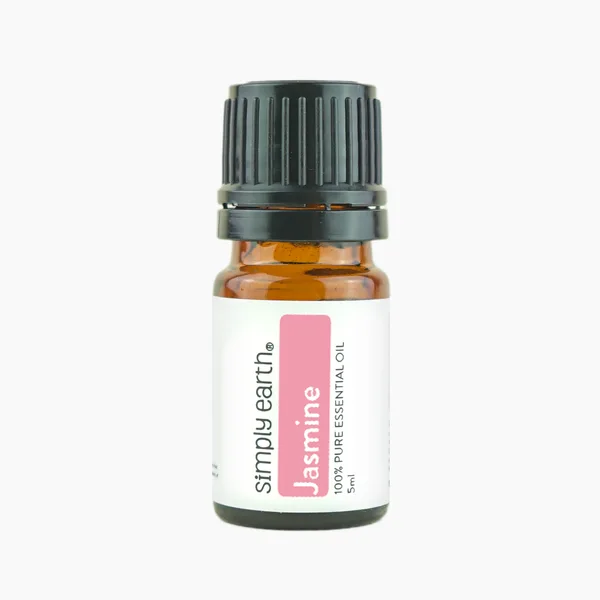
Here is the thing almost every jasmine article gets wrong, including the one this page replaces: jasmine is not a steam-distilled essential oil. It is an absolute. The blossom is too delicate to survive distillation, so the aroma is drawn out with a solvent instead — which is why Simply Earth's label reads 100% Pure Absolute rather than essential oil, and why it comes in a 5ml bottle when most of our singles come in 15ml. It is Jasminum grandiflorum from India, the flowers hand-picked before dawn while the scent is at its strongest, and it takes more than a ton of them to make about four pounds of oil. All of that is the reason jasmine is expensive, and it is also the reason a cheap "jasmine essential oil" is almost always neither. This page is the honest version: what it actually does, how little of it you need, and how to tell the real thing from the three cheaper things sold under its name.
Free Cheat Sheet
New to Essential Oils? Start Here.
Get our free Essential Oil Guide — the safe-use basics, dilution rates, and the oils worth buying first.
Supports Romantic Feelings
The use Simply Earth lists first, and the one jasmine has always been known for.
 Shop This Oil
BEST FOR: PERFUME, PULSE-POINT ROLLERS & EVENING DIFFUSING
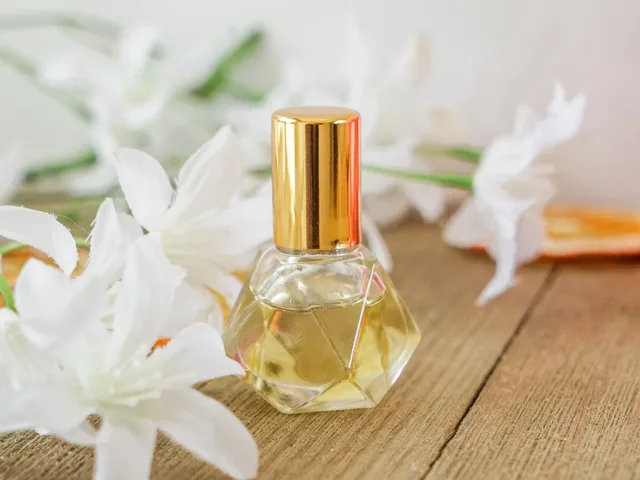
Jasmine's reputation as a romantic oil is genuinely ancient and genuinely cross-cultural — it turns up in Indian wedding garlands, in Arabian and Chinese medicine, and in French perfumery, all more or less independently. Simply Earth's own product record lists Supports Romantic Feelings as this oil's first use. What is fair to say is that jasmine is a rich, warm, unmistakably sensual floral and that scent is tightly wired to memory and mood. What is not fair to say is that it works on anyone like a switch. There is no clinical evidence for jasmine as an aphrodisiac, and you should treat any page that tells you otherwise with suspicion. Use it because it smells extraordinary and because it makes an occasion feel like one.
KATIE'S TIP
One drop. Genuinely. Jasmine has a blending factor of 1, which is the lowest on our whole range — it will dominate anything you put it next to. In a 10ml roller one drop is a 0.5% dilution, which is also this oil's maximum recommended rate.


BEST FOR: MORNING DIFFUSING, DESK BLENDS & LOW-ENERGY AFTERNOONS
This is where jasmine has actual human data behind it. Hongratanaworakit (2010) applied jasmine oil in a massage to healthy adults and measured what happened — breathing rate, blood pressure and skin conductance all rose, and the participants rated themselves more alert, more vigorous and less drowsy than the placebo group. The author's conclusion was that jasmine produces behavioural arousal. That is worth reading carefully, because it is the opposite of what people assume a floral does. Jasmine is not a wind-down oil in the way lavender is. It lifts and it wakes up.
KATIE'S TIP
If a floral blend is making you sleepy, jasmine is not the culprit — try it in the morning instead. One drop against two or three of a citrus is a genuinely excellent start-of-day diffuser blend.


BEST FOR: MEDITATION, JOURNALLING & TRANSITION MOMENTS
Simply Earth lists Centers among this oil's uses, and it sits comfortably alongside the arousal finding above rather than contradicting it — alert and settled are not opposites. Jasmine has a long history in contemplative and devotional settings across South and East Asia, where it was burned, worn and offered rather than swallowed. The honest framing is that this is traditional use plus the ordinary, well-understood effect of a strong scent marking a change of gear. If you diffuse the same thing every time you sit down to concentrate, your brain learns it. Jasmine is a good candidate for that job precisely because it smells like nothing else in the cupboard.
KATIE'S TIP
Keep it for one purpose. An oil this distinctive works best as a signal — use it for the thing you want to mark, and use something cheaper for everyday background diffusing.
USE IT IN →
BEST FOR: FACIAL SERUMS, BODY OILS & DRY-SKIN BLENDS
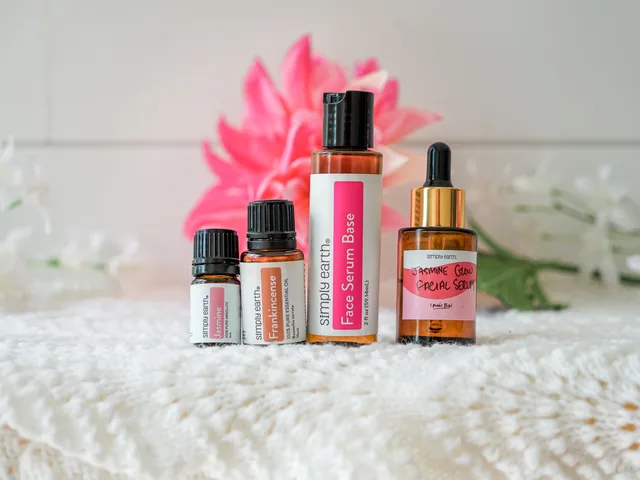
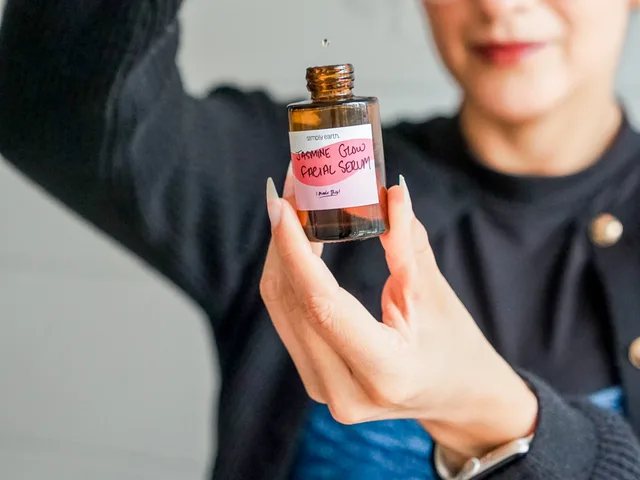
Jasmine is a long-standing skincare ingredient and Simply Earth lists Tightens as one of its uses, which is why it anchors our own Jasmine Glow Facial Serum. The evidence usually attached to this claim needs handling honestly, though. Hirapara and colleagues (2017) did find improved wound healing from Jasminum grandiflorum — but they tested an ethanolic extract of the flowers, applied to diabetic rats. That is not this product, not this preparation, and not human skin. The previous version of this article used that study to say jasmine regenerates skin cells, treats dermatitis and eczema, and fades scars and stretch marks. We are not repeating that. What is reasonable — a beautiful, well-diluted floral in a facial oil that people genuinely enjoy using.
KATIE'S TIP
Half a drop is not a joke here. For a 30ml facial serum, one drop of jasmine is roughly 0.17% — well under the 0.5% ceiling and still very present. Patch test on the inner arm first, especially if fragrance ever bothers your skin.
USE IT IN →

BEST FOR: EVENING WIND-DOWN, BATH BLENDS & BEDROOM LINEN
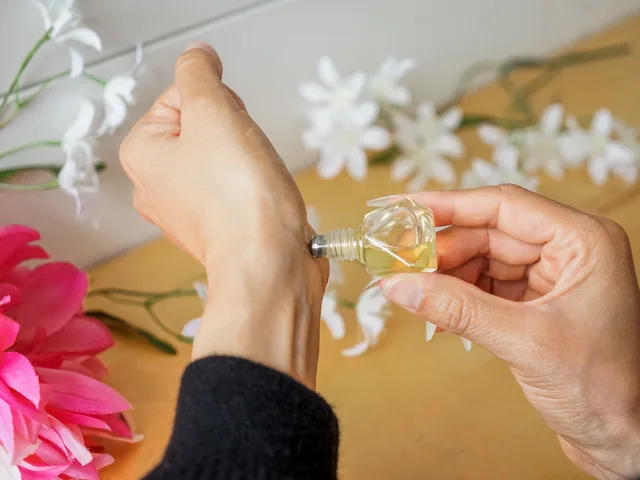
Simply Earth lists Promotes Rest, and jasmine appears in a lot of traditional evening and sleep preparations. It is worth pairing that with the arousal research above rather than pretending they do not sit oddly together — the measured effect of jasmine inhalation in healthy adults was increased alertness, so if you are sensitive to scent, a heavy jasmine diffuser at bedtime may not do what you want. The way most Earthies actually use it well is earlier — in a bath, or on pillowcases hours before sleep, where it is doing the work of marking the end of the day rather than switching you off. If it keeps you up, that is a known possibility, not you doing it wrong.
KATIE'S TIP
Never straight into bathwater — oils do not disperse in water. Put your drop into a tablespoon of carrier oil or a handful of Epsom salts first, then into the bath.
USE IT IN →
Promotes Hormone Balance
Listed by Simply Earth. Traditional use — and no clinical evidence we can point you to.
 Shop This Oil
BEST FOR: MONTHLY-CYCLE BLENDS & LOWER-ABDOMEN MASSAGE
This one is on Simply Earth's product record, so it belongs on this page — but it also needs the most careful wording of anything here, so here it is plainly. Jasmine has been used in women's traditional medicine across India, China and the Arab world for a very long time, and it remains a common ingredient in blends made for the monthly cycle. We are not able to point you at a clinical trial showing that jasmine absolute alters hormone levels in humans, because we have not found one. Treat this as traditional use and as a pleasant, grounding oil to have in a massage blend — not as a treatment. If something about your cycle, fertility or hormones is worrying you, please talk to your doctor rather than to a bottle.
KATIE'S TIP
If you are pregnant, this is the row to pay attention to. Simply Earth lists jasmine as pregnancy safe with your doctor's go-ahead — get it first, particularly given this oil's traditional associations.
USE IT IN →
BEST FOR: STUDY SESSIONS, CREATIVE WORK & LONG DRIVES
The same 2010 study that found jasmine raised physiological arousal also found participants rating themselves as more alert and more attentive afterwards, and Simply Earth lists Supports Awareness as a distinct use. Of everything on this list, this is the one most people have never tried, largely because jasmine gets filed mentally under romance and never makes it to the desk. It is worth breaking that habit. A single drop in a diffuser alongside a citrus is bright without being sharp, and it does not have the medicinal edge that peppermint or rosemary bring to the same job — which matters if you are going to sit in it for three hours.
KATIE'S TIP
Pair it with sweet orange or grapefruit rather than another floral. Two florals together muddy each other; a citrus gives jasmine somewhere to sit.
USE IT IN →
Put It to Work
How to Use Jasmine Absolute
Diffuser
- • 1 drop is usually the whole answer — jasmine's blending factor is 1, the lowest we sell
- • Pair with 2–3 drops of a citrus rather than with another floral
- • A middle note, so it arrives after the citrus and outlasts it
- • Best in the morning or early evening, given it is mildly stimulating
Topical (Roller & Massage)
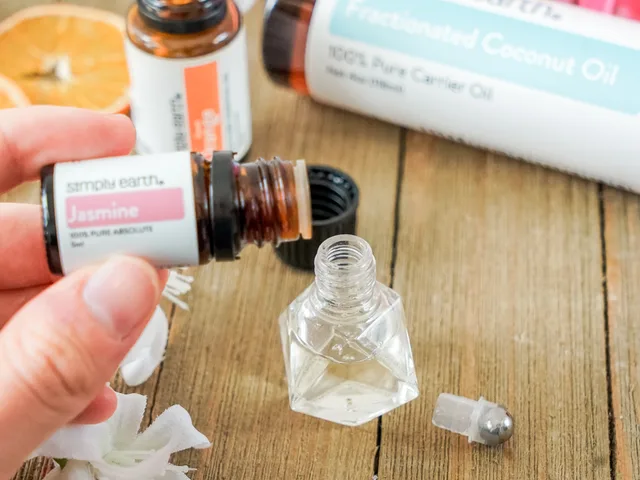
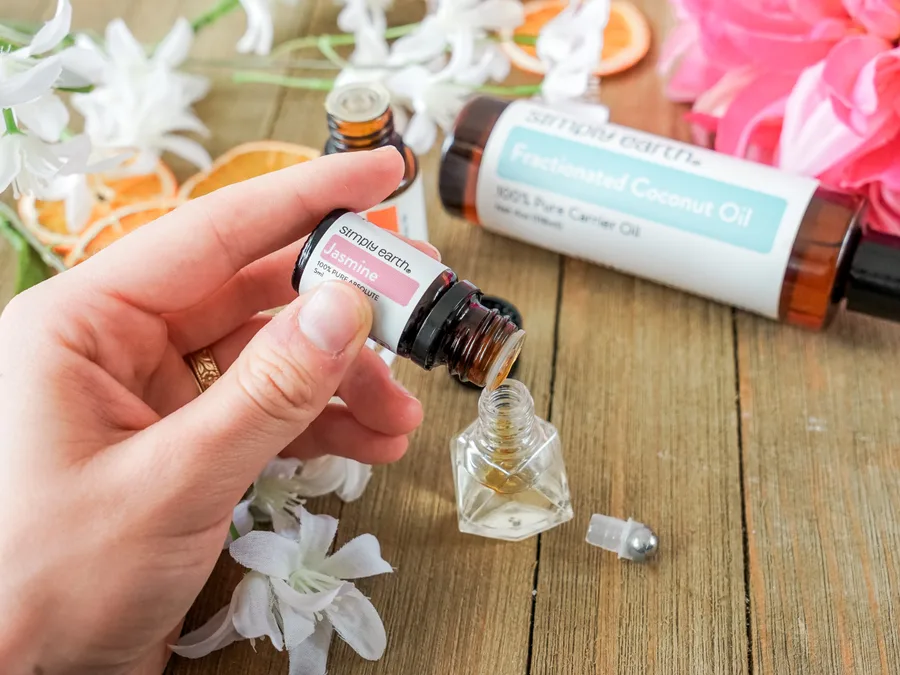
- • 0.5% is the maximum recommended dilution — about 1 drop in a 10ml roller
- • Fractionated coconut oil or jojoba as the carrier
- • Pulse points for perfume; lower abdomen or shoulders for massage
- • Patch test on the inner arm first, and skip it if fragrance irritates your skin
Perfume & Skincare
- • The natural use for an absolute — this is what the material was made for
- • One drop in a 30ml facial serum is roughly 0.17% and still clearly present
- • Blend into perfumers alcohol for a spray, or a carrier for a solid perfume
- • Let a finished perfume blend rest 24–48 hours before you judge it
Bath & DIY
- • Into Epsom salts or a spoon of carrier oil first — oils do not disperse in water
- • Excellent in candles, wax melts and room sprays, where a little carries a long way
- • Keep the cap on tightly; shelf life is about 4 years
- • For external and aromatic use only — never add to food
Know the Difference
Absolute vs. Essential Oil vs. Fragrance Oil
This is the section worth reading twice, because jasmine is one of the most commonly faked materials in the whole category. An absolute is not an essential oil. An essential oil is steam distilled; jasmine blossoms collapse under that heat and give up almost nothing, so the aroma is drawn out with a solvent instead and what you get is called an absolute. It is richer and closer to the living flower than a distillate would be, and it is a great deal more expensive to produce. That is why bargain "jasmine essential oil" is a warning sign: at that price it is usually a fragrance oil, a jasmine-scented blend diluted in a carrier, or a different flower entirely. Simply Earth's is Jasminum grandiflorum from India, solvent extracted, sold as an absolute and labelled as one. There is a second true jasmine — Jasminum sambac, sometimes sold as sambac absolute — which is greener and more tea-like; we do not currently carry it. If you want the other great white floral for comparison, that is ylang ylang.
Swipe to compare →
Jasmine Absolute What Simply Earth sells | Jasmine Sambac A different jasmine species | Jasmine Fragrance Oil Not a plant extract at all | |
|---|---|---|---|
| Botanical Name | Jasminum grandiflorum | Jasminum sambac | None — synthetic |
| How It's Made | Solvent extraction | Solvent extraction | Blended in a lab |
| Plant Part | Flower | Flower | N/A |
| Origin | India | Usually India or China | N/A |
| Aroma | Sweet & floral, rich | Greener, more tea-like | Sweeter and flatter |
| Certification | 100% pure — not certified organic | Varies by supplier | Not applicable |
| Sold by Simply Earth | Yes, 5mL | No | No |
| Simply Earth | This page's oil | — | — |
Perfect Pairs
Jasmine Blends Well With…
The single oils come straight from Simply Earth's product record for this oil. Unicorn is the one Simply Earth blend our own formulators put jasmine into — grapefruit (pink), sweet orange, lemon and jasmine. Citrus is the easiest place to start, because it gives a very loud floral somewhere to sit.
Picked Before Dawn
A Ton of Flowers, Picked in the Dark
Jasmine is harvested at night. The blossoms release the most scent in the hours before sunrise and lose it quickly once the sun is on them, so the flowers are hand-picked before dawn — every one of them, by hand, because a machine would bruise them and bruising costs aroma. It is among the most labour-intensive harvests in the whole perfumery world, and it is the single biggest reason a small bottle of the real thing costs what it does.
The arithmetic is the part that surprises people. It takes more than a ton of jasmine flowers to produce roughly four pounds of oil. Set against a peppermint or a lemon, where the plant gives up its oil readily and in volume, jasmine is in a different category of scarcity — which is also why a 5ml bottle is the sensible size, and why one drop is almost always enough.
The uses travelled as widely as the flower did. Jasmine was a perfumery material in France, and was used medicinally in India, China and Arabia. It is still served as a tea in China and still given as garlands to guests in India — a flower that is simultaneously a luxury good, a medicine cabinet staple and an ordinary gesture of welcome, depending on where you are standing.
What's Inside
What's Actually In the Bottle
These three constituents are the ones Simply Earth names on its own record for this oil. Percentages shift between harvests — the previous version of this article put the oil at roughly 58% esters, 8.85% diterpenoids and 8.61% monoterpenols, which is a reasonable picture of the shape of it but not a guarantee for any given bottle. That is exactly what the batch report is for.
Benzyl Acetate
The lead constituent · Sweet & floral
The compound that most defines what jasmine smells like. Benzyl acetate is an ester with a sweet, fresh, jasmine-and-pear character, and it is the dominant aromatic in jasmine absolute — which is why esters as a class make up the bulk of this oil. It is one of the most widely used materials in commercial perfumery, and it is also the compound a synthetic "jasmine" tries hardest to imitate.
Benzyl Benzoate
Fixative · Faint & balsamic
Barely smells of anything on its own — a faint, sweet, balsamic note — but it does something structurally important in a natural perfume. Benzyl benzoate is a fixative — it slows the evaporation of the lighter aromatics around it, which is part of why jasmine lingers on skin far longer than its middle-note position suggests. It is also a recognised fragrance allergen, which is worth knowing if scent has ever irritated your skin.
Squalene
Skin-conditioning · Odourless
An unusual thing to find on an aromatic material's constituent list, because it contributes no scent at all. Squalene is a lipid that occurs naturally in human sebum and is widely used in skincare for its conditioning and emollient properties. Its presence is part of why jasmine absolute behaves well in a facial oil rather than merely perfuming one.
Every batch of Simply Earth Jasmine is GC/MS tested and a batch-specific report is available with every bottle. We do not hold a linked spec sheet for a specific batch on this page, so no constituent percentages are quoted here as current — only the compounds Simply Earth names for the oil. On a material this frequently adulterated, that batch report is the thing actually worth asking any supplier for.
Support The Source
A Ton of Flowers, Four Pounds of Oil
Simply Earth's jasmine is Jasminum grandiflorum, grown in India and extracted from the flower with a solvent rather than with steam. All three of those facts come from the product record rather than being a description written around the oil, and together they are most of what you need to judge a jasmine.
This oil is 100% pure and is not certified organic, which is worth stating plainly rather than leaving to inference. Simply Earth does sell certified organic oils and says so on those labels; jasmine is not one of them, so we are not going to imply otherwise. Every batch is GC/MS tested and the batch-specific report is available with the bottle — which matters more here than on almost any other oil we sell, because genuine jasmine is expensive enough that the incentive to cut it is real.
We do not have farm-level figures to publish for this oil — years partnered, percentage farm-direct, that sort of thing — and rather than estimate them we would rather say so. What we can tell you is what is in the bottle and where the plant grew.
Jasminum grandiflorum
What We Extract
India
Origin
Solvent Extracted
Extraction Method
Use It Right
Things to Remember When Using This Oil
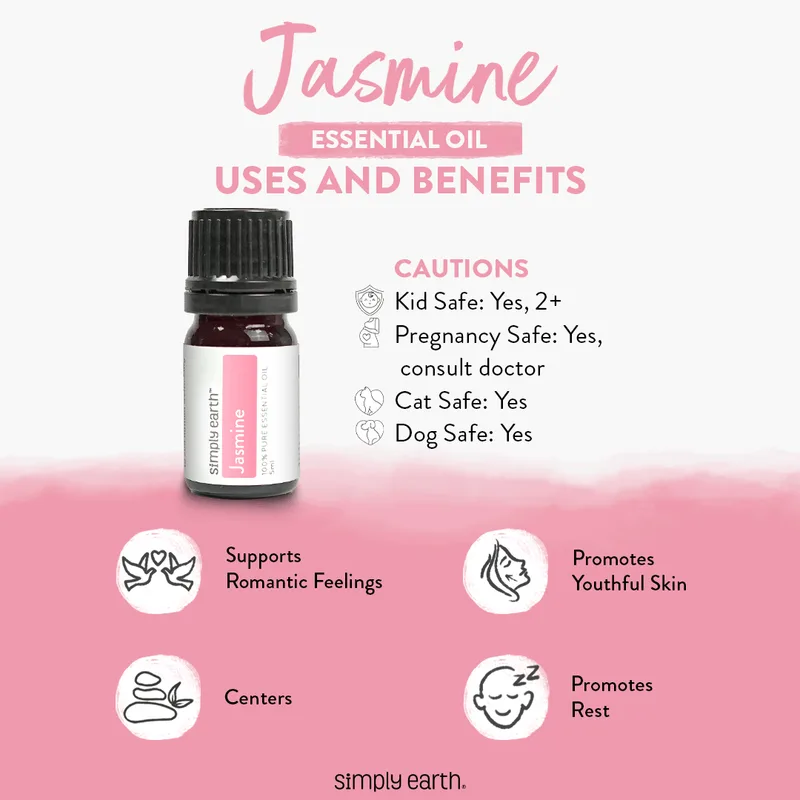
Always dilute before applying to skin, and dilute this one harder than most. Simply Earth's record sets a special dilution rate of 0.5% for jasmine — roughly 1 drop in a 10ml roller, or 3 drops in 30ml of carrier. Here is a dilution chart for getting that right.
Jasmine may cause an allergic reaction in people with fragrance-sensitive dermatitis. This is the specific caution Simply Earth lists for this oil, and it is the one most worth taking seriously. Patch test on the inner arm before the first full use, and stop if skin reacts.
Safe for children aged 2 and over, diluted, according to Simply Earth's own record for this oil. Keep the bottle out of reach.
Considered safe in pregnancy and while breastfeeding on Simply Earth's record — but consult your doctor before using it in either case, and particularly given jasmine's traditional associations with the monthly cycle.
Safe to use around cats and dogs. Simply Earth's record lists both as Yes, which is genuinely unusual — a great many oils are not. More on using essential oils with cats and with dogs.
Not phototoxic — Simply Earth lists this oil as sun safe, so it will not make skin more reactive to sunlight the way the citrus oils can. Note that the Unicorn blend, which contains jasmine, is possibly phototoxic because of its citrus content.
Shelf life is about 4 years. Keep the cap tight and out of direct light. An absolute is a costly thing to let go off.
We don't recommend ingesting essential oils unless under the direction of a doctor certified in aromatherapy. Here is why we don't ingest essential oils.
These statements have not been evaluated by the Food and Drug Administration. This product is not intended to diagnose, treat, cure, or prevent any disease.
Real Results
What Earthies Are Saying
"This Jasmine smells amazing! Not at all like other perfume oils or "essential oils" I have tried in the past. Because it has a very low blending factor the 5 ml bottle will last you a long time. I only need one drop in a 10ml roll-on or in my diffuser. Normally Jasmine would not be in my reach budget-wise."
Shannon A.
Jasmine Essential Oil
"Absolutely LOVE the Jasmine oil I got in my monthly box last month! Made a roller for stress and it is AMAZING what it does for me!"
Anita Miller
Verified Buyer • Jasmine Essential Oil
"Jasmine is one of my favorite scents and this oil is absolutely amazing. I carry it in my purse to use as a perfume. I get compliments constantly!"
Jeri
Jasmine Essential Oil
OUR SIMPLY PURE PROMISE
What Goes Into Your Products Matters
Certified 100% Pure
No fillers, no synthetics. Just pure absolute.
GC/MS Third-Party Tested
Batch-specific reports with every bottle.
Ethically Sourced from Quality Farms
Responsibly harvested. People and planet first.
Jasminum grandiflorum
Botanical Source
Solvent extracted from the flower, in India
5mL
Bottle Size
Smaller because a ton of flowers yields four pounds
Public
GC/MS Tests
MLM brands: Rarely
Your Order Changes Lives: 13% of profits fight human trafficking globally.
Jasmine Absolute FAQ
The questions Earthies actually ask — including the two this article used to get wrong, and the one about the garden.
Is jasmine an essential oil or an absolute? +
An absolute. Jasmine blossoms will not survive steam distillation — the heat destroys the aroma before you can capture it — so the material is solvent extracted instead, and an extract made that way is called an absolute rather than an essential oil. Simply Earth's label says "100% Pure Absolute" for exactly this reason. Almost everything sold as "jasmine essential oil", including the earlier version of this article, is using the phrase loosely because that is the term people search for.
Why doesn't it smell like the jasmine growing in my garden? +
Because it is a different thing, and this catches people out often enough to be worth a straight answer. A living blossom gives you a light, airy, very fresh version of the scent, constantly renewed by the plant. An absolute is that same aroma concentrated enormously, and concentration changes the character — the sweet and slightly animalic notes that sit in the background on the bush come forward hard, and the airiness disappears. Undiluted from the bottle it can smell heavy or even off-putting. Dilute it to 0.5% and it usually resolves into the thing you were expecting. If it still is not for you, that is a matter of taste rather than a faulty bottle.
Why is jasmine so expensive, and why such a small bottle? +
Because the flowers are hand-picked before dawn and it takes over a ton of them to make about four pounds of oil. There is no way to make that cheap. The 5ml bottle is a deliberate response to both the cost and the strength — with a blending factor of 1 and a 0.5% dilution ceiling, 5ml of jasmine goes a very long way. One reviewer makes the point better than we can — she only needs one drop in a 10ml roll-on.
Does jasmine oil actually clean anything? +
There is some real laboratory evidence, and it is narrower than the way this claim usually gets made. Thaweboon and colleagues (2017), writing in IOP Conference Series, tested jasmine oil against oral microorganisms and found antimicrobial activity. That is a laboratory result against specific organisms, not evidence that jasmine sanitises a kitchen counter. The previous version of this article listed "Cleans" as a benefit of the oil; it is not one of the seven uses on Simply Earth's product record, so it is not a benefit row here. Use jasmine because of how it smells and treat cleaning as a job for a cleaning product.
What dilution should I use for jasmine? +
0.5% or less — this is one of the lowest recommended rates on our range, and it is on Simply Earth's own record for the oil. In practice that is about 1 drop in a 10ml roller, or 3 drops in 30ml of carrier. Going higher does not make it smell better; it makes it smell overwhelming and raises the chance of skin irritation, especially as jasmine can trigger a reaction in people with fragrance-sensitive dermatitis.
Is jasmine safe around cats and dogs? +
Yes, on Simply Earth's record for this oil — both cat safe and dog safe, which is genuinely uncommon and one of the nicer things about this particular bottle. The usual sensible practice still applies — diffuse in a room an animal can walk out of, and do not apply oils directly to a pet.
Which Simply Earth products contain jasmine? +
Jasmine is in the Unicorn Essential Oil Blend and the Unicorn Roll-On — both are grapefruit (pink), sweet orange, lemon and jasmine, and both were built for kids and adults alike. We also publish two recipes built around the single oil — the Jasmine Bliss Roll-On Perfume and the Jasmine Glow Facial Serum.
What is the difference between Jasminum grandiflorum and Jasminum sambac? +
They are two different species of true jasmine, both used to make absolutes. Grandiflorum — what Simply Earth sells — is the classic rich, sweet, full-bodied jasmine of French perfumery. Sambac, sometimes called Arabian jasmine, is greener and more tea-like, and it is the one used to scent jasmine tea. Neither is better; they are different materials, and a recipe written for one will not smell the same made with the other.
About the Author: Katie Veldkamp
Katie Veldkamp
Certified Aromatherapist · Co-Founder, Simply Earth
Katie Veldkamp is a Certified Aromatherapist and co-founder of Simply Earth. She personally formulates and reviews SE's essential oil blends and verifies all benefit claims on Simply Earth content before it goes live.
Join 20,000+ Earthies Making Their Homes Natural
New recipes, usage guides, and DIY tips — delivered free.
No spam. Unsubscribe any time.
Learn by doing
Make your own natural products every month.
The Simply Earth Recipe Box ships 4 full-size essential oils, 6 natural recipes, and everything you need to make them. No guesswork.
Start My Recipe Box$39.99 for your first box, then $49.99/month. Skip, pause, or cancel anytime.