
Sandalwood Essential Oil Benefits, Uses & Recipes

Katie Veldkamp
Lead Certified Aromatherapist
Fact Checked & Approved
Sandalwood is the oil people describe as smelling like calm. Soft, creamy, woody without being sharp, it has been burned in temples and worn as perfume for thousands of years, and it is still the note perfumers reach for when a fragrance needs a base that lasts all day. It is also the oil where the source matters more than for almost anything else on the shelf. Indian sandalwood has been harvested to vulnerability, which is why the bottle on this page is Australian sandalwood instead — a deliberate decision rather than a marketing line. Here is what Sandalwood does, what the species difference actually means, and why our customers overwhelmingly reach for it at the start of a quiet moment.
In this Guide
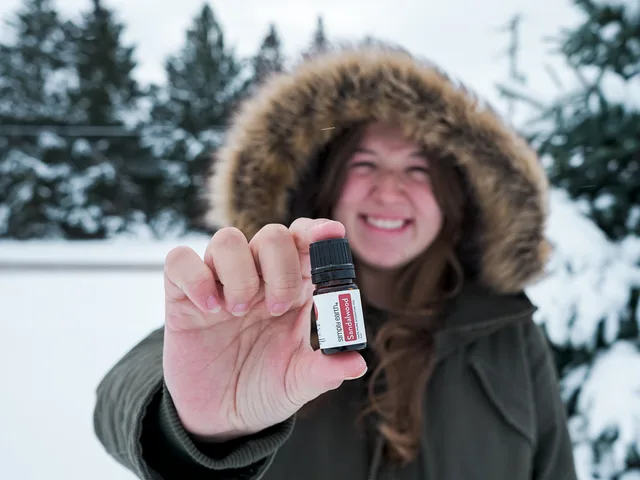
BEST FOR: FOCUS AND DESK BLENDS
This is the one Sandalwood claim with a real primary study behind it. Heuberger, Hongratanaworakit and Buchbauer found that the odour of East Indian sandalwood, and of the compound alpha-santalol on its own, increased physiological and self-rated arousal in humans — it made people measurably more alert rather than more drowsy. Worth being precise about what that does and does not cover. The study was run on East Indian sandalwood, not on the Australian species in this bottle, but alpha-santalol is the lead constituent of ours too. Read the study in Planta Medica.
KATIE'S TIP
This surprises people, because Sandalwood smells so calming. It is calm and alert at the same time, which is exactly what you want at a desk. Diffuse it while you work rather than saving it for bedtime.
USE IT IN →

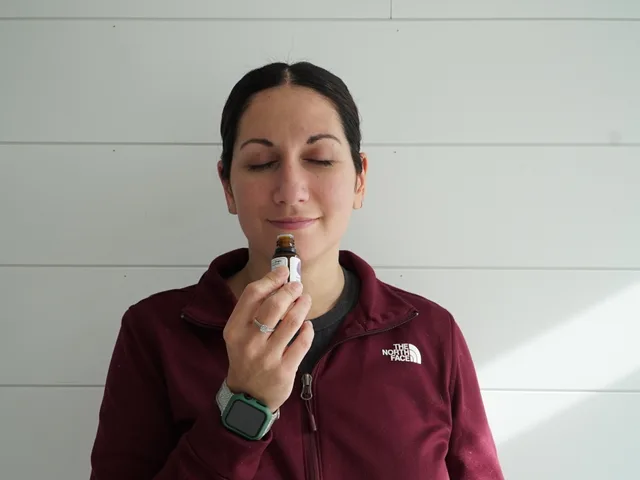
BEST FOR: EVENING AND WIND-DOWN BLENDS
Sandalwood's creamy, woody depth is one of the most settling scents in aromatherapy, and it is the reason it turns up in so many quiet-moment blends. Simply Earth lists calming among the oil's uses, and it is the quality customers mention first when they describe what the bottle is for. This is a scent and mood benefit rather than a clinical one.
KATIE'S TIP
Sandalwood is slow. Give it ten minutes in a diffuser before you judge it — the first minute smells like almost nothing, and then the room changes.
USE IT IN →


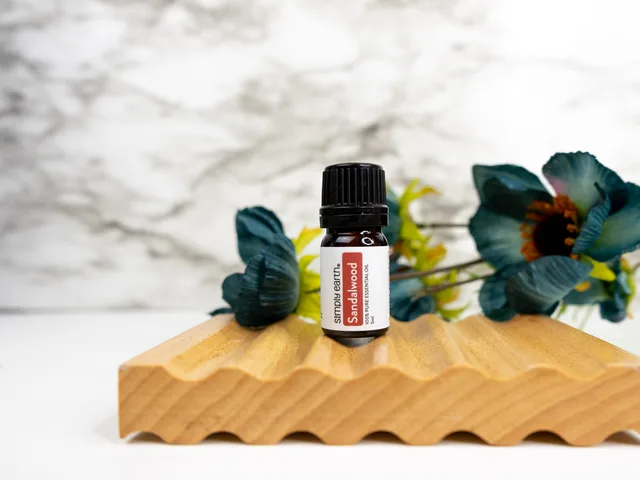
BEST FOR: FACE OILS AND BALMS
Sandalwood has a long history in skincare and is a common addition to facial oils for skin that feels dry or tight. Simply Earth lists promoting youthful skin among its uses, and the oil blends into a carrier without heaviness. Its scent also survives in a finished balm, which is rarer than it sounds. This is about comfort and appearance rather than healing or repair.
KATIE'S TIP
Sandalwood is one of the few oils that genuinely improves a balm's smell as it ages rather than fading out of it. Patch test on the inner arm before you put anything new on your face.
USE IT IN →
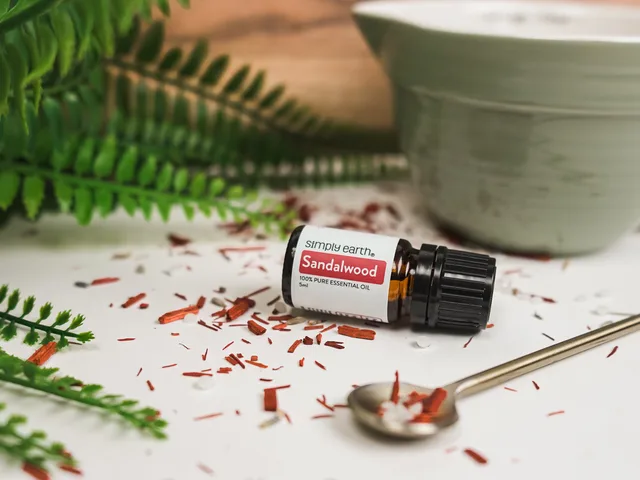
BEST FOR: HOUSEHOLD AND WAX BLENDS
Sandalwood appears in household blends, sachets and wax work, valued as much for the scent it leaves behind as for anything else. It is a base note, so it is what stops a citrus-led cleaning or candle blend disappearing within the hour.
KATIE'S TIP
One customer described using it for washing thresholds — a lovely, old use, and a reminder that not every use has to be therapeutic to be worth writing about.
USE IT IN →

A Base Note for Perfume and Grooming
Where Sandalwood is genuinely irreplaceable.
 Shop Sandalwood Essential Oil
BEST FOR: DIY PERFUME, BEARD OIL, AFTERSHAVE
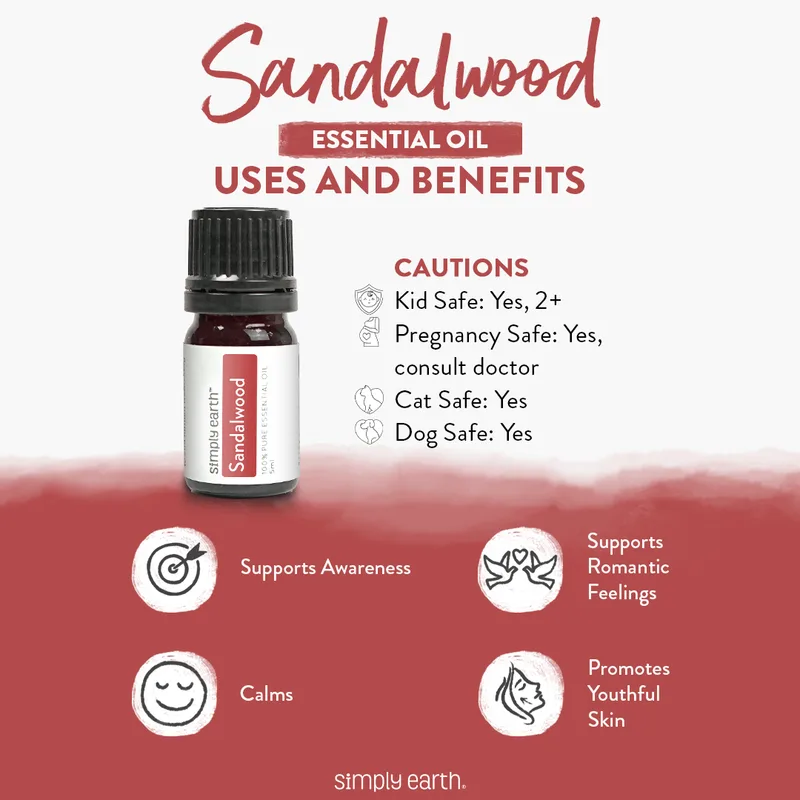
Sandalwood is one of the great base notes in perfumery. It fixes a fragrance, which means it slows the evaporation of everything above it and makes a blend last. Simply Earth's own record classes it as a base note with a blending factor of 6. It is also the classic note in traditional men's grooming — shaving soap, aftershave and beard oil — which is why it anchors our Timber blend.
KATIE'S TIP
If your homemade perfume vanishes in an hour, this is the fix. Two drops in a 10ml roller will hold a citrus together all day.
USE IT IN →
BEST FOR: MEDITATION, PRAYER, QUIET ROUTINES
Sandalwood has been burned in temples and used in meditation and prayer for millennia, across Hindu, Buddhist and Jain traditions. Per Simply Earth's own customer research this is the number one reason people reach for it, which makes it striking that the previous version of this page did not mention it once. Simply Earth's product record lists supporting awareness as the oil's first use, and this is what that looks like in practice.
KATIE'S TIP
A drop on the wrists before you sit down works better than a diffuser for this, because the scent moves with you and stays close.
USE IT IN →
BEST FOR: ANYONE WHO CARES WHERE IT CAME FROM
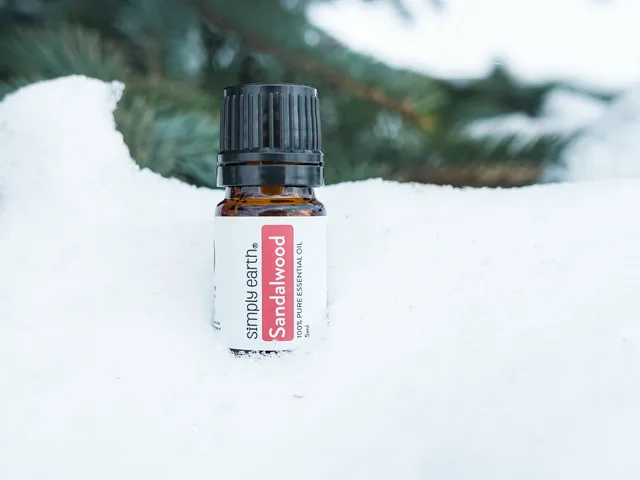
Indian sandalwood has been harvested to the point of vulnerability, because the fragrant heartwood only develops after decades of growth and the tree is felled to get it. Simply Earth's response was to source from Australian sandalwood instead, a cultivated species with a very similar scent and chemistry. Choosing responsibly grown sandalwood is a genuine environmental decision rather than a marketing line, and it is the whole reason this bottle costs what it does instead of considerably more.
KATIE'S TIP
If you love the smell but want to go further, try Amyris — sometimes called West Indies Sandalwood. Aromatherapists use it in place of the endangered species, and a customer of ours put it best. If you love Sandalwood, you will love Amyris.
Put It to Work
How to Use Sandalwood Essential Oil
Diffuser
- • 3–5 drops in your diffuser of choice
- • Give it a full ten minutes before you judge the scent
- • Lift it with a citrus, or deepen it with Ylang Ylang or Geranium
- • Simply Earth lists this oil as both cat safe and dog safe
Topical (Roller)
- • 10ml roller bottle
- • 9ml fractionated coconut oil or jojoba
- • Simply Earth's maximum for this oil is 5%, so stay at or under it
- • A drop on the wrists for meditation or focus
Perfume & Grooming
- • Two drops in a 10ml roller as the base note
- • Beard oils, aftershave and shaving soap
- • It fixes a blend, so add it last and add it sparingly
- • Blending factor 6 — a little goes a long way
DIY
- • Face oils, balms and soap
- • Candles, wax sachets and room sprays
- • Patch test on the inner arm before any facial use
- • Store cool and dark; shelf life is around five years
Know the Difference
Australian vs. Indian Sandalwood
This is the most consequential comparison on any of our oil pages, because the difference is ethical as well as olfactory. Indian sandalwood is the scent most people picture, and it is also the species that has been harvested to vulnerability — the fragrant heartwood takes decades to form and the tree is felled to get it. Simply Earth's Sandalwood is Santalum spicatum, the Australian species, cultivated rather than wild-cut, with a very similar chemistry and a noticeably lower price. Amyris is not a sandalwood at all, but aromatherapists have long used it in place of the endangered species and it is the cheapest way into that family of scents.
Swipe to compare →
Indian Sandalwood The classic, and the problem | Australian Sandalwood What Simply Earth sells | Amyris Often called West Indies Sandalwood | |
|---|---|---|---|
| Botanical Name | Santalum album | Santalum spicatum | Amyris balsamifera — not a true sandalwood |
| Conservation Status | Vulnerable, from heavy over-harvesting | Cultivated and managed | Not of concern |
| Plant Part | Heartwood | Heartwood | Heartwood |
| Aroma | The classic — soft, creamy, deep | Rich and sweet, delicately woody and floral | Woody and sweet; close, not identical |
| Where It Grows | India | Australia | Jamaica |
| Price at Simply Earth | Not sold | $59.99 / 15mL | $15.99 / 15mL |
| Simply Earth | — | This page's oil | — |
Perfect Pairs
Sandalwood Blends Well With…
Sandalwood sits underneath other oils rather than beside them, so add it last and add it sparingly. Simply Earth also builds it into four ready-made blends — Timber, B.O. Be Gone, Clear Skin and Lava.
Four Thousand Years of the Same Smell
History of Sandalwood Essential Oil
Sandalwood is among the oldest continuously traded aromatics in the world. Its heartwood has been carved into temple doors and devotional objects, ground into paste for ritual use, and burned as incense across Hindu, Buddhist and Jain practice for thousands of years. Few scents carry that much accumulated association. When people say Sandalwood smells sacred, they are responding to a very long history as much as to a chemical profile.
What makes it precious is also what has endangered it. The fragrant compounds accumulate in the heartwood of a mature tree, developing slowly over decades, and harvesting them has traditionally meant felling the tree outright. Centuries of demand outran the growth rate, and Santalum album — Indian sandalwood — now carries a vulnerable conservation status, with government restrictions and a price to match.
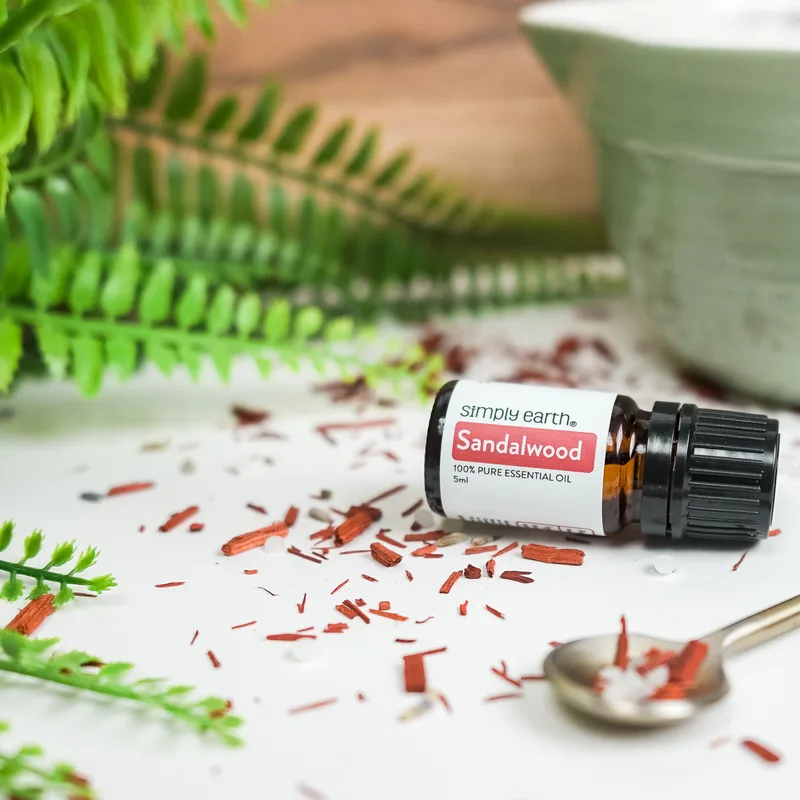
That is why the modern sandalwood conversation is really a sourcing conversation. The oil in this bottle is steam-distilled from the heartwood of Santalum spicatum, the Australian species, which is cultivated rather than wild-cut and which Simply Earth chose deliberately as the ecological answer to that history. It is the same family of scent, arrived at a different way.
The Chemistry
The Science Behind Sandalwood Oil
Two naturally occurring compounds account for most of Sandalwood's character, and one of them has a real human study behind it.
α-Santalol
16.2% · The signature compound
The compound most responsible for sandalwood's characteristic scent, and the one the research is actually about. It contributes to the oil's reputed sedative character, and the chemistry literature describes anti-inflammatory, antioxidant, antiviral and antibacterial activity for the compound itself. It is also the constituent the Planta Medica arousal study isolated and tested on its own, linked in the note below.
trans-Farnesol
13% · The floral edge
A sesquiterpene alcohol found across many essential oils, carrying a delicate floral odour. It is used as a bioactive agent in pharmaceutical and cosmetic products, and it is a large part of why Sandalwood reads as floral as well as woody rather than as a flat wood note.
Steam-Distilled Heartwood
Santalum spicatum · Australia
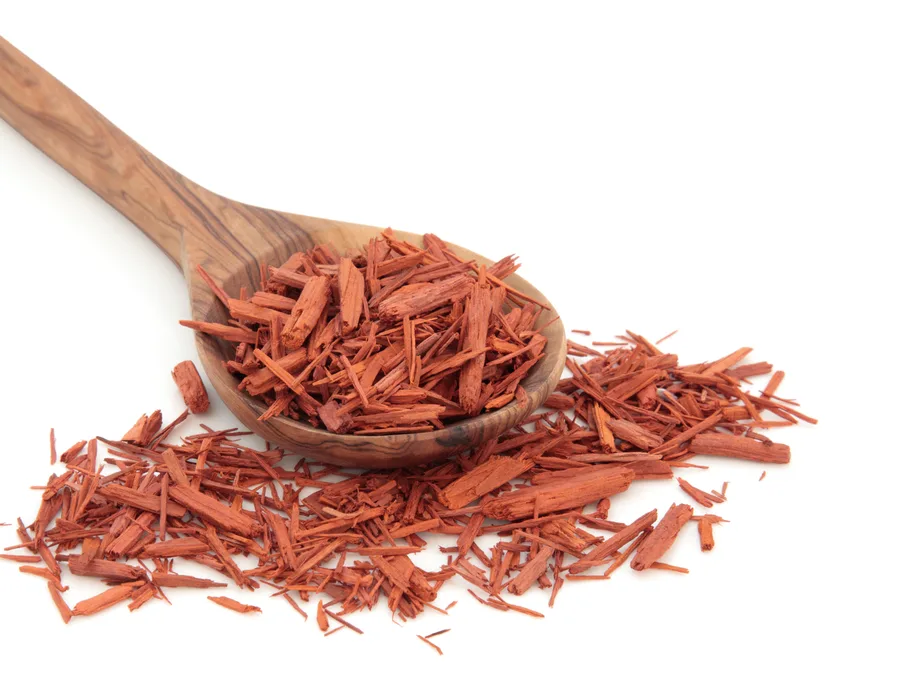
Sandalwood oil is not pressed from a peel or distilled from a leaf. It comes from the heartwood at the centre of a mature tree, which is the reason the oil is expensive, the reason harvesting is slow, and the reason the species question on this page matters at all.
The arousal finding above comes from Heuberger, Hongratanaworakit and Buchbauer, published in Planta Medica in 2006 — read the study. A note on honesty about the percentages. They are Simply Earth's published figures for this oil, but we do not currently have a spec sheet linked to this product, so they cannot yet be tied to a specific tested batch. We third-party test our oils and publish the results, and we never blend them with synthetic fragrance, fillers or extenders. See Our Testing →
Choose a More Ecological Option
Where Our Sandalwood Comes From
Traditionally the most common source of sandalwood oil is Indian sandalwood, Santalum album. Its popularity is exactly what undid it. Demand outran the decades it takes for heartwood to develop, and the species now carries a vulnerable conservation status, with government restrictions and a very high price attached.
Simply Earth's ecological response was to source this oil from Australian sandalwood, Santalum spicatum, instead. It has a very similar scent and chemical profile to the Indian species, and lower production and processing costs, which is how we can offer it at a lower price than Indian sandalwood oil — though it is still, honestly, one of the more expensive bottles we sell. That is what mature heartwood costs.
One thing we would rather say plainly than dress up. This is a species and stewardship story, not a farm story. We can tell you the species, the country and the plant part, all of which are on the product record and the label. We cannot yet name a farm partner or a distiller for this oil the way we can for several others, and we would rather leave that blank than invent it.
Australia
Where It's Grown
Heartwood
Plant Part
Public
GC/MS Results
Use It Right
Things to Remember When Using This Oil
Always dilute before applying to skin. Simply Earth lists a special maximum dilution rate of 5% for this oil. See our dilution chart for the drops-per-ounce equivalents.
Safe for kids age 2 and up. Still dilute conservatively for children and keep the bottle out of their reach.
Pregnancy safe, with your doctor's guidance. Simply Earth lists it as safe during pregnancy but recommends consulting your doctor first.
Generally safe while breastfeeding, again with your doctor's guidance.
Cat safe and dog safe. Worth stating plainly, because a great many essential oils are neither.
Not phototoxic. Simply Earth lists this oil as sun safe, so there is no sun-exposure restriction after topical use.
Patch test before facial use. Apply a diluted drop to the inner arm and wait a day before putting anything new on your face.
Store it cool and dark. Shelf life is around five years, and Sandalwood is among the longest-lived essential oils — it generally improves with age rather than fading.
We do not recommend ingesting essential oils.
These statements have not been evaluated by the Food and Drug Administration. This product is not intended to diagnose, treat, cure, or prevent any disease.
Real Results
What Earthies Are Saying About It
"I am a Sandalwood Essential Oil fan. I use Simply Earth's Sandalwood Essential Oil for various things such as anointing candles, air diffusing, skincare and washing thresholds."
m'chel
Verified Buyer • Sandalwood Essential Oil
"Love the aroma when I diffuse it."
Shirley J.
Verified Buyer • Sandalwood Essential Oil
"Great smells! So far so good… I am partial to earthy smells like sandalwood!"
Susie Hass
Website Review • Sandalwood Essential Oil
OUR SIMPLY PURE PROMISE
What Goes Into Your Products Matters
Certified 100% Pure
No fillers, no synthetics. Just pure oil.
GC/MS Third-Party Tested
Every batch independently verified.
Ethically Sourced from Quality Farms
Responsibly harvested. People and planet first.
15mL
Bottle Size
MLM brands: 10mL
Cultivated
Our Species
Indian sandalwood: vulnerable
Public
GC/MS Tests
MLM brands: Rarely
Your Order Changes Lives: 13% of profits fight human trafficking globally.
Sandalwood Essential Oil FAQ
The questions people ask most — about the scent, the species, the price and the safety.
What does Sandalwood essential oil smell like? +
Rich and sweet, delicately woody with a floral edge — creamy rather than sharp, and much softer than most wood oils. It is a slow scent. Give it ten minutes in a diffuser before you decide what you think, because the first minute barely registers and then the whole room changes.
Which sandalwood does Simply Earth sell? +
Australian sandalwood, Santalum spicatum, steam-distilled from the heartwood and grown in Australia. We deliberately do not sell Indian sandalwood (Santalum album), which carries a vulnerable conservation status from decades of over-harvesting. The Australian species has a very similar scent and chemistry and is cultivated rather than wild-cut.
Why is Sandalwood essential oil so expensive? +
Because the fragrant compounds only accumulate in the heartwood at the centre of a mature tree, which takes decades to develop. There is no fast way to grow it and no part of the plant you can harvest early. Australian sandalwood has lower production and processing costs than Indian sandalwood, which is why our bottle costs meaningfully less than the classic species would.
Is Sandalwood essential oil safe around cats and dogs? +
Simply Earth lists this oil as both cat safe and dog safe, which puts it in a minority — a great many essential oils are not. Diffuse in a ventilated room, give pets the option to leave it, and keep the bottle itself well out of reach.
How much Sandalwood oil can I use on my skin? +
Simply Earth lists a special maximum dilution rate of 5% for this oil, which is higher than the 1–2% we suggest for everyday use on most oils. Dilute in a carrier such as jojoba or fractionated coconut oil, and patch test on the inner arm before any facial use.
Does Sandalwood essential oil make you sleepy or alert? +
Both, oddly, and that is the interesting thing about it. The scent is deeply settling, but the research on East Indian sandalwood and alpha-santalol found increased physiological and self-rated arousal — more alert, not less. Calm and awake at the same time is exactly why it works at a desk as well as at bedtime.
What is Amyris, and is it the same thing? +
No. Amyris (Amyris balsamifera) is sometimes called West Indies Sandalwood, but it is not a true sandalwood at all. Aromatherapists have long used it in place of the endangered species because the scent is close, it is not of conservation concern, and it costs a fraction as much. Simply Earth sells it as well.
How long does Sandalwood essential oil last? +
Around five years, stored cool and dark. Sandalwood is among the longest-lived essential oils and it is one of the few that many people think improves with age rather than fading — which is also why it holds a homemade perfume together the way it does.
About the Author: Katie Veldkamp
Katie Veldkamp
Certified Aromatherapist · Co-Founder, Simply Earth
Katie Veldkamp is a Certified Aromatherapist and co-founder of Simply Earth. She personally formulates and reviews SE's essential oil blends and verifies all benefit claims on Simply Earth content before it goes live.
Join 20,000+ Earthies Making Their Homes Natural
New recipes, usage guides, and DIY tips — delivered free.
No spam. Unsubscribe any time.

Learn by doing
Make your own natural products every month.
The Simply Earth Recipe Box ships 4 full-size essential oils, 6 natural recipes, and all the supplies you need to make them — $39.99 a month, cancel anytime.
Start My Recipe Box