
Camphor Essential Oil Benefits, Uses & Recipes

Katie Veldkamp
Lead Certified Aromatherapist
Fact Checked & Approved
Camphor is the oil behind that unmistakable warming, nose-opening smell you already know from every drugstore muscle rub on the shelf — and it is far more useful than that one job suggests. Steam-distilled from the wood of the camphor tree in China, Simply Earth's Camphor is the clear, cineole-rich white fraction, the one aromatherapy actually uses. It earns its place in a kit for sore shoulders and stiff joints, for stuffy winter rooms, and — the use most people never hear about — for keeping insects away from your skin, your candles and your wardrobe. It also asks more of you on safety than most oils do, so that section is worth reading before the recipes.
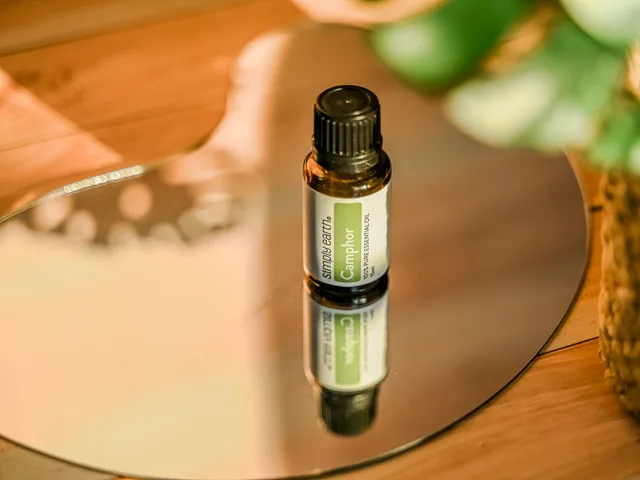
BEST FOR: STIFF KNEES, ELBOWS AND KNUCKLES
Supporting joint function is on Simply Earth's own list of uses for this oil, and it is the job camphor has been doing in commercial rubs for a century — Tiger Balm still lists it as an active ingredient. A 2021 study that isolated camphor from Ocimum kilimandscharicum reported analgesic and anti-inflammatory activity in joint tissue, which is a reasonable explanation for why the traditional use persisted. Diluted into a balm or a body butter, it may help take the edge off the stiff joints you notice most first thing in the morning.
KATIE'S TIP
Camphor is a middle note with a blending factor of 5, so it carries a balm without taking it over. Two or three drops per tablespoon of butter is plenty — this is not an oil that rewards a heavy hand.
USE IT IN →

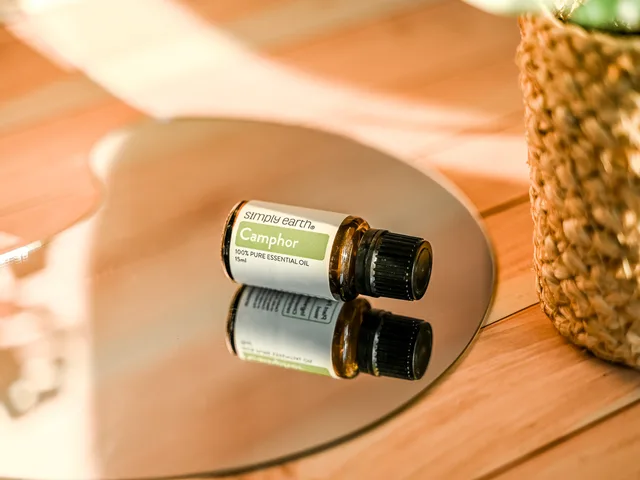
BEST FOR: AFTER LONG DAYS ON YOUR FEET
Soothing muscles is the sixth use Simply Earth lists for camphor, and it is the one Earthies write in about most. A 2019 review of the antispasmodic effects of essential oils and their constituents covers camphor among the compounds studied for exactly this — which is why it turns up in so many post-workout and end-of-shift rubs. It pairs naturally with Rosemary, which Simply Earth also lists as a muscle-soothing oil, in the same carrier.
KATIE'S TIP
Warm the carrier oil in your palms before you rub it in. It spreads further, and the warmth makes camphor's own warming character land faster.
USE IT IN →
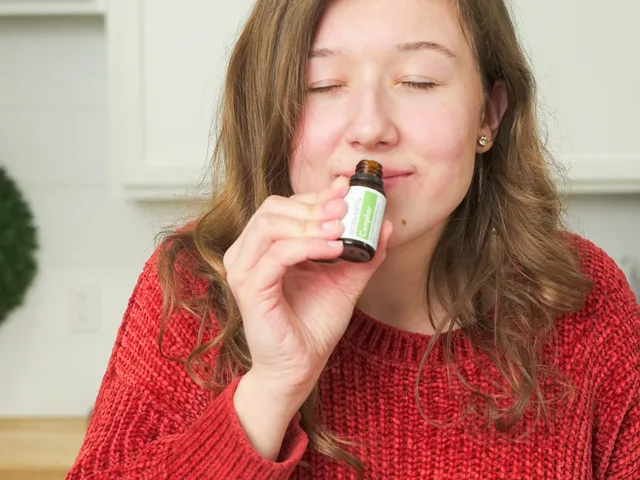
BEST FOR: STUFFY ROOMS AND WINTER EVENINGS
Simply Earth lists this one as Comforts Respiration, and a 2022 review of aromatic ointments for the common cold looked at what the science actually supports for camphor-containing rubs, reporting faster nasal cooling and a sense of easier breathing. Note what that means — much of the effect is the cooling sensation on your receptors rather than a change in airflow, which is a genuinely useful thing on a stuffy evening and not the same as a decongestant drug.
KATIE'S TIP
Diffuse it across the room rather than leaning over the diffuser. Camphor is strong, and with this oil more really is less — three drops in a room beats six in your face.
USE IT IN →

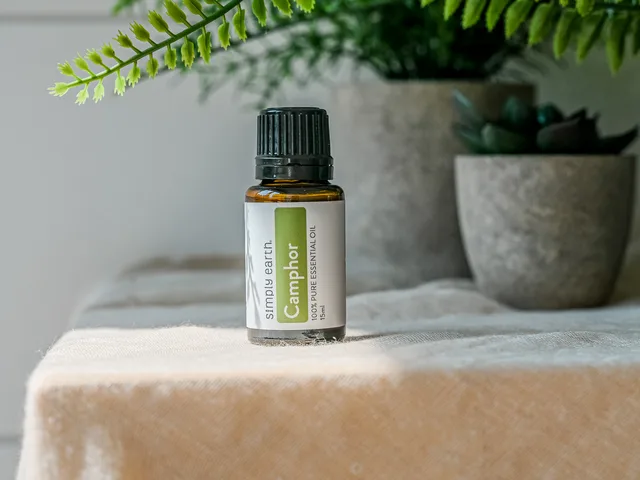
BEST FOR: CLARIFYING BODY AND FOOT BLENDS
Cleanses Skin is one of the two benefits Simply Earth prints on the bottle itself. The evidence most often quoted for it is a 2014 screening of essential oils against decay fungi, in which camphor was the strongest performer of the oils tested — worth being precise about, because that study tested fungi attacking palmyrah leaf handicrafts, not skin. Treat it as a reason camphor earned its clarifying reputation rather than as a clinical skin result, keep it well diluted, and keep it off the face.
KATIE'S TIP
Feet are where this one really belongs. A drop in a tablespoon of carrier oil after a long day, rubbed into the soles, is the most popular use in my house.
USE IT IN →

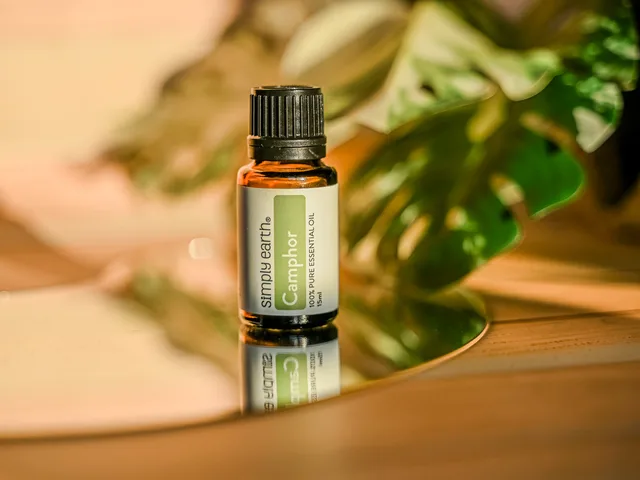
BEST FOR: WARMING MASSAGE BLENDS
This is the best-evidenced entry on the list, and unusually it was measured in people rather than in a dish. A 2014 study in human volunteers found that camphor produced both cold and warm sensations and increased blood flow in skin and muscle — which is precisely the double sensation you get from a camphor rub, and the reason it feels like it is doing something within a minute of going on.
KATIE'S TIP
This is why camphor and a massage go together so well. Work it in properly rather than dabbing it on, and give it sixty seconds before you decide whether you have used enough.
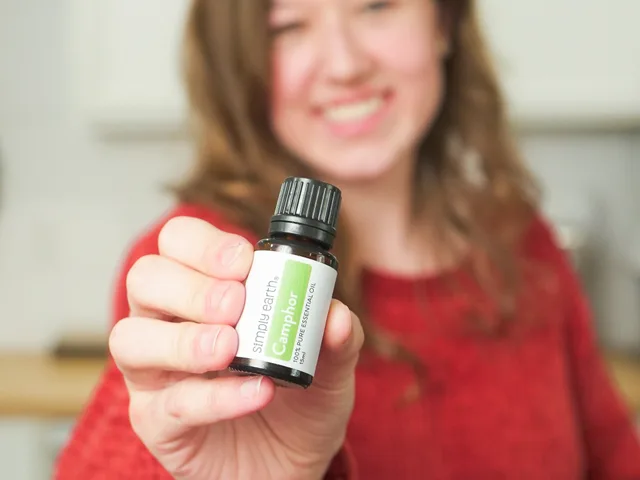
BEST FOR: BODY OILS, NOT FACE OILS
Tightens is the first use on Simply Earth's own list, and the research behind it is genuinely interesting — a 2015 study found camphor encouraged proliferation and anti-senescence activity in human dermal fibroblasts and reduced UV-induced wrinkling in mouse skin. Both halves of that are worth stating plainly — cells in a dish and mouse skin, not a human trial. It is a reason to find camphor interesting in a body oil, not a reason to put a strong oil with a 5% ceiling on your face.
KATIE'S TIP
If you want camphor's character in a skincare blend, use it at the very bottom of its range and let a gentler oil do the work. Ho Wood, from the same tree, is the one I would actually reach for on skin.
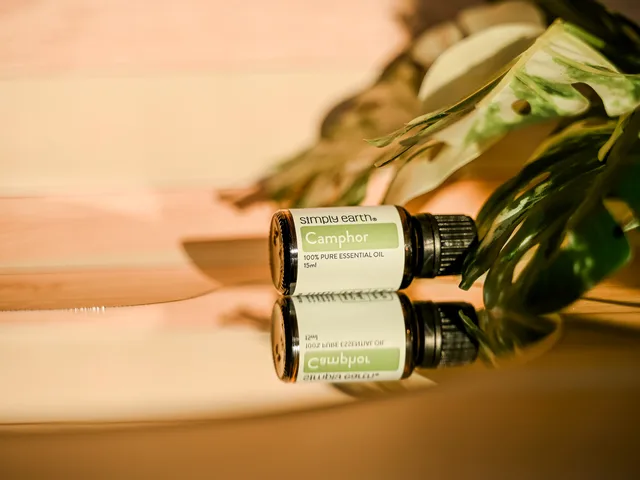
BEST FOR: SUMMER ROLL-ONS, CANDLES AND DRAWER SACHETS
Deters Insects is the seventh use on Simply Earth's product record, and it is the practical, non-therapeutic job a lot of people are really shopping for. You can see it in what Simply Earth actually publishes — of the camphor recipes on the blog, three are insect-repellent recipes — lotion bars, a citronella-style candle and a roll-on — all built around this oil. Camphor blocks have been tucked into wardrobes and drawers for generations for the same reason, and the oil carries the aromatic compounds that job depends on.
KATIE'S TIP
For a wardrobe, put a few drops on an unfinished wooden block or a cotton pad and tuck that in — never straight onto wool or linen, which can mark. Refresh it every few weeks.


Put It to Work
12 Ways to Use Camphor Essential Oil
Diffuse
- • Clear a stuffy room — 3 to 4 drops, 30 minutes at a time
- • A morning wake-up blend with Rosemary and Lemon
- • An evening winter blend with Lavender to soften the medicinal edge
Topical (always diluted)
- • A warming muscle rub for shoulders, neck and calves
- • A stiff-joint balm for knees, elbows and knuckles
- • A clarifying foot oil — one drop per tablespoon of carrier
Household
- • A bug-deterrent room and doorway spray for summer
- • A wardrobe or drawer sachet to keep moths off wool
- • A purifying boost in a homemade surface spray
DIY
- • A vapor-style chest balm with beeswax and coconut oil
- • Insect-repellent lotion bars for camping and hiking
- • Poured candles for the porch and the patio table
Know the Difference
Camphor vs. Ho Wood vs. Brown Camphor
All three columns are the same botanical species, Cinnamomum camphora, which is the single most confusing thing about this oil. What separates them is the chemotype and the fraction. White camphor is the cineole-rich fraction and the only one used in aromatherapy — it is what Simply Earth sells, and SE's own records name it: the historical product listing is Camphor Essential Oil (white). Ho Wood is the same tree distilled from twig and bark with a linalool chemotype, which makes it far gentler — kid-safe from age 2, and safe around cats and dogs, where camphor is neither. Brown and yellow camphor are the safrole-rich fractions; safrole is a restricted compound and these are not used in aromatherapy or sold by Simply Earth.
Swipe to compare →
Camphor (White) The subject of this page | Ho Wood Same tree, different chemotype | Brown & Yellow Camphor The fractions aromatherapy does not use | |
|---|---|---|---|
| Botanical Name | Cinnamomum camphora | Cinnamomum camphora | Cinnamomum camphora |
| Main Constituents | 1,8-Cineole, alpha-Pinene, Limonene, Camphor | Linalool, trans-Linalool oxide | High in safrole |
| Origin | China | China | Varies |
| Plant Part | Wood | Twig & bark | Wood |
| Aroma | Fresh and medicinal, penetrating and nose-opening | Woody and floral, much softer | Heavy and crude |
| Kid Safe | Yes, from age 10 | Yes, from age 2 | N/A — not sold by Simply Earth |
| Pregnancy & Breastfeeding | No — avoid both | Yes, consult your doctor | N/A — not sold by Simply Earth |
| Cat & Dog Safe | No — neither | Yes, both | N/A — not sold by Simply Earth |
| Max Dilution | 5% | 5% | N/A — not sold by Simply Earth |
| Best For | Muscles, joints, stuffy rooms, deterring insects | Calming, skin, blends safe around kids and pets | Industrial use, not aromatherapy |
| Simply Earth | This page's oil | — | — |
Perfect Pairs
Camphor Blends Well With…
This is Simply Earth's own blending list for camphor. Lavender and German Chamomile soften its medicinal edge, Rosemary and Cajeput lean into it for muscle and breathe-easy blends, and Melissa or Basil lift it. Camphor has a blending factor of 5, so add it a drop at a time — it will happily dominate anything you put it next to.
Where It Comes From
A Tree That Outlives the People Who Plant It
The camphor tree is native to Japan and Taiwan, and spread from there into the warm, humid parts of Asia and beyond — India, Sri Lanka, and eventually South Africa. It is an evergreen that can reach 35 metres, and Simply Earth's own sourcing record notes two things about it that put the oil in perspective: a camphor tree takes more than fifty years before it will yield oil at all, and it can live through a millennium.
Ayurvedic practitioners have used camphor for a very long time, across a range far wider than the muscle rub it is known for in the West. Its most striking historical moment came in fourteenth-century Europe, where camphor was used as a disinfectant during the bubonic plague — one of those details that tells you how highly a strong, clean-smelling aromatic was valued before anyone understood why it worked.
What has not changed is the part of the tree the oil comes from. Simply Earth's camphor is steam-distilled from the wood, which is why it smells the way it does: sharp, clean and penetrating rather than sweet or green.
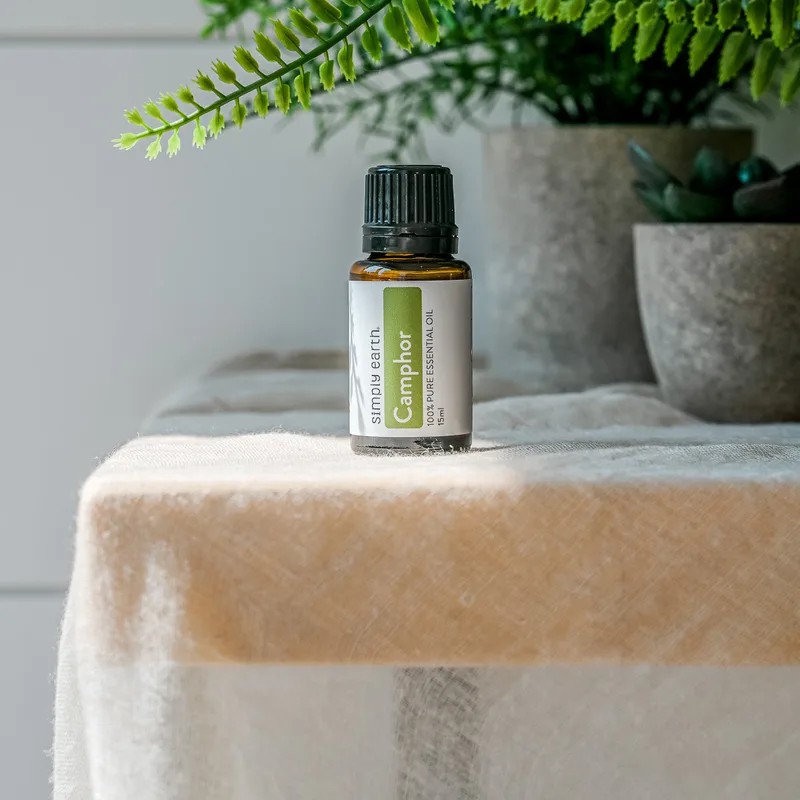
What's Inside
The Science Behind Camphor Essential Oil
Four main constituents, taken straight from Simply Earth's product record for this oil.
1,8-Cineole
The nose-opening one
Cineole is what gives camphor its characteristic clean, camphoraceous smell, and it is the compound shared with Eucalyptus and Rosemary. It is the constituent most associated with camphor's reputation around stuffy rooms and easier breathing, and its presence is also how you tell the white fraction apart from the others.
alpha-Pinene
The fresh, forest note
Alpha-pinene is one of the most widespread compounds in the plant world, the smell of pine needles and fresh-cut wood. In camphor it sits underneath the cineole and rounds it out, and it is widely studied for anti-inflammatory and antimicrobial activity.
Limonene
The bright edge
Limonene is the citrus compound, found in the peel of every orange and lemon. It is present in smaller amounts here and it lifts the blend, keeping camphor from reading as purely medicinal. It is also the compound that makes camphor pair so easily with Lemon and Melissa.
Camphor
The compound the tree is named for
Camphor itself is a main constituent of the oil, and it is the one responsible for the warm-then-cool sensation on skin. That double sensation is not imagined — it is the effect measured in the human blood-flow study behind the circulation benefit above, and it is also the reason this oil has a 5% ceiling rather than the usual higher limits.
Every bottle is third-party tested, and Simply Earth publishes the results — batch-specific GC/MS reports are available with every bottle.
See the current batch reportSimply Earth Sourcing
How We Source Camphor
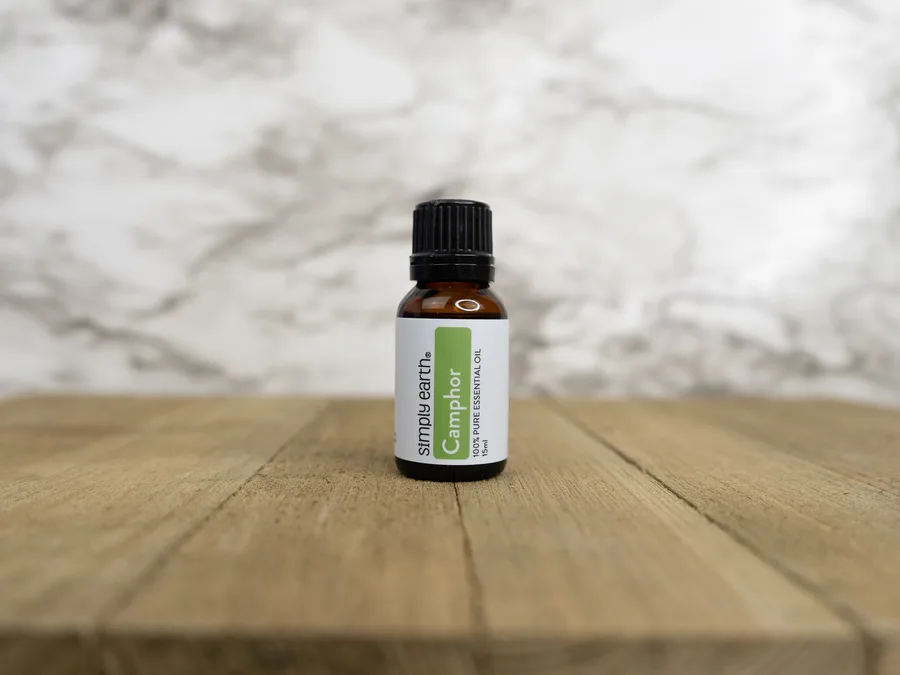
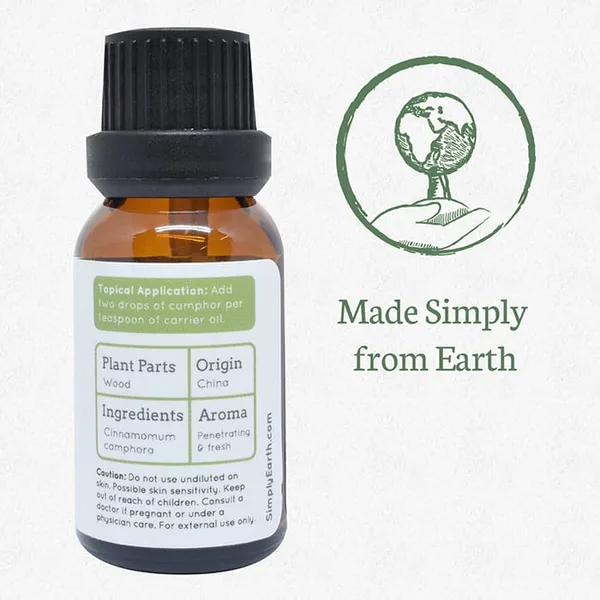
Simply Earth's camphor comes from China, steam-distilled from the wood of Cinnamomum camphora. That is the origin on our own product record and on our sourcing infographic, and it is the white fraction — the cineole-rich one aromatherapy uses — not the safrole-heavy brown or yellow fractions sold for industrial purposes.
Every batch is third-party GC/MS tested and the report is available with the bottle, which for an oil sold in several very different fractions matters more than usual: the certificate is how you know which one you actually have.
China
Where It's Grown
Wood
Plant Part
Public
GC/MS Results
Use It Right
Safety & Dilution Guide
Camphor asks more of you than most oils. It is a strong oil with a low ceiling and several firm exclusions, so read this section before you use it rather than after.
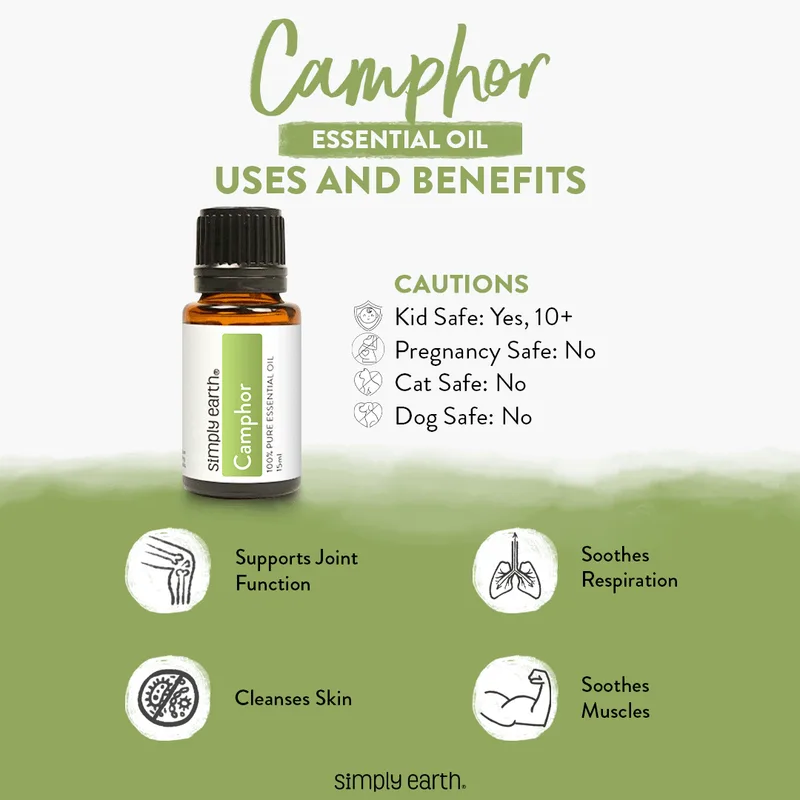
Always dilute before applying to skin. Simply Earth lists a maximum dilution rate of 5% for camphor, and most everyday uses sit well below that — the bottle's own guidance is two drops per teaspoon of carrier oil, roughly 2%. See the dilution chart for other ratios.
Not for use during pregnancy or while breastfeeding. Simply Earth's product record says no to both. Consult your doctor before use if either applies to you.
Children age 10 and up only. This is stricter than most oils in the range, many of which are safe from age 2. For a younger child, Ho Wood from the same tree is the gentler substitute.
Not safe around cats or dogs. Simply Earth lists camphor as neither cat safe nor dog safe, so keep it out of rooms your pets share and do not use it on them.
For external use only, and keep it away from your eyes. Camphor may cause skin irritation in some people, so patch test on your inner arm before the first topical use.
Do not ingest it. Simply Earth does not recommend ingesting any essential oil except under the direction of a doctor certified in aromatherapy.
Camphor is sun safe, so unlike the citrus oils it does not carry a photosensitivity warning. Shelf life is around three years — if the cap has been left off for long stretches and the oil has oxidised, replace it rather than using it on skin.
These statements have not been evaluated by the Food and Drug Administration. This product is not intended to diagnose, treat, cure, or prevent any disease.
Real Results
What Earthies Are Saying About It
"My search for camphor had been long until I found Simply Earth!! This oil is necessary for my homemade pain balm that I used to buy on the shelf paying way too much. Love to now make it a pint at a time."
Jamie A.
Verified Buyer • Camphor Essential Oil
"I used a roller and liquid coconut oil from my BONUSBOX and made a blend of cypress, camphor, and cassia for some deep sore muscles I had. I was seriously amazed on how much the pain level dulled."
Melissa H.
Verified Buyer • Cypress Essential Oil
"I love making my own creams, lotions, etc. With this bottle of Simply Earth Camphor, I will be making my own inhalers and diffuser blends to help clear out sinus gunk from all the pollen that is falling around us."
Gina K.
Verified Buyer • Camphor Essential Oil (white)
OUR SIMPLY PURE PROMISE
What Goes Into Your Products Matters
Certified 100% Pure
No fillers, no synthetics. Just pure oil.
GC/MS Third-Party Tested
Batch-specific reports with every bottle.
Ethically Sourced from Quality Farms
Responsibly harvested. People and planet first.
100%
Pure Essential Oil
No carriers, no fillers
15mL
Bottle Size
MLM brands: 10mL
Public
GC/MS Tests
MLM brands: Rarely
Your Order Changes Lives: 13% of profits fight human trafficking globally.
Common Questions
Camphor Essential Oil FAQ
The questions Earthies ask most about this oil — including the two that decide whether it is the right one for you at all.
What does camphor essential oil smell like? +
Fresh, clean and medicinal, with a penetrating quality that opens up your nose the moment you smell it. Simply Earth describes the aroma as pervasive and penetrating with a clean, nose-opening character. Some people find it sharp on its own — a drop of Lavender or German Chamomile softens it considerably.
Is camphor essential oil safe for kids? +
For children aged 10 and up, according to Simply Earth's product record. That is stricter than most oils in the range, many of which are kid safe from age 2. For a younger child, Ho Wood is the gentler option from the same botanical species.
Can I use camphor essential oil while pregnant or breastfeeding? +
No. Simply Earth lists camphor as neither pregnancy safe nor breastfeeding safe. If either applies to you, consult your doctor and choose a different oil for the job in the meantime.
What is the difference between camphor and Ho Wood essential oil? +
They come from the same tree. Camphor is distilled from the wood and is rich in 1,8-cineole, alpha-pinene, limonene and camphor. Ho Wood is distilled from the twig and bark and is a linalool chemotype, which makes it much softer in both smell and safety — kid safe from age 2 and safe around cats and dogs, where camphor is neither.
Is white camphor different from brown or yellow camphor? +
Yes, and it matters. White camphor is the cineole-rich fraction and the only one used in aromatherapy. Brown and yellow camphor are high in safrole, a restricted compound, and are not used in aromatherapy. Simply Earth sells the white fraction only.
Is camphor essential oil safe to diffuse around cats and dogs? +
No. Simply Earth lists camphor as neither cat safe nor dog safe, so keep it out of rooms your pets share and never apply it to them. Cedarwood is one alternative Simply Earth does list as safe around both.
How many drops of camphor should I use in my diffuser? +
Three to four drops is plenty for a standard diffuser, and 30 minutes at a time is more effective than running it continuously. Camphor is a strong oil, so if in doubt use fewer drops rather than more.
Can camphor essential oil be applied directly to skin? +
Never undiluted. Simply Earth sets a maximum dilution rate of 5% for camphor, and the bottle's own guidance of two drops per teaspoon of carrier oil is about 2%, which suits most everyday uses. Patch test on your inner arm first, keep it away from your eyes, and keep it off your face.

About the Author: Katie Veldkamp
Katie Veldkamp
Certified Aromatherapist · Co-Founder, Simply Earth
Katie Veldkamp is a Certified Aromatherapist and co-founder of Simply Earth. She personally formulates and reviews SE's essential oil blends and verifies all benefit claims on Simply Earth content before it goes live.
Join 20,000+ Earthies Making Their Homes Natural
New recipes, usage guides, and DIY tips — delivered free.
No spam. Unsubscribe any time.

Learn by doing
Make your own natural products every month.
The Simply Earth Recipe Box ships 4 full-size essential oils, 6 natural recipes, and everything you need to make them. No guesswork.
Start My Recipe Box$39.99 for your first box, then $49.99/month. Skip, pause, or cancel anytime.