
Nutmeg Essential Oil: Benefits, Uses & Recipes

Katie Veldkamp
Lead Certified Aromatherapist
Fact Checked & Approved
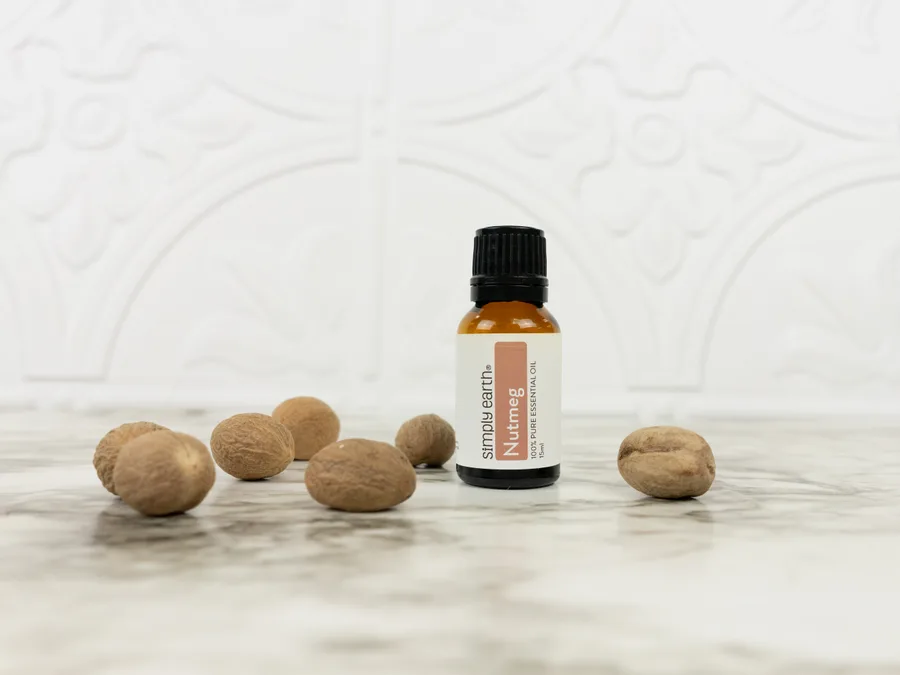
Nutmeg smells like the inside of a bakery, and that is most of why people buy it. What surprises them is how useful it turns out to be. Simply Earth's is steam-distilled from the seed of Myristica fragrans grown in Indonesia, and it has a long history behind queasy stomachs, stiff joints and muscles that have worked harder than they wanted to. It also asks for a lighter hand than almost anything else on our shelf — a special dilution rate of 1%, and no diffusing around cats or dogs. Below are seven benefits, the recipes we actually make with it, why the essential oil is not the jar in your spice rack, and the safety notes worth reading before you open the bottle.
Free Download
Nutmeg dilutes to 1%. Get the rest of the rates right too.
Get the free Essential Oil Cheat Sheet — dilution rates, safety basics and starter recipes on a single page you can keep beside your oils.
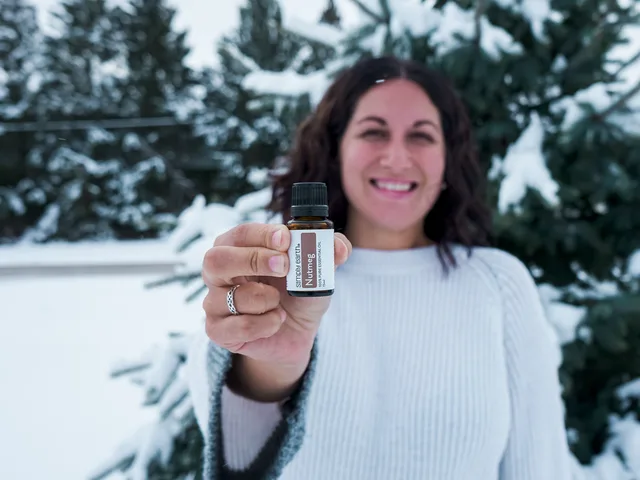
BEST FOR: HEAVY MEALS AND SLUGGISH AFTERNOONS
Nutmeg has been used to settle digestion for about as long as it has been traded, and the reference works still carry it — Hempen and Fischer's A Materia Medica for Chinese Medicine documents that traditional use. The practical version is a warm massage over the stomach, diluted to 1% in a carrier and worked in a slow clockwise circle. It is a comforting after-dinner ritual rather than a fast fix, and it is worth treating it as one.
KATIE'S TIP
Warm the carrier oil between your palms before it touches skin. Cold oil on a full stomach is nobody's idea of soothing, and it is the difference between a ritual you keep and one you try once.


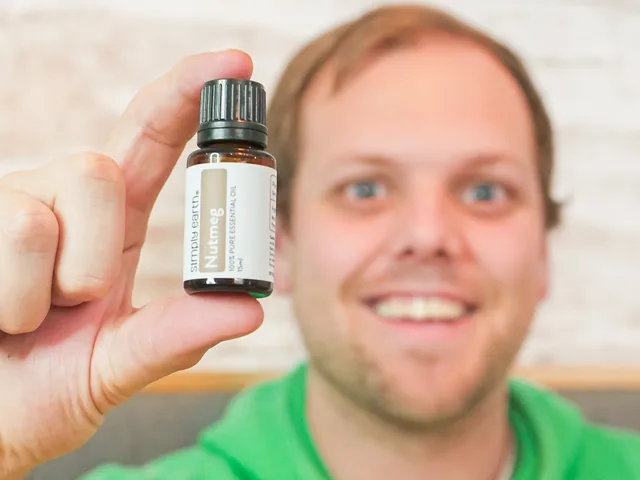
BEST FOR: GENERAL STOMACH COMFORT
The same warmth that makes nutmeg good in baking is what makes it a traditional choice for stomach comfort. A 2022 review of nutmeg essential oil's composition and pharmacological activities collects the research behind that reputation, and notes how long the seed has been used this way in traditional medicine. Use it aromatically or heavily diluted on skin — never internally, and never as a substitute for the kitchen spice.
KATIE'S TIP
Pair it with ginger. They are traditional partners, they smell far better together than either does alone, and ginger carries the warmth without nutmeg having to do all the work.
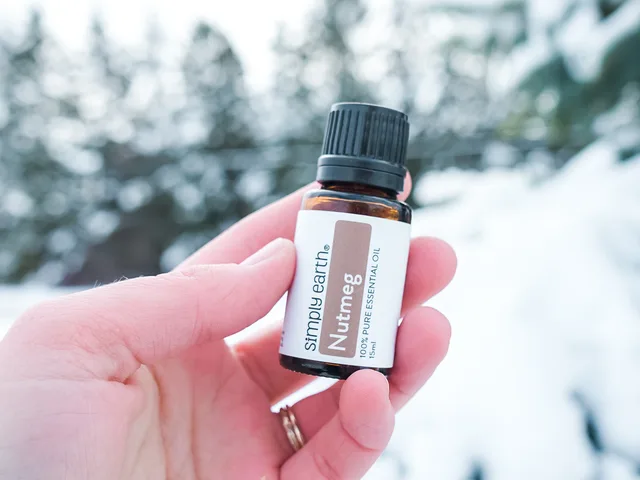
BEST FOR: COLD MORNINGS AND STIFF HANDS
Nutmeg is a warming oil, and warmth is most of what a stiff joint wants. There is research underneath the tradition too — a 2016 study found that nutmeg oil alleviated chronic inflammatory pain in vivo through inhibition of COX-2 expression and substance P release. At 1% in a carrier it makes a genuinely good addition to a hand or knee balm.
KATIE'S TIP
Blend it into a balm rather than a thin oil. A balm stays where you put it, which on a knuckle or a knee is the whole point.
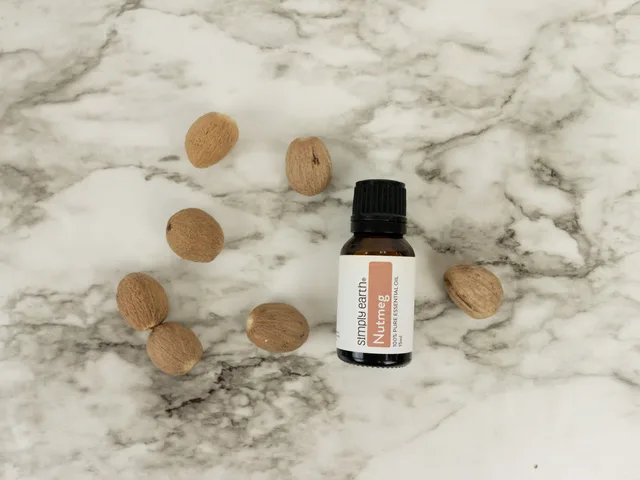
BEST FOR: OVERWORKED MUSCLES
The same 2016 study points the same way for muscles, reporting anti-inflammatory and analgesic effects for nutmeg oil. In practice a warming massage oil is a genuinely pleasant end to a physical day. Keep it at 1% and give it time rather than strength — this is not an oil that rewards using more of it.
KATIE'S TIP
If you want it in a bath, take it in on a carrier or a solubilizer first. Neat oil poured onto water sits on the surface and then lands on skin undiluted, which at 1% is exactly what you were avoiding.
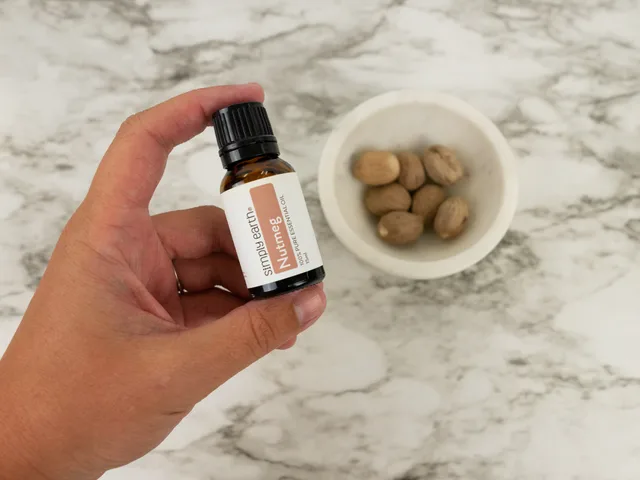
BEST FOR: AROMATIC COMFORT THROUGH THE MONTH
Nutmeg turns up in traditional preparations for monthly comfort, usually warm and diluted across the lower abdomen. A 2018 systematic review of randomised placebo-controlled trials looked at aromatherapy for managing pain in primary dysmenorrhea more broadly, which is the context this use sits in. Treat it as traditional practice with research alongside it rather than a treatment.
KATIE'S TIP
Clary sage is the usual partner here, and it happens to sit at the top of Simply Earth's own blending list for nutmeg. That is a rare case of tradition and the product record agreeing.
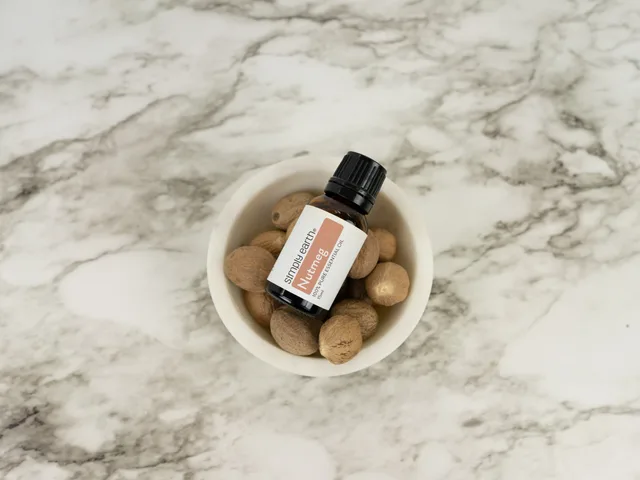
BEST FOR: EVENING WIND-DOWN
Nutmeg reads as warming rather than sedating, which makes it a useful base note in an evening blend that would otherwise feel sharp. A 2021 paper on aromatherapy formulations of essential oils looked at reducing stress and blood pressure in people, and nutmeg's role in blends of that kind is the practical version of it. One drop is usually enough.
KATIE'S TIP
One drop really is enough in a diffuser blend. Nutmeg has a blending factor of 2 for a reason and it will take over anything you put it with if you let it.
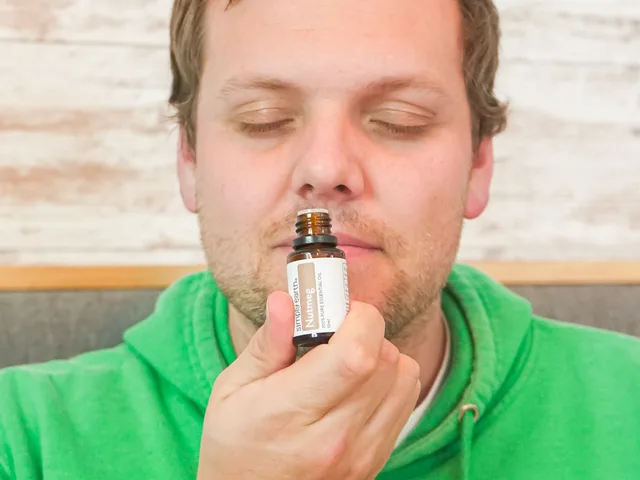
BEST FOR: SCATTERED, OVERSTIMULATED DAYS
A seed oil with a heavy, sweet-spicy profile reads as steadying — the aromatic equivalent of sitting down. Research identifying compounds in nutmeg seed oil that inhibit locomotor activity in mice is the usual citation here, and it is worth being honest that a mouse study is a long way from a claim about your afternoon. What is not in doubt is the smell, and the smell is most of the effect.
KATIE'S TIP
Try it with sweet orange. Warm and bright together is more grounding than warm on its own, which sounds backwards until you smell it.
Put It to Work
How to Use Nutmeg Oil
Diffuser
- • Start with 1 drop, not 3 — nutmeg has a blending factor of 2 and it leads
- • Pair with sweet orange, clary sage or ginger to give it something to sit against
- • Diffuse 30–60 minutes at a time rather than continuously
- • ⚠️ Not cat safe and not dog safe. Give pets a way out of the room, or pick a different oil
Topical (Rollerball)
- • 10 ml roller bottle
- • Fill with fractionated coconut oil or jojoba
- • 2 drops Nutmeg — this is roughly 1%, the published special dilution rate
- • Apply over the stomach, a stiff joint or a tired muscle. Patch test first
Candles & Wax Melts
- • Nutmeg holds up well to heat, which not every spice oil does
- • Works as the base note under lime, pine or sweet orange
- • Add the oils once the wax is off the heat, not while it is still warming
Household
- • A few drops with cinnamon on wool dryer balls, which is a real customer's use
- • Around 10 drops in a batch of homemade dishwasher powder, with lemon
- • Around 5 drops in a batch of foaming hand soap
Recipes We Make With It
- • Greet the Season Bath Salts — nutmeg with lemon and Winter Spice
- • Sugar Plum Fairy Diffuser Blend — nutmeg with lemon, spearmint and Winter Spice
- • Both are shoppable recipes with every ingredient listed. Links are in the benefit rows above
Know the Difference
Nutmeg Oil vs. the Spice Rack
The confusion worth clearing up on this page is not between varieties. It is between the essential oil and the spice, and it matters because the two are not interchangeable in either direction. Ground nutmeg is the whole seed, milled; you measure it in pinches and it ends up in custard. Nutmeg essential oil is that same seed steam-distilled, which concentrates its aromatic compounds enormously — that is why Simply Earth publishes a 1% dilution rate for it and why a single drop dominates a diffuser blend. A pinch of the spice and a drop of the oil are not the same quantity of anything. Mace is the third thing people meet, and it is genuinely interesting — it is distilled from the aril, the red lacy covering around the seed, so it comes from the same fruit without being the same oil. We do not carry it. And if a bottle will not tell you whether it is an essential oil or a fragrance oil, it has not told you anything.
Swipe to compare →
Nutmeg Essential Oil The one this page is about | Mace Essential Oil Same tree, different part | Ground Nutmeg The jar in your spice rack | Nutmeg Fragrance Oil Not an essential oil at all | |
|---|---|---|---|---|
| What It Actually Is | Steam-distilled oil from the seed of <em>Myristica fragrans</em> | Steam-distilled oil from the aril, the red lace around that same seed | The whole seed, dried and milled | A synthetic aroma compound built to smell like nutmeg |
| Part Used | Seed | Aril | Seed | No plant material at all |
| How Concentrated | Very — Simply Earth publishes a special dilution rate of 1% | Very | Mild. A whole jar is a fraction of one bottle's strength | Not measurable in the same terms |
| What It Is For | Aromatic use and heavily diluted topical use | Aromatic use | Food | Scenting products, never aromatherapy |
| Where Ours Comes From | Indonesia | Not carried by Simply Earth | Not carried by Simply Earth | Not carried by Simply Earth |
| Simply Earth | We carry this | — | — | — |
Perfect Pairs
Nutmeg Blends Well With…
Simply Earth's own blending list for nutmeg. Sweet orange is the easiest place to start — warm against bright is a combination that works immediately. Nutmeg is a middle note with a blending factor of 2 and a thin consistency, so use noticeably less of it than of whatever you are pairing it with. One drop against four is a sensible opening ratio, not a timid one.
A fun fact about nutmeg
The Spice That Redrew Maps
Nutmeg is the seed of Myristica fragrans, an evergreen that for most of recorded history grew on a very small number of islands. That scarcity did what scarcity does. Nutmeg became one of the most valuable commodities in the world, worth more by weight than most metals, and valuable enough that European powers fought wars over who controlled the islands it came from.
The monopoly eventually broke, the trees spread across the tropics, and nutmeg turned into something you buy in a supermarket without thinking about it. What did not change is the character of the oil — warm, sweet, faintly woody, unmistakably the same thing you smell when someone opens a jar of it in a kitchen.
The part worth carrying away is what distillation does to that character. The seed is picked from a fruit that has to be opened by hand, dried, and then steam-distilled, and the process concentrates the aroma enormously. A pinch of ground nutmeg in a custard and a drop of nutmeg essential oil are separated by several orders of magnitude, which is the real reason this oil has its own dilution rate.
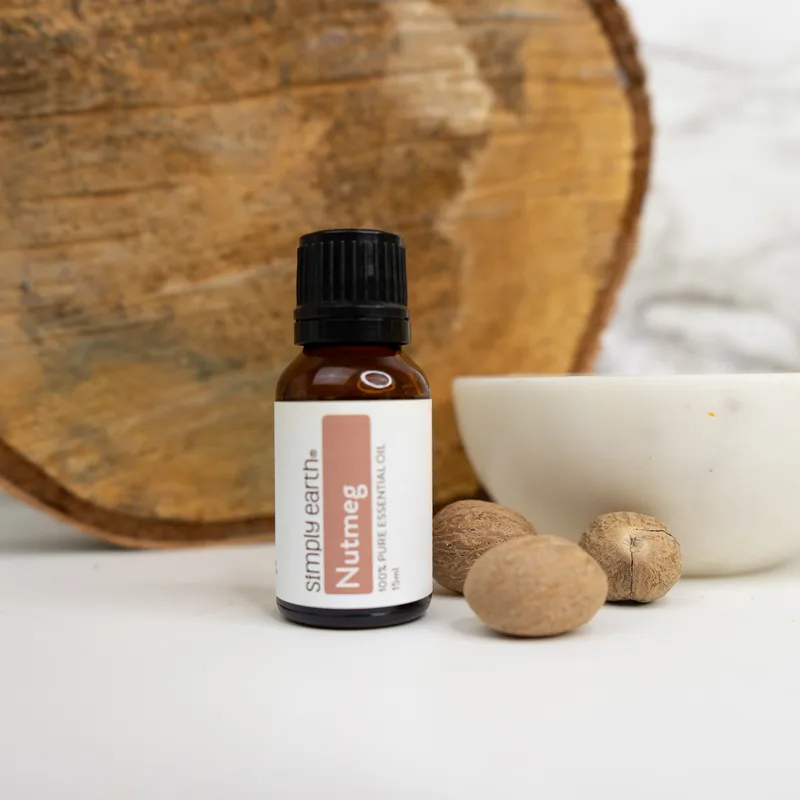
The Chemistry
The Science Behind Nutmeg Oil
Simply Earth lists three main constituents for this oil, and between them they account for nutmeg's warm, sweet, faintly woody character:
α-Pinene
The fresh edge
A monoterpene found across an enormous range of plants, and one of the most common terpenes in nature. It reads fresh and faintly pine-like, and in nutmeg it is part of what keeps a heavy, sweet seed oil from smelling cloying. It is also why nutmeg sits so comfortably next to conifer oils in a winter blend.
β-Pinene
The dry, woody underside
The structural isomer of α-pinene, and a monoterpene in its own right. It carries a drier, woodier, more resinous character, and it sits underneath nutmeg's sweetness rather than on top of it. Between the two pinenes you get most of the reason nutmeg is described as woody as often as it is described as sweet.
Sabinene
The warm-spicy note
A bicyclic monoterpene that carries much of what people actually mean by the smell of nutmeg — warm, peppery and spicy. It is found in black pepper too, which is a useful thing to know when you are trying to work out why a blend smells the way it does. It is the constituent most responsible for nutmeg reading as a spice rather than a wood.
Simply Earth's Nutmeg Essential Oil is steam-distilled from the seed of Myristica fragrans, and every bottle ships with a batch-specific GC/MS report. The constituent profile you have just read about is the general picture for this oil; the report in your box is the specific picture for the bottle in your hand, which is a meaningful difference on a crop that varies by season and by farm. See Our Testing →
Support The Source
Where Our Nutmeg Grows
Our nutmeg comes from Indonesia, which is where nutmeg has been grown for longer than anywhere else on earth. The trees are slow — they take years to come into full yield — and the harvest is unavoidably manual, because the fruit has to be opened by hand to reach the seed inside it.
That hand work is the part worth understanding, because it is where the quality is decided. A seed dried properly concentrates its aroma. A seed dried badly does not, and no amount of careful distillation afterwards will put back what was lost in the drying. It is skilled seasonal work done by people who have been doing it for generations, and it is not something a machine has taken over.
Buying farm-direct wherever we can is how we try to make that work pay properly, and testing every batch by GC/MS before it is bottled is the part we can actually prove to you. The report ships with the oil, in the same box, for the same batch.
Indonesia
Where It's Grown
Seed
Plant Part
Public
GC/MS Results
Use It Safely
Things to Remember When Using Nutmeg Oil
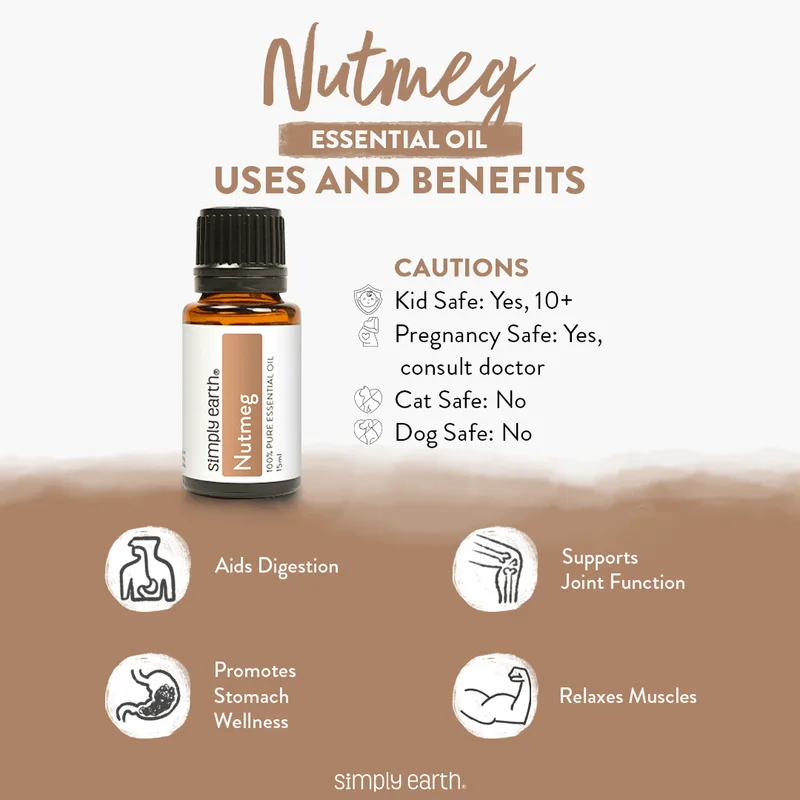
Dilute to 1%. Simply Earth publishes a special dilution rate of 1% for nutmeg, which is stricter than the general guidance for most oils. That is roughly 1 drop per 5 ml of carrier, or 2 drops in a 10 ml roller bottle. Never apply it neat.
In large amounts it can cause toxic symptoms. Simply Earth's own caution names nausea and tachycardia. This is the reason for the 1% rate, and it is the one line on this page worth taking literally. More is not better with this oil — it is worse.
Not cat safe and not dog safe. Do not apply it to an animal, and give pets a way out of the room before you diffuse. If a pet cannot leave, pick a different oil rather than a smaller number of drops.
Children aged 10 and over only. For a younger child, choose a gentler oil instead of reducing the dose.
Pregnant or breastfeeding — yes, but consult your doctor first. Simply Earth lists nutmeg as usable in both cases with medical advice, which is a different answer from a flat yes.
Sun safe. Nutmeg is not phototoxic, so it does not carry the sunlight restriction that the citrus oils do.
External use only, and keep it away from your eyes. The essential oil is not the kitchen spice and is never a substitute for it in food.
Shelf life is 3 years. Store it closed, out of direct light, and away from heat.
A note on myristicin. Myristicin is the compound usually named as the reason for nutmeg's toxicity-in-quantity caution. It is not listed in Simply Earth's main-constituents field for this oil, so we are not presenting it as part of our published profile — but it is the chemistry behind the warning above, and it is why the dilution rate is what it is.
Real Results
What Earthies Are Saying
"This nutmeg oil has such a comforting smell, it's warm and spicy. It's very similar to the powdered spice you use for cooking, but not exactly the same. I've been blending it with other spicy oils and fruity oils in my diffuser for an array of different calming scents throughout my home."
Dawne Ackerson
Verified Buyer • Nutmeg Essential Oil
"Perfect essential oil to start getting you in the mood for fall!! It has a warm scent with some sweet and spicy notes to it and I can't wait to use it in a variety of diffuser blends!"
Cynthia Olgren
Verified Buyer • Nutmeg Essential Oil
"I put a few drops of cinnamon and nutmeg essential oils on the wool dryer balls for my laundry. It is delightful to be pulling on a t-shirt and getting the comforting scents. Very enjoyable."
Theresa Stewart
Verified Buyer • Cinnamon Leaf Essential Oil
OUR SIMPLY PURE PROMISE
What Goes Into Your Products Matters
Certified 100% Pure
No fillers, no synthetics. Just pure oil.
GC/MS Third-Party Tested
Every batch independently verified.
Ethically Sourced from Quality Farms
Responsibly harvested. People and planet first.
15mL
Bottle Size
MLM brands: 10mL
Indonesia
Where It's Grown
Seed-distilled, farm-direct
Public
GC/MS Tests
MLM brands: Rarely
Your Order Changes Lives: 13% of profits fight human trafficking globally.
Nutmeg Essential Oil FAQ
The questions people actually ask about nutmeg — starting with the two that matter most, which are how much to use and how it differs from the spice.
What is nutmeg essential oil good for? +
Simply Earth lists seven uses — aiding digestion, promoting stomach wellness, supporting joint function, relaxing muscles, supporting women's wellness, calming and centering. In practice it splits into two jobs. It is a warming oil for stomachs, joints and tired muscles when it is diluted to 1% in a carrier, and it is a base note that makes a spice blend smell like a kitchen in December when it is diffused. It is also a genuinely good cleaning oil, which surprises people.
Is nutmeg essential oil the same as ground nutmeg? +
No, and this is the confusion worth clearing up. Ground nutmeg is the whole seed milled into a spice, measured in pinches and used in food. Nutmeg essential oil is that same seed steam-distilled, which concentrates its aromatic compounds enormously. That is why Simply Earth publishes a 1% dilution rate for the oil and why one drop takes over a diffuser blend. The oil is not a cooking ingredient and should not be used as one.
How much should I dilute nutmeg essential oil? +
To 1%. Simply Earth publishes this as a special dilution rate for nutmeg, which is stricter than the general-purpose guidance most oils get. In practice that is about 1 drop per 5 ml of carrier oil, or 2 drops in a 10 ml roller bottle. Never apply it neat, and patch test on the inner arm before you use it more widely.
Is nutmeg essential oil safe for cats and dogs? +
No. Simply Earth lists nutmeg as neither cat safe nor dog safe. Never apply it to an animal, and always give pets a way out of the room before you diffuse it. If a pet cannot leave the room, use a different oil rather than fewer drops — the answer here is not a smaller dose.
Can nutmeg essential oil be toxic? +
In large amounts, yes, and Simply Earth says so directly — its caution names nausea and tachycardia. This is the reason nutmeg carries a 1% dilution rate rather than the usual guidance. Used at that rate, aromatically or topically on intact skin, it is a well-established oil with a long history. The risk comes from quantity, so respect the dilution rate and never ingest it.
Is nutmeg essential oil safe during pregnancy? +
Simply Earth lists it as safe during pregnancy and while breastfeeding, with the qualification that you should consult your doctor first. That is a different answer from an unqualified yes, and given that nutmeg already carries the strictest dilution rate on our shelf, it is worth actually having the conversation rather than assuming.
What does nutmeg essential oil smell like? +
Warm, sweet, spicy and faintly woody — recognisably the same smell as the jar in your spice rack, but far more concentrated and with more of a woody edge underneath. Simply Earth describes the aroma as spicy and nutty. It is a middle note with a blending factor of 2 and a thin consistency, so it leads a blend easily. Use less of it than you think you need.
Which recipes actually use nutmeg essential oil? +
Two of our shoppable recipes call for nutmeg by name in the ingredient list — Greet the Season Bath Salts, which pairs it with lemon and Winter Spice, and the Sugar Plum Fairy Diffuser Blend, which adds spearmint. Both are linked in the benefit rows above with every ingredient listed. Nutmeg is also an ingredient inside our Gingerbread and Pumpkin Spice blends, though those recipes call for the finished blend rather than for the single oil.
Where does Simply Earth's nutmeg come from? +
Indonesia, where the trees take years to reach full yield and the fruit is opened by hand to reach the seed. We buy farm-direct wherever we can and publish a batch-specific GC/MS report with every bottle, so the constituent profile you get belongs to the oil that is actually in your box.


About the Author: Katie Veldkamp
Katie Veldkamp
Certified Aromatherapist · Co-Founder, Simply Earth
Katie Veldkamp is a Certified Aromatherapist and co-founder of Simply Earth. She personally formulates and reviews SE's essential oil blends and verifies all benefit claims on Simply Earth content before it goes live.
Join 20,000+ Earthies Making Their Homes Natural
New recipes, usage guides, and DIY tips — delivered free.
No spam. Unsubscribe any time.

Learn by doing
Make your own natural products every month.
The Simply Earth Recipe Box ships 4 full-size essential oils, 6 natural recipes, and everything you need to make them. No guesswork.
Start My Recipe Box$39.99 for your first box, then $49.99/month. Skip, pause, or cancel anytime.