
Melissa Essential Oil — Rare, Expensive, and Worth Understanding Before You Buy

Katie Veldkamp
Lead Certified Aromatherapist
Fact Checked & Approved
Melissa is the most expensive oil on our shelf, and the reason is not markup. The plant gives up so little oil when it is distilled that the cost per bottle is extremely high before anyone adds a margin. That single fact explains almost everything else about this oil — why a 5mL bottle costs what a whole set of citrus oils costs, why so many people meet it as lemon balm tea long before they meet the oil, and why it pays to know exactly what you are looking at when you shop. Here is what melissa does, what it is made of, where ours grows, and how to tell it apart from the far cheaper oils that lead on the very same compounds.
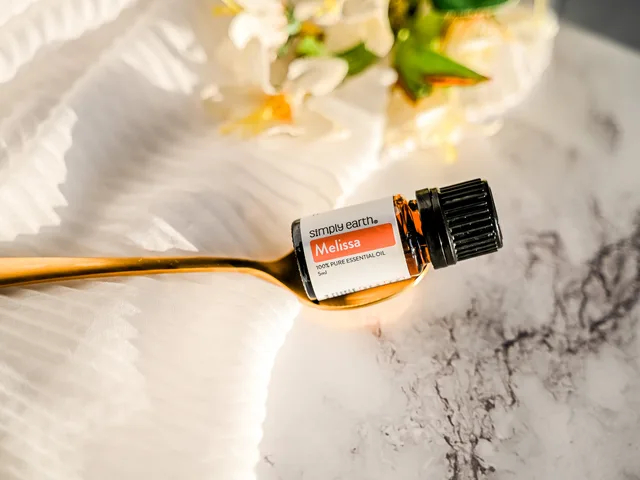
BEST FOR: LOW MOODS, HEAVY DAYS & DIFFUSING
Uplifting is the first use Simply Earth lists for melissa, and it is the one the oil is best known for. It manages the unusual trick of being revitalising and calming at the same time — it lifts without winding you up. A 2004 study at the Human Cognitive Neuroscience Unit found melissa attenuated laboratory-induced stress in humans after a single dose, which is a rare thing to be able to point at for an oil with this long a folk reputation.
KATIE'S TIP
Two drops is plenty. Melissa is potent and expensive in equal measure, and it carries a room far better than its price tag makes you expect — start low and you will be surprised.
USE IT IN →

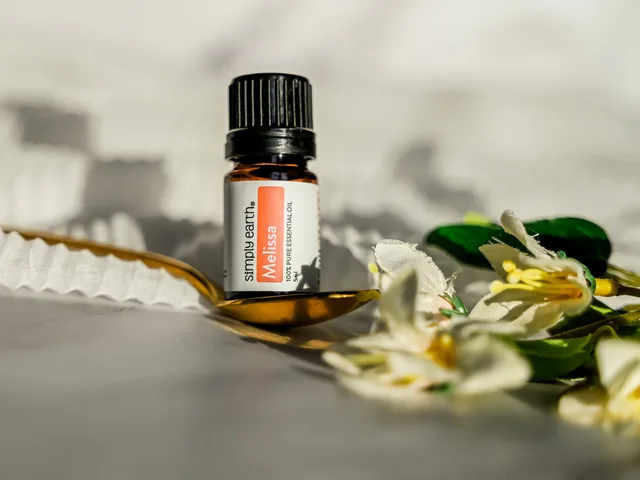
BEST FOR: BEDTIME ROUTINES & RESTLESS EVENINGS
This is the strongest research on the page. A 2006 study of a valerian and lemon balm combination reported improvement in restlessness and dyssomnia symptoms in children of roughly 70 to 80 percent. Lemon balm and melissa are the same plant — Melissa officinalis — so this is research about the plant in your bottle rather than a distant relative. It is why melissa turns up in so many wind-down routines.
KATIE'S TIP
Diffuse it about half an hour before bed rather than at bedtime. The ritual of starting the diffuser early is doing as much work as the oil is.
USE IT IN →


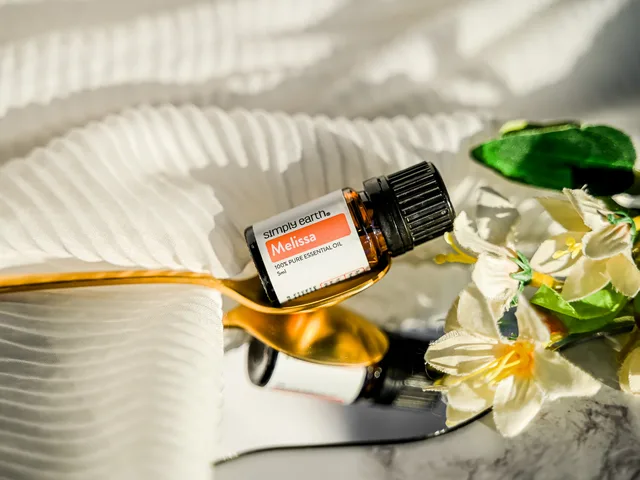
BEST FOR: AFTER MEALS & UNSETTLED STOMACHS
Lemon balm has been a kitchen herb for centuries, and the oil carries that association into aromatherapy. Two separate reviews support it — a 2010 study on a cold dessert with added digestive herbs in people with functional dyspepsia, and a 2005 evidence-based systematic review of lemon balm by the Natural Standard Research Collaboration covering nausea. For everyday use this is a diluted-massage or diffusing oil, never an ingested one.
KATIE'S TIP
Diluted properly and massaged over the stomach in a slow clockwise circle is the traditional way to use it. Never take it internally.
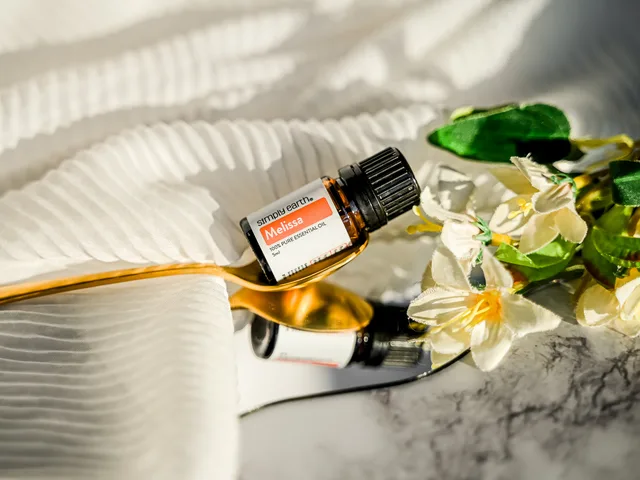
BEST FOR: LOTIONS, BALMS & FACIAL OILS
Soothing skin is the second use Simply Earth lists for this oil. It is an easy one to overlook because melissa's aroma is so assertive that people assume the oil must be harsh — it is not. In practice it earns its place in a facial oil or a balm where you want something calming rather than active, and where you are working in very small quantities anyway.
KATIE'S TIP
One drop in a whole facial oil is genuinely enough. With an oil at this price, that is a feature rather than a compromise.
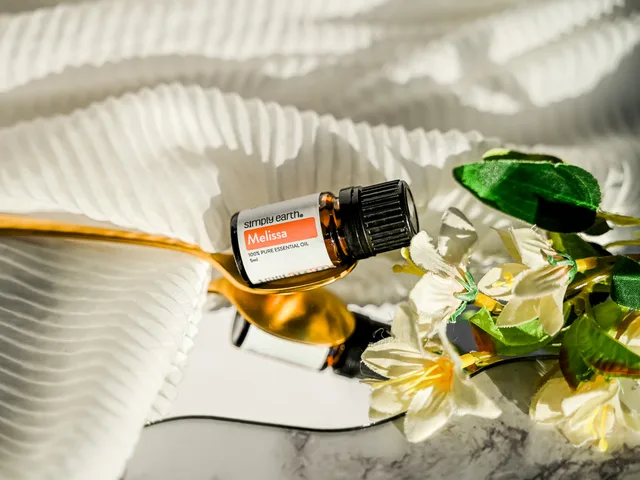
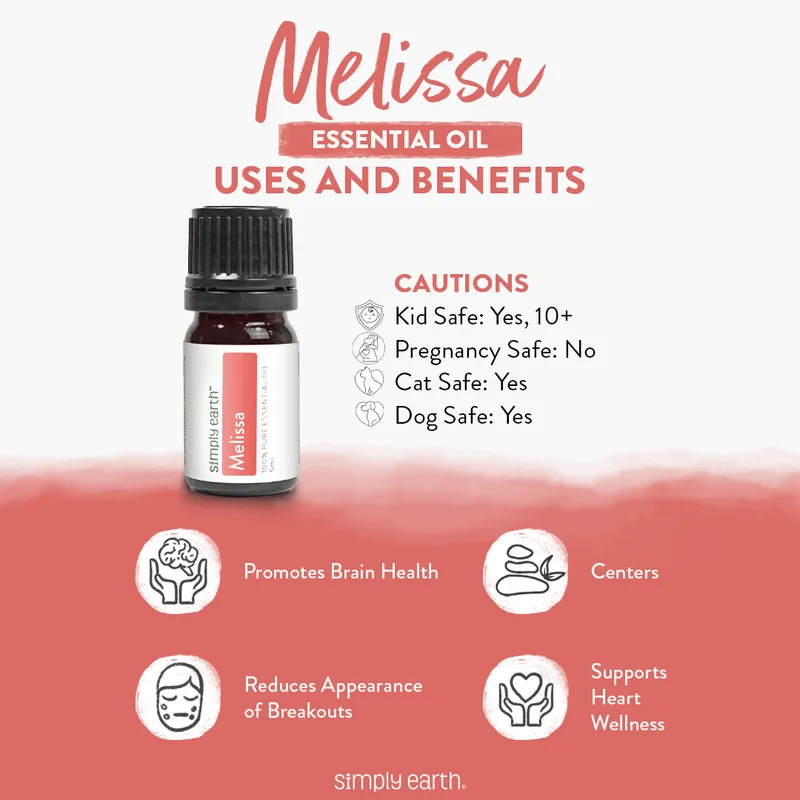
Melissa Reduces the Appearance of Breakouts
A Small-Quantity Oil for a Small-Area Problem
 Shop Melissa
BEST FOR: SPOT TREATMENTS & CLARIFYING BLENDS
Simply Earth lists reducing the appearance of breakouts among melissa's uses, and it fits the oil's chemistry — citral, the compound pair that gives melissa its lemon character, has documented antimicrobial activity. It suits a targeted, diluted blend rather than an all-over treatment, which happens to be the only sensible way to use an oil this precious.
KATIE'S TIP
Always dilute, always patch test, and keep it off broken skin. Stronger is not better here — it never is with a citral-rich oil.
BEST FOR: STUDY SESSIONS & FOGGY AFTERNOONS
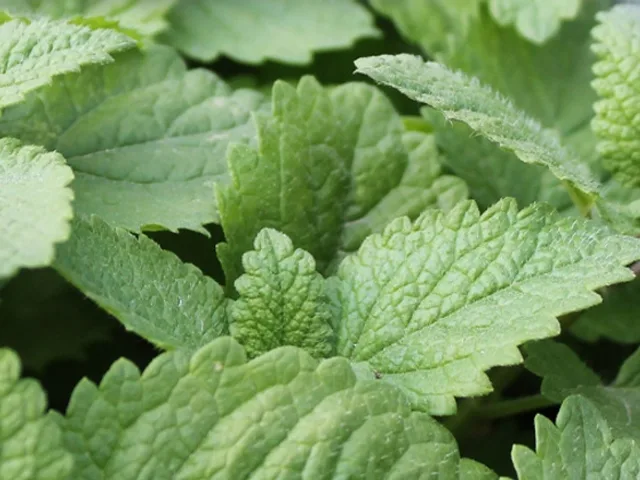
Promoting brain health heads Simply Earth's own list of melissa's uses. Lemon balm has one of the longest continuous records of any herb used for mental clarity and memory in European herbalism, and the 2004 stress study sits underneath this one too — much of what reads as clearer thinking is a calmer baseline rather than stimulation. Diffuse it when you need to settle enough to concentrate.
KATIE'S TIP
This is not a wake-you-up oil like peppermint. It is the one for when you are too scattered to focus, not too tired.
BEST FOR: MEDITATION, JOURNALING & RESET MOMENTS
Centering is the use that is hardest to measure and easiest to recognise once you have used the oil. Melissa has been used for centuries to support spiritual, mental and emotional wellbeing, and it remains one of the oils people reach for when they want to feel gathered rather than merely relaxed. It is a fitting use for a plant the physician Paracelsus called the Elixir of Life.
KATIE'S TIP
I keep melissa for the moments that actually warrant it. Making it the oil you only open on purpose is part of why it works.
USE IT IN →

Put It to Work
How to Use Melissa Essential Oil
Diffuser — the basics
- • 1–3 drops is plenty; melissa is potent and carries a room
- • Diffuse 30–60 minutes at a time rather than continuously
- • Give pets a way out of the room before you diffuse
- • Start twenty minutes before you want the room to feel different
Orchard Wanderer Diffuser Blend
- • 5 drops Sweet Orange
- • 2 drops Melissa
- • 1 drop Eucalyptus
- • Add to your diffuser with water — bright and orchard-sweet, good for mornings
Flora Aura Diffuser Blend
- • 3 drops Melissa
- • 2 drops Roman Chamomile
- • 1 drop Palmarosa
- • Add to your diffuser with water — the softest of the four, made for winding down
Equinox Echo Diffuser Blend
- • 3 drops Beauty Within
- • 2 drops Cedarwood (Virginian)
- • 1 drop Melissa
- • Add to your diffuser with water — grounded and woody, with melissa lifting the top
Thyme Out Diffuser Blend
- • 3 drops Roman Chamomile
- • 1 drop Melissa
- • 1 drop Thyme
- • Add to your diffuser with water — herbal and clean, a good reset for a stuffy room
Topical (Roller)
- • 10ml roller bottle
- • 9ml fractionated coconut oil or jojoba
- • 2 drops Melissa gives roughly a 1% roller — start there
- • Patch test on the inner arm before the first full use
Know the Difference
Melissa vs. Lemongrass vs. Citronella
This is the comparison worth understanding before you spend anything. Look at the constituents row. Melissa leads on geranial and neral — together these are citral, the pair responsible for its lemon character. Lemongrass leads on the same two compounds. They are different plants from different families growing on different continents, but a lemony, citral-forward aroma is something all three of these oils can give you, and one of them costs a fifth of what melissa costs. None of this makes the cheaper oils lesser — lemongrass and citronella are excellent at what they do. It does mean that aroma alone cannot tell you what is in a bottle sold as melissa, and that a batch-specific GC/MS report is the only thing that can. Simply Earth publishes one for every lot.
Swipe to compare →
Melissa The subject of this page | Lemongrass Same lead compounds | Citronella The other lemony grass | |
|---|---|---|---|
| Botanical Name | Melissa officinalis | Cymbopogon flexuosus | Cymbopogon winterianus |
| Also Called | Lemon balm, sweet balm | Lemongrass | Java citronella |
| The Plant | A leafy perennial herb in the mint family | A tall tropical grass | A tall tropical grass |
| Plant Part | Leaf & Flower | Grass | Grass |
| Origin at Simply Earth | Bulgaria | India | Indonesia |
| Aroma | Herbal & lemony | Earthy & citrusy | Fresh & citrusy |
| Main Constituents | Geranial, trans-β-caryophyllene, Neral | Geranial, Neral, Geranyl acetate | Citronellal, Geraniol, Citronellol |
| Price at Simply Earth | $59.99 / 5mL | $11.99 / 5mL | $11.99 / 5mL |
| Simply Earth | This page's oil | — | — |
Perfect Pairs
Melissa Blends Well With…
Melissa has a blending factor of 1, which is the lowest on our scale — it means a single drop goes a very long way in a blend. Add it last and add less than you think.
The Elixir of Life
History of Melissa Essential Oil
Melissa is steam-distilled from the leaf and flower of Melissa officinalis, a leafy perennial in the mint family that most of the world knows by its English name, lemon balm. The botanical name comes from the Greek word for honey bee, and it was earned honestly — the plant is so attractive to bees that beekeepers have historically rubbed it inside empty hives to encourage a swarm to settle.
Its reputation in European herbalism is unusually long and unusually consistent. It was grown in monastery gardens, carried into kitchens as a cooking herb, and prescribed for the nerves, the stomach and the spirits in roughly equal measure — the same three areas the oil is still used for today. The Swiss-born physician and alchemist Paracelsus called it the Elixir of Life, which is the kind of endorsement that tends to stick to a plant for several centuries.
What surprises people is the gap between the herb and the oil. Lemon balm is one of the easiest plants in the world to grow — it spreads enthusiastically in an ordinary garden — yet the essential oil is among the most expensive you can buy. The plant simply yields very little oil when distilled, which makes the cost per bottle extremely high. The herb is generous. The oil is not.
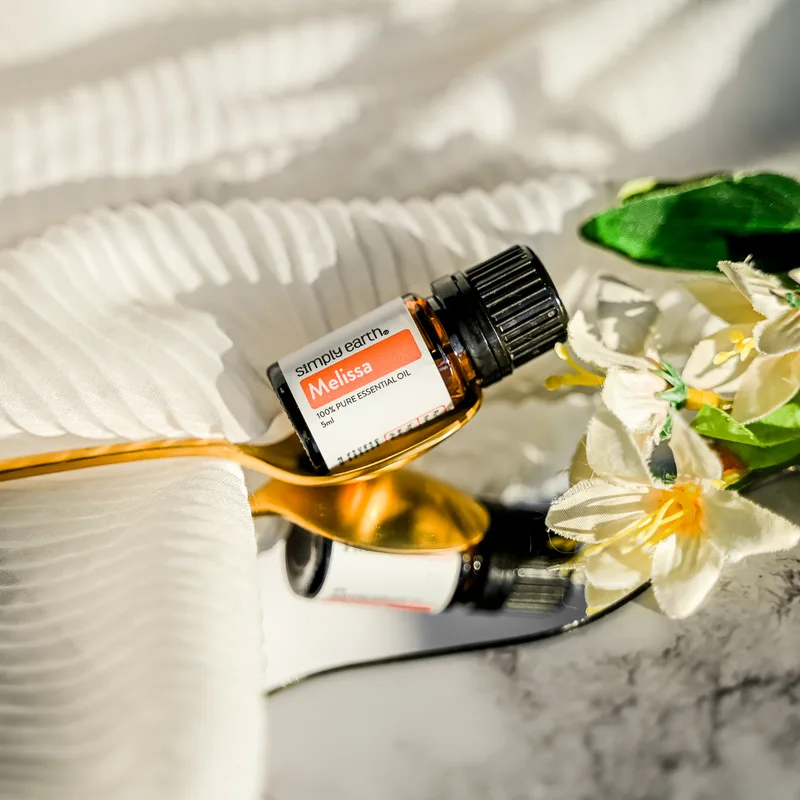
The Chemistry
The Science Behind Melissa Essential Oil
Melissa's aroma comes down to one compound pair — and that same pair is why a GC/MS report matters more on this oil than on almost any other.
Geranial & Neral
Together, citral · The signature pair
Neral and geranial are geometric isomers of citral, the component that gives melissa its strong lemon character and makes it a long-standing favourite in perfumery. Citral also has documented antimicrobial activity, which is the chemistry underneath melissa's traditional use on skin. This pair is also the reason melissa and lemongrass can smell like relatives — lemongrass leads on the same two compounds.
Germacrene D
Produced in the melissa plant
A sesquiterpene noted for antimicrobial and insecticidal properties. In the living plant it is part of how melissa defends itself, and in the bottle it contributes to the oil's usefulness in household and skin applications rather than to its aroma.
β-caryophyllene
Listed on Simply Earth's own constituent list
One of the most widely distributed sesquiterpenes across plant species, and the third compound Simply Earth names for this oil. It rounds out the aroma, giving melissa a warm, faintly peppery depth underneath the lemon that keeps the oil from reading as one-dimensionally citrus.
Simply Earth third-party GC/MS tests every batch of melissa and publishes the reports by lot — NP0101, K0G0208S and G0D1111D are all live right now — so the numbers for the bottle you actually receive are available to you, not just to us. On an oil this expensive, that is the only real proof of what you bought. We never blend our oils with synthetic fragrance, fillers or extenders. See Our Testing →
Support The Source
Where Our Melissa Comes From
Simply Earth's melissa comes from Bulgarian Essential Oils, in the Dobrudja region of Bulgaria. Naming the farm matters more than usual on this oil. When a product is expensive and hard to verify by smell, "sourced from Europe" is not an answer — it is a way of avoiding one.
The melissa plant thrives in the Bulgarian climate, which is what made this partnership worth building rather than simply buying on a spot market. The company has implemented strict operational procedures prohibiting the use of harmful chemicals during the growing process. That is good for the land, and it is also part of how the oil stays clean enough to stand up to the batch testing we publish.
The part we are proudest of is not agronomic. Workers at Bulgarian Essential Oils are paid more than a fair wage and given serious training and on-the-job experience — including the option to branch out and grow melissa on their own account. A supply chain that creates growers instead of only employing pickers is a rarer thing than good soil.
We have been to the farm, and the visit is on our YouTube channel as Melissa: Straight From Bulgarian Essential Oils, Bulgaria. Every batch is third-party GC/MS tested and the results are published by lot.
Bulgaria
Where It's Grown
Leaf & Flower
Plant Part
Public
GC/MS Results
Use It Right
Things to Remember When Using Melissa
Always dilute before applying to skin. Melissa is potent and a little goes a long way — 2 drops in 10ml of carrier oil is roughly a 1% roller and is a sensible place to start. See our dilution chart.
Not for use during pregnancy or breastfeeding. Simply Earth lists melissa as neither pregnancy safe nor breastfeeding safe. This is stricter than most oils in our range — take it at face value and speak to your healthcare provider.
Kids age 10 and up only. Simply Earth lists melissa as safe for children from age 10, which is later than most of our oils. Dilute conservatively even then, and keep bottles out of reach.
Cat safe and dog safe. Simply Earth lists melissa as safe to diffuse and use around both. Always let pets leave the room while you diffuse. More on cats and pets generally.
Sun safe. Unlike most citrus-smelling oils, melissa is not phototoxic — its lemon character comes from citral in a herb, not from a pressed citrus peel. No need to stay out of the sun after using it.
Patch test on the inner arm first. Melissa is rich in citral, and citral-heavy oils are worth introducing slowly even when they are well tolerated. Test before any full use.
Keep away from eyes and mucous membranes. If contact happens, flush with a carrier oil rather than water.
We don't recommend ingesting essential oils unless under the direction of a doctor certified in aromatherapy. More on why we don't ingest.
Shelf life is about 3 years. Store cool, dark and tightly capped. With an oil at this price, buy the size you will actually finish.
These statements have not been evaluated by the Food and Drug Administration. Essential oils are not intended to diagnose, treat, cure, or prevent any disease.
Real Results
What Earthies Are Saying
"Simply Earth's Melissa is simply the best quality ive used and a great value. Definitely recommend to anyone needing Melissa."
Michelle A.
Verified Buyer • Melissa Essential Oil
"This oil smells wonderful! It's very relaxing and puts a smile on your face. :)"
Kaye A.
Verified Buyer • Melissa Essential Oil
"I love this oil! I find it to be the strongest antiviral on the market."
Ginger
Verified Buyer • Melissa Essential Oil
OUR SIMPLY PURE PROMISE
What Goes Into Your Products Matters
Certified 100% Pure
No fillers, no synthetics. Just pure oil.
GC/MS Third-Party Tested
Every batch independently verified.
Ethically Sourced from Quality Farms
Responsibly harvested. People and planet first.
5mL
Bottle Size
A low-yield oil, in a size you'll finish
$59.99
Per Bottle
Low yield is the reason — not markup
Public
GC/MS Tests
MLM brands: Rarely
Your Order Changes Lives: 13% of profits fight human trafficking globally.
Questions
Melissa Essential Oil FAQ
Why is melissa essential oil so expensive? +
Because the plant yields very little oil. Lemon balm grows easily and abundantly, but it takes an enormous quantity of leaf and flower to distil a small amount of essential oil, which makes the distillation cost per bottle extremely high. The price reflects the raw material, not a premium positioning decision.
Is melissa essential oil the same as lemon balm? +
Yes. Melissa and lemon balm are two names for the same plant, Melissa officinalis, sometimes also called sweet balm. Research published under the name lemon balm is research about the plant in a bottle labelled melissa — which is why the rest and digestion studies on this page apply.
What is the difference between melissa and lemongrass? +
They are completely different plants — melissa is a leafy herb in the mint family, lemongrass is a tropical grass — but they lead on the same two compounds, geranial and neral. That shared chemistry is why both smell lemony, and it is why melissa costs $59.99 at Simply Earth while lemongrass costs $11.99. A GC/MS report is the reliable way to tell what is in a bottle.
How do I know my melissa essential oil is real? +
Ask for a batch-specific GC/MS report and read it. Aroma alone will not settle it, because other oils lead on the same compounds. Simply Earth publishes a GC/MS report for every lot of melissa we sell, so you can check the bottle you actually received rather than a generic sample.
Is melissa essential oil safe during pregnancy? +
No. Simply Earth lists melissa as neither pregnancy safe nor breastfeeding safe, which is stricter than most oils in our range. Speak to your healthcare provider and choose a different oil for now.
Is melissa safe for kids? +
From age 10 and up, according to Simply Earth's own listing. That is later than most of our oils, so dilute conservatively even for older children and keep the bottle out of reach.
Is melissa safe around cats and dogs? +
Simply Earth lists melissa as both cat safe and dog safe for diffusing and use around pets. As with any oil, give your animals a way to leave the room while the diffuser runs.
What does melissa essential oil smell like? +
Herbal and lemony — bright and citrus-forward on first impression, with a soft herbaceous body underneath that keeps it from smelling like a citrus oil. It is a middle note with a blending factor of 1, meaning one drop carries a long way in a blend.
About the Author: Katie Veldkamp
Katie Veldkamp
Certified Aromatherapist · Co-Founder, Simply Earth
Katie Veldkamp is a Certified Aromatherapist and co-founder of Simply Earth. She personally formulates and reviews SE's essential oil blends and verifies all benefit claims on Simply Earth content before it goes live.
Join 20,000+ Earthies Making Their Homes Natural
New recipes, usage guides, and DIY tips — delivered free.
No spam. Unsubscribe any time.
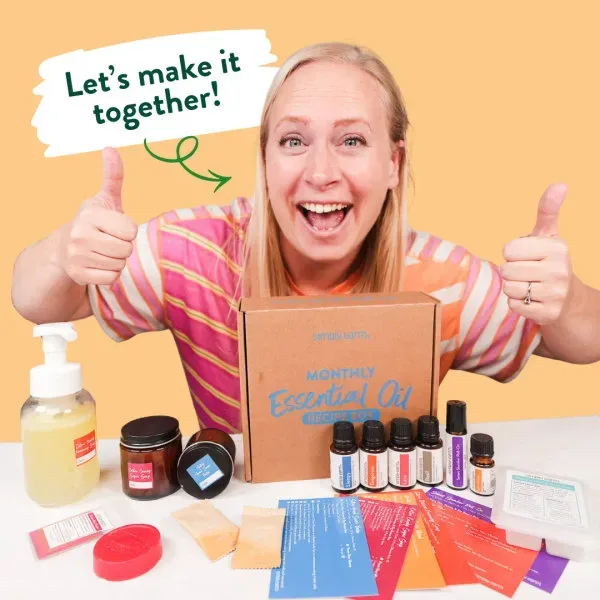
Learn by doing
Make your own natural products every month.
The Simply Earth Recipe Box ships 4 full-size essential oils, 6 natural recipes, and everything you need to make them. No guesswork.
Start My Recipe Box$39.99 for your first box, then $49.99/month. Skip, pause, or cancel anytime.