
Basil Essential Oil Benefits, Uses & Recipes

Katie Veldkamp
Certified Aromatherapist
Fact Checked & Approved
Basil is the herb everyone already knows by smell, which makes the essential oil one of the easier ones to like — sweet, green and faintly peppery, closer to a herb garden than to a spice rack. It has an unusually practical range for a single oil: it is a focus oil you diffuse at a desk, and it is one of the very few in the range people reach for a scalp. It is also the oil where which basil you bought genuinely matters, because basil is sold in chemotypes that differ in safety, not just in scent. Here is what Simply Earth's Basil Essential Oil does, how to dilute it, what its own constituent list says, and how it differs from the holy basil and tropical basil you will see beside it.
In this Guide
Free Cheat Sheet
New to Essential Oils? Start Here.
Get our free Essential Oil Guide — the safe-use basics, dilution rates, and the oils worth buying first.
Start Here
What Is Basil Essential Oil?
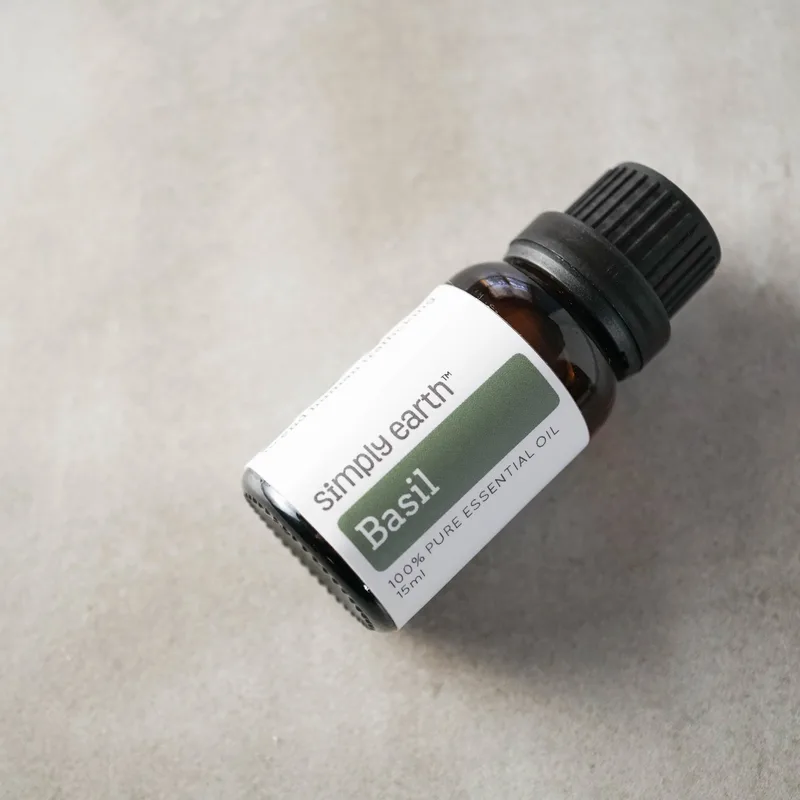
Basil Essential Oil is steam-distilled from the leaves of Ocimum basilicum — the sweet basil you already grow on a windowsill. Simply Earth's is a thin, clear oil with a fresh, sweet aroma, a top note with a blending factor of 4, which in practice means it lifts a blend immediately and does not hang around underneath it the way a wood or resin oil does.
It is worth knowing exactly what you are buying, because "basil" on a label covers more than one oil. Ocimum basilicum is grown in several chemotypes — populations of the same species whose chemistry differs enough to change how the oil is used. The two that matter to a shopper are the linalool type, the one aromatherapy generally reaches for, and the methyl chavicol type, usually sold as tropical or exotic basil, which is treated as restricted because of its estragole content. Holy basil, or tulsi, is not a chemotype at all — it is a different species.
Simply Earth publishes its own constituent list for this oil, and it names estragole, linalool and trans-α-bisabolene. That is the honest starting point for the safety section further down, and it is why this oil carries firmer cautions than most of the herbaceous oils in the range. Every bottle ships with a batch-specific GC/MS report, which is the document that tells you what is actually in the bottle you were sent.
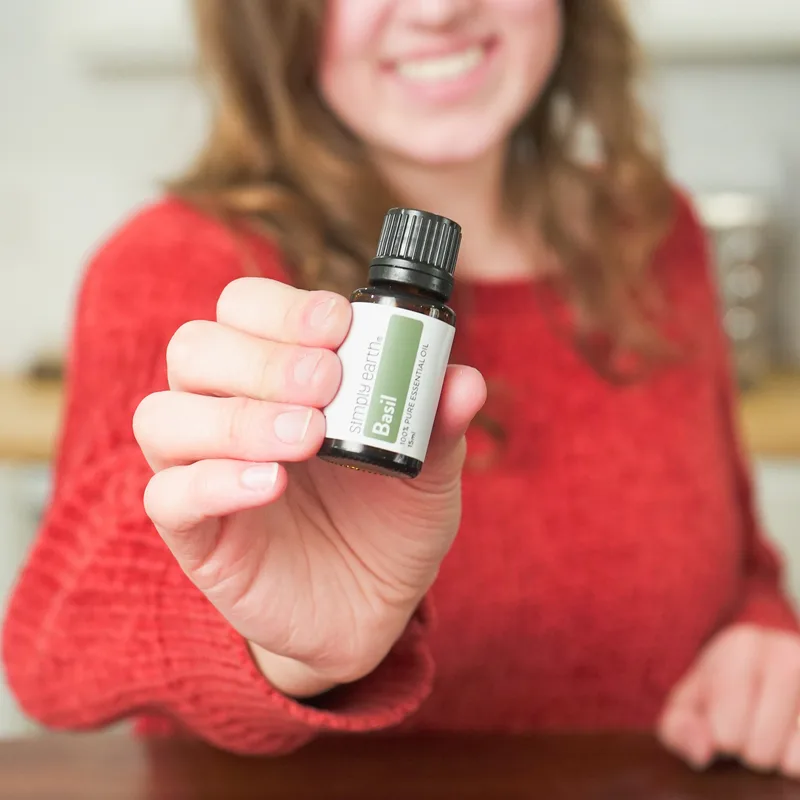
BEST FOR: DESK DIFFUSING & STUDY BLENDS
Supporting awareness is the first use Simply Earth lists for this oil, and it is the one most people end up buying it for. Basil is bright and green rather than sweet or heavy, so it reads as alert without the sharpness of a mint or the sugariness of a citrus. As a top note with a blending factor of 4 it arrives in a room fast, which is exactly what you want from something you switch on when you sit down to work rather than something you burn all evening.
KATIE'S TIP
Basil and Lemon in a desk diffuser is my standard working blend — three drops of Basil to two of Lemon. Run it for the first hour of a task, not all afternoon.


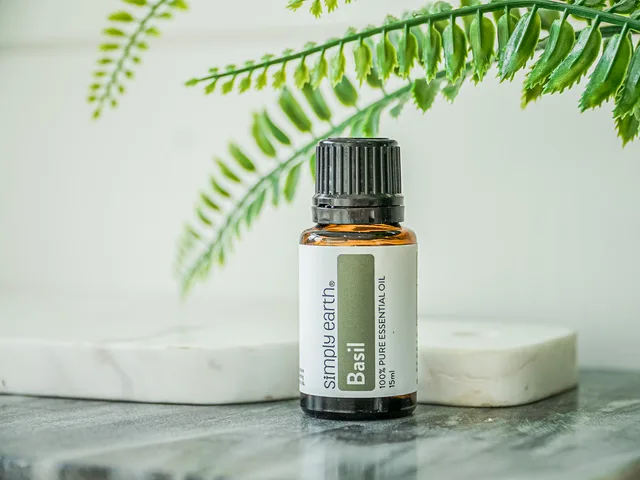
BEST FOR: ROLL-ONS & QUIET MOMENTS
Centering is on Simply Earth's own list of uses for this oil. Basil sits in an unusual place among the calming oils — it settles without making you drowsy, which is close to the opposite of what a lavender or a cedarwood does. That makes it the more useful choice in the middle of a day rather than at the end of one. It is a herb note, so it pairs naturally with the other herbaceous oils rather than with the florals.
KATIE'S TIP
Keep a basil roll-on in a bag rather than on a nightstand. This is a reset-in-the-afternoon oil, not a wind-down-at-night one.

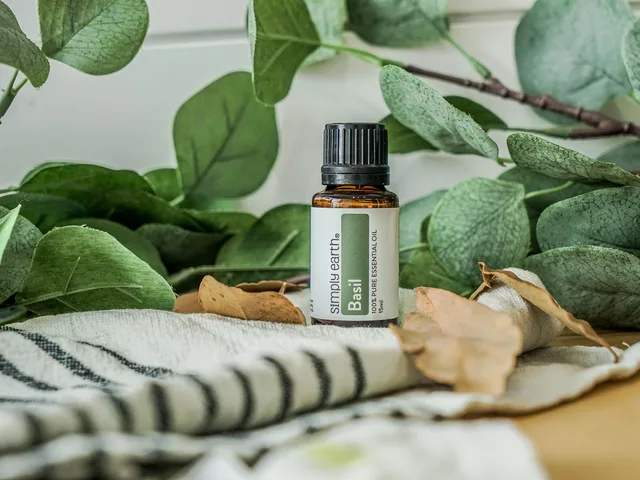
BEST FOR: ROOM SPRAYS & DIFFUSER BLENDS
Uplifting is another of the seven uses Simply Earth lists here, and it is the reason basil turns up in so many household recipes rather than only in wellness ones. A green, garden-fresh note does something to a room that a floral does not — it reads as clean and outdoors rather than as perfumed. Because it is a top note it also fixes the common problem with homemade room sprays, which is that they smell of nothing within a minute.
KATIE'S TIP
In a room spray, basil needs a partner that lasts — pair it with Rosemary or Clary Sage so the blend does not disappear the moment the mist settles.


BEST FOR: PRE-WASH SCALP & HAIR OILS
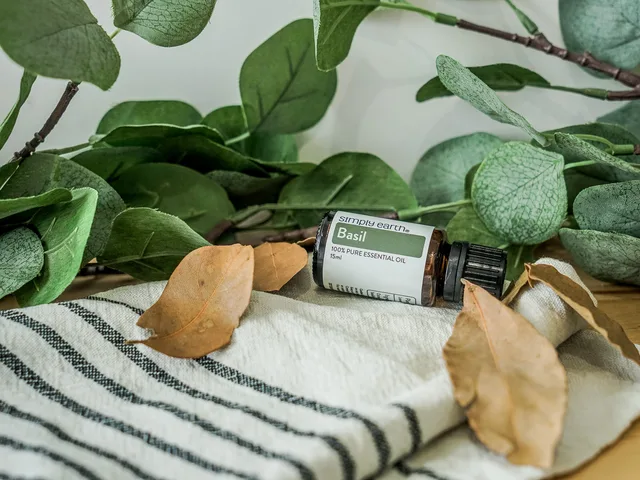
Clarifying the scalp is on Simply Earth's list of uses for this oil, and it is what makes basil worth owning if you already have a shelf full of calming oils — very few of them have anything to offer a scalp. Basil is popular in DIY hair care as a pre-wash treatment, diluted into a carrier oil, massaged in and then washed out, aimed at build-up and residue rather than at the hair itself. Treat it as a clarifying step in a wash routine, not as a leave-in. It needs a carrier oil every time, and the maximum dilution for this oil is 5%.
KATIE'S TIP
Massage it into the scalp about half an hour before you wash, not after. Applied afterwards you simply rinse it away, and basil is not an oil to leave sitting on skin.
USE IT IN

BEST FOR: CLAY MASKS & BODY CARE
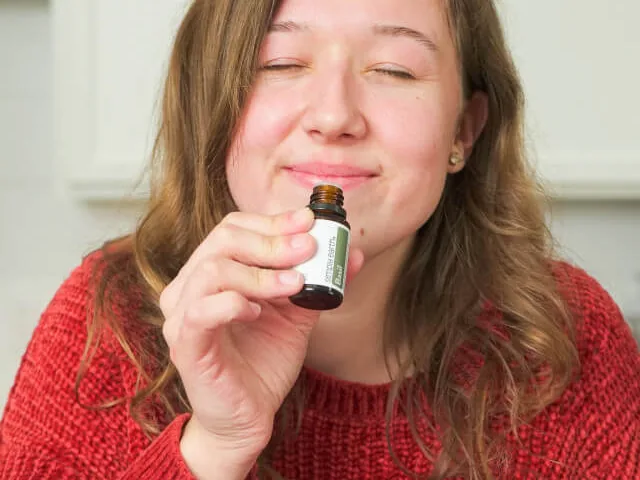
Reducing the appearance of breakouts is the seventh use on Simply Earth's own list for this oil, and it is the one the legacy article never covered. Basil shows up in DIY clay masks and body care for the look of clearer skin, and it suits the same skin the scalp use suits — the kind that runs oily rather than dry. This is the use that most needs restraint, though. Facial skin wants to sit well under the 5% maximum, and this is an oil to patch test on an inner arm first rather than try straight on a face.
KATIE'S TIP
Start in a clay mask rather than a leave-on serum. A mask is a wash-off product, so it is the lowest-risk way to find out how your skin takes basil.


BEST FOR: MASSAGE OILS & ROLL-ONS
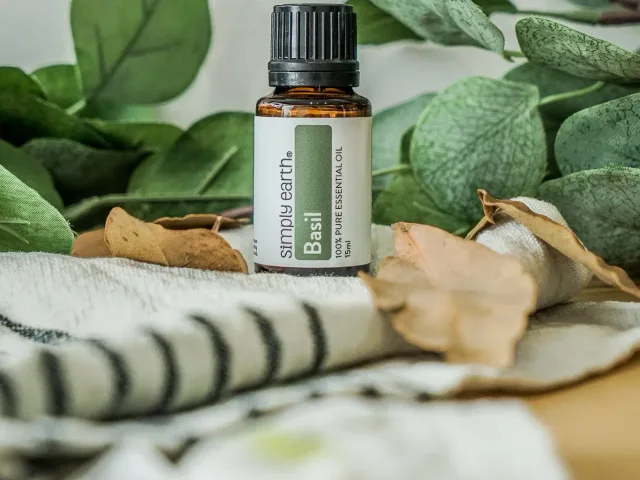
Supporting joint function is on Simply Earth's list of uses for this oil, and it is why basil turns up in massage and roll-on blends rather than only in diffusers. In practice it is a blending oil for this job rather than a solo one — it brings a green, herbal lift to a roll-on built on heavier oils. Everything here is topical, so everything here is diluted, and 5% is the ceiling for this oil rather than a target.
KATIE'S TIP
A 10ml roller is the easiest way to keep basil inside its dilution limit — you are measuring drops into a fixed volume instead of guessing at a palmful of carrier oil.
BEST FOR: AROMATIC USE & MASSAGE BLENDS
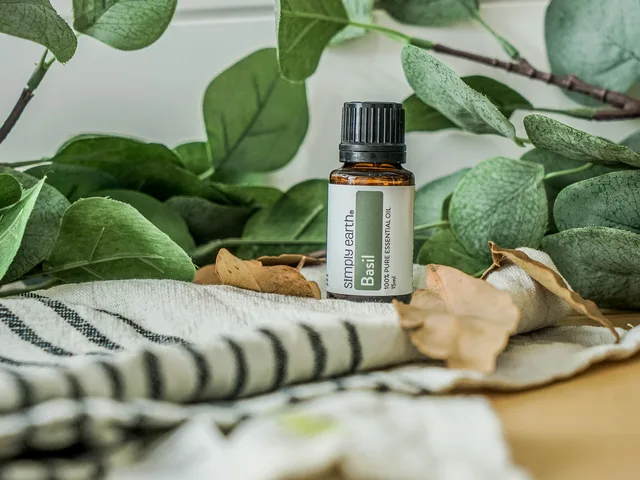
Aiding digestion is the last of the seven uses on Simply Earth's list, and basil has a long culinary association that makes it an intuitive one. One point needs making plainly, because it is where people go wrong with a kitchen herb — the fact that you eat basil does not mean you can ingest basil essential oil. We do not recommend ingesting essential oils, and that goes double for an oil whose own constituent list names estragole. Aromatic use, or a properly diluted massage blend, is the whole range here.
KATIE'S TIP
If you want basil for this, diffuse it or blend it into a carrier oil for external use. A drop in water is not a use we recommend for any oil, and least of all this one.
Put It to Work
How to Use Basil Essential Oil
Diffuser
- • 3–5 drops for a bright, green, alert room
- • Pairs with Lemon or Bergamot for focus, Rosemary for a herb blend
- • A top note with a blending factor of 4 — it arrives fast and fades fast
- • Listed by Simply Earth as dog safe, but NOT cat safe
Topical (Roller)
- • 10ml roller bottle with a carrier oil
- • 5% is the maximum dilution for this oil
- • Patch test on the inner arm before the first full use
- • For external use only — avoid contact with eyes
Scalp & Hair
- • Always dilute into a carrier oil, never apply neat
- • Massage in about 30 minutes before you wash, then wash it out
- • A clarifying pre-wash step, not a leave-in treatment
Household
- • Room and bathroom sprays — see the Greenhouse Room Spray
- • Foaming hand soap, such as the Citrus Breeze Foaming Soap
- • Keep it away from cats and from the surfaces they walk across
DIY
- • Clay masks, body butter and deodorant
- • Roll-ons and diffuser blends
- • Try the Ignite & Inspire Diffuser Blend for a focus blend
Know the Difference
Sweet vs. Holy vs. Tropical Basil
Three quite different oils are sold as "basil", and this is the single most useful thing to understand before buying one. Sweet basil is Ocimum basilicum, and it is what Simply Earth sells. Holy basil, or tulsi, is Ocimum tenuiflorum — not a variety of the same plant but a different species, with a richer, spicier aroma and its own Ayurvedic tradition. Tropical or exotic basil is confusingly also Ocimum basilicum, but a chemotype dominated by methyl chavicol, better known as estragole, which is why it is treated as restricted rather than general-purpose. Simply Earth's own published constituent list for its Basil Essential Oil names estragole alongside linalool, so read the safety section below rather than assuming any basil is a gentle oil — and check the batch-specific GC/MS report that ships with your bottle.
Swipe to compare →
Sweet Basil The subject of this page | Holy Basil (Tulsi) A different species entirely | Tropical / Exotic Basil The restricted chemotype | |
|---|---|---|---|
| Botanical Name | Ocimum basilicum | Ocimum tenuiflorum | Ocimum basilicum, methyl chavicol chemotype |
| Also Sold As | Basil, Sweet Basil, Basil Linalool | Tulsi, Holy Basil | Exotic Basil, Tropical Basil, Basil Estragole |
| Plant Part | Leaf | Leaf | Leaf |
| Aroma | Fresh and sweet, green and lightly peppery | Rich and spicy | Camphor-like and pungent |
| Main Constituents | Estragole, Linalool, trans-α-Bisabolene | Typically eugenol-rich | High in methyl chavicol (estragole) |
| Typically Used For | Focus, scalp care, skin, roll-ons and diffusing | Ayurvedic traditions | Restricted in aromatherapy use |
| Kid Safe | Yes, from age 10 | N/A — not currently sold | N/A — not currently sold |
| Pregnancy & Breastfeeding | No — Simply Earth lists this oil as unsafe for both | N/A — not currently sold | N/A — not currently sold |
| Cat & Dog Safe | Dog safe, but NOT cat safe | N/A — not currently sold | N/A — not currently sold |
| Max Dilution | 5% | N/A — not currently sold | N/A — not currently sold |
| Sold by Simply Earth | Yes, 15mL | Not currently sold | Not currently sold |
| Simply Earth | This page's oil | — | — |
Perfect Pairs
Basil Essential Oil Blends Well With…
Simply Earth's own blending list for this oil. Basil is a top note with a blending factor of 4, so it works best over something with more staying power than itself — Clary Sage and Rosemary are the two easiest places to start, and Lemon is the one to reach for in a focus blend.
The King of Herbs
History of Basil Essential Oil
Basil's name is the most quoted thing about it, and for once the etymology is genuinely interesting: it comes from the Greek basileus, meaning king, which is why basil is still called the king of herbs. Simply Earth's own product notes record the same root, and the association was not merely poetic — the herb turns up in accounts of royal and ceremonial anointing.
What makes basil unusual among aromatic plants is how far its meanings diverge by culture. In India it is sacred, planted around temples and homes — though the plant venerated there is tulsi, Ocimum tenuiflorum, the holy basil from the table above rather than the sweet basil in this bottle. In China it was used in traditional medicinal practice. In Italy it became domestic and romantic, and one of the more charming stories has women setting pots of basil in their windows as a signal to suitors.
It is worth being careful with the more colourful claims. Basil's antiquity around the Mediterranean and the Near East is well attested, and Simply Earth's own legacy article repeats the often-told line that basil was found in the Egyptian pyramids — a story that circulates very widely but is not one we can trace to a primary source, so treat it as folklore rather than as fact. The oil itself is a much more recent thing than the herb: steam distillation of the leaf is what turns a kitchen plant into the concentrate on this page, and that concentration is exactly why the safety section matters.
The Chemistry
What's the Science Behind This Oil?
Three naturally occurring compounds account for basil's character — and on this oil in particular, the constituent list is also the safety information. These describe the compounds, not effects on people:
Estragole
The constituent to know about
The first compound on Simply Earth's own constituent list for this oil, also known as methyl chavicol. It is the compound that separates the basil chemotypes from one another, and the reason basil as a category carries firmer cautions than most herbaceous oils — it is why this oil is listed as unsafe in pregnancy and breastfeeding, unsuitable for epilepsy, and for ages 10 and up rather than 2 and up. How much of it a given basil contains varies by chemotype, growing region and harvest, which is precisely what a batch-specific GC/MS report is for.
Linalool
Floral · Green · Widely studied
The second constituent on Simply Earth's list, and the one basil shares with lavender, clary sage and bergamot. A naturally occurring terpene alcohol found across a great many flowers and spice plants, it is one of the most common fragrance compounds in the world, and it accounts for the softer, faintly floral edge underneath basil's green sharpness.
trans-α-Bisabolene
Woody · Balsamic · Structural
The third on Simply Earth's list. A sesquiterpene produced by a range of plants, it is heavier than the other two and contributes the slightly balsamic, woody depth that keeps sweet basil from smelling purely like a salad herb. These are facts about the compounds themselves, from the chemistry literature, rather than claims about what this product does to a person.
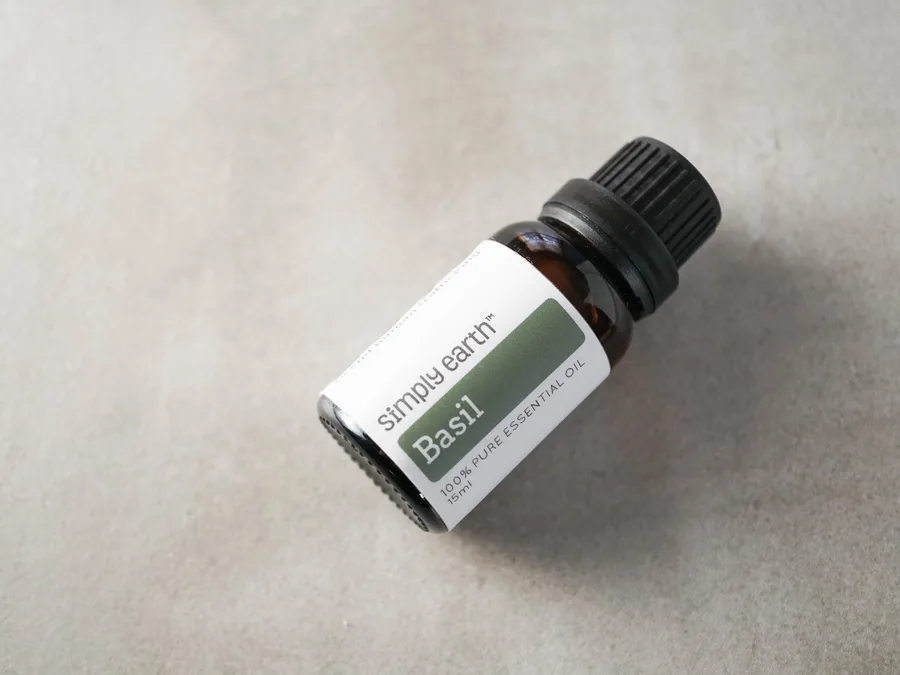
Simply Earth's Basil Essential Oil is steam-distilled from the leaf of Ocimum basilicum. Batch-specific GC/MS reports are available with every bottle — and on an oil sold in more than one chemotype, that report is the only thing that tells you what is actually in the bottle you were sent. We never blend our oils with synthetic fragrance, fillers or extenders. See Our Testing →
Support The Source
How Simply Earth Sources Basil
Simply Earth's own Support The Source material for this oil points to Egypt, and names Fridal as the growing region — a small shrub reaching roughly 30 to 130 cm, harvested for its leaves. Egypt has long been one of the significant origins for basil oil, and it is the origin our own farm-story material for basil documents.
The oil is steam-distilled from the leaf, which is the ordinary and appropriate method for a herb like this one — there is no solvent step and nothing is extracted chemically. What comes off the still is the whole aromatic fraction of the leaf, which means the chemotype question earlier in this article is settled in the field, by which basil population was planted and where, rather than anywhere in the distillation.
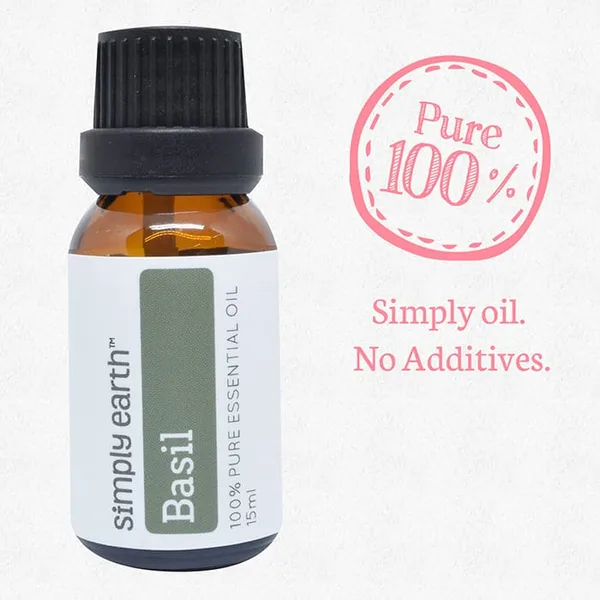
Every bottle is 100% pure, with no fillers, extenders or synthetic fragrance, and ships with a batch-specific GC/MS report. On this particular oil that report is doing more work than it does on most: it is what tells you the constituent balance of your bottle rather than of a typical sample. 13% of profits go to fighting human trafficking, as they have on every Simply Earth product since the company started.
Egypt
Where It's Grown
Steam Distilled
From the Leaf
Every Batch
GC/MS Tested
Use It Right
Things to Remember When Using This Oil
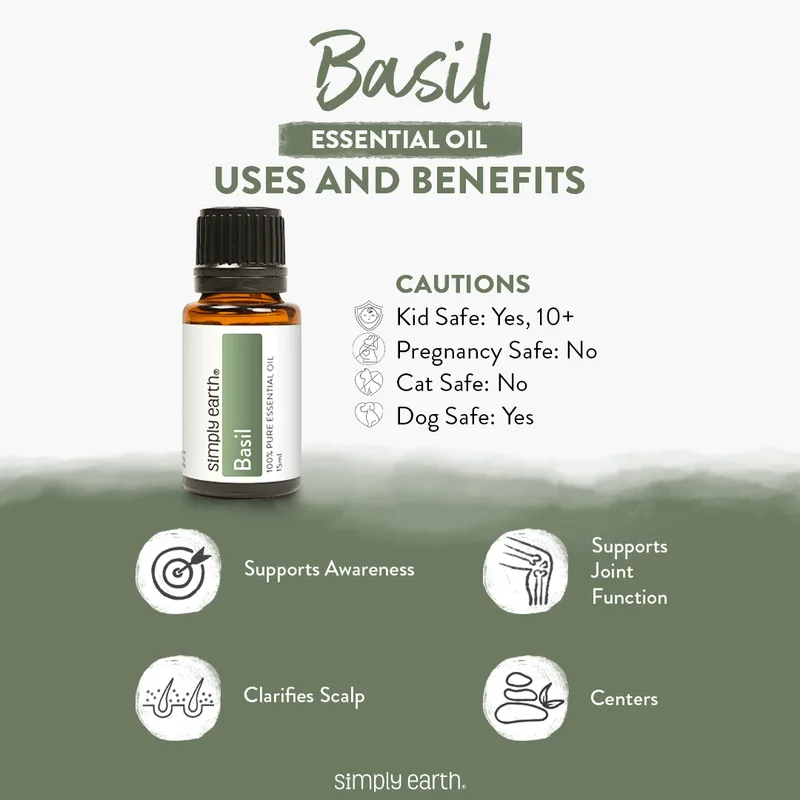
Always dilute before applying to skin. Simply Earth lists a special maximum dilution of 5% for this oil, and facial or scalp use wants to sit well under it. See our dilution chart.
Not safe during pregnancy. Simply Earth lists this oil as not safe to use if you are pregnant. Do not use it, and consult your doctor before using any essential oil in pregnancy.
Not safe while breastfeeding. Listed as not breastfeeding safe. This is firmer guidance than most oils in the range carry, and it is worth taking at face value.
Not considered safe with epilepsy. Simply Earth's own cautions for basil name epilepsy specifically. If that applies to you or to anyone in your household, choose a different oil.
For kids age 10 and over only. Basil is not one of the gentle oils — most of the kid-safe range starts at age 2. Dilute conservatively even then, and keep bottles out of reach.
Dog safe, but NOT cat safe. Simply Earth lists basil as safe around dogs and unsafe around cats. Keep it away from cats and from the surfaces they use, make sure pets can always leave the room, and never apply essential oils directly to an animal.
Not phototoxic. Simply Earth lists this oil as sun safe, so there is no sun-exposure restriction the way there is with the citrus oils.
May irritate some skin — patch test first. For external use only, and avoid contact with the eyes. Oil that has oxidised after being left with the cap off is more likely to irritate. If contact happens, flush with a carrier oil rather than water.
Never ingest it. We do not recommend ingesting essential oils, and basil is a particularly poor candidate given its own constituent list. Cooking with the fresh herb is not the same thing as using the oil.
Store cool, dark and tightly capped. Simply Earth lists a 3-year shelf life for this oil.
These statements have not been evaluated by the Food and Drug Administration. This product is not intended to diagnose, treat, cure, or prevent any disease.
Real Results
What Earthies Are Saying About It
"I love the smell of Basil & this one is so crisp. I tend to mix it with citrus bases & it gives such an unusual scent. I've not been disappointed with any of the scents I have received from Simply Earth."
Brooke St John
Website Review • Basil Essential Oil
"I love using Basil oil for my bathroom air spray — I mixed it with pine and eucalyptus to get a forest scent and my bathroom smells like a rainforest. It feels like a spa experience with these high quality essential oils."
Christina Ramos
Website Review • Basil Essential Oil
"This is probably the BEST SMELLING essential oil I've ever had!! It is my first time trying Basil, and I am in LOVE!!! I like to make my own natural products and I guarantee this will be going into as many as possible."
Pat
Website Review • Basil Essential Oil
OUR SIMPLY PURE PROMISE
What Goes Into Your Products Matters
Certified 100% Pure
No fillers, no synthetics. Just pure oil.
GC/MS Third-Party Tested
Batch-specific reports with every bottle.
Ethically Sourced from Quality Farms
Responsibly harvested. People and planet first.
Egypt
Where It's Grown
Per our own Support The Source material
Steam Distilled
From the Leaf
No solvents, nothing extracted chemically
Public
GC/MS Tests
MLM brands: Rarely
Your Order Changes Lives: 13% of profits fight human trafficking globally.
Basil Essential Oil FAQ
The questions people actually ask about basil — starting with which basil you are holding.
What is basil essential oil good for? +
Simply Earth lists seven uses — supporting awareness, centering, uplifting, clarifying the scalp, reducing the appearance of breakouts, supporting joint function and aiding digestion. In practice it is a green, top-note herb oil that does its best work in desk diffuser blends, pre-wash scalp oils, clay masks and roll-ons.
Which basil does Simply Earth sell — sweet, holy or tropical? +
Sweet basil, Ocimum basilicum, distilled from the leaf. Holy basil (tulsi) is a different species, Ocimum tenuiflorum, and Simply Earth does not currently sell it; nor do we sell a tropical or exotic basil. One caveat worth reading — sweet basil is grown in more than one chemotype, and Simply Earth's own published constituent list for this oil names estragole alongside linalool and trans-α-bisabolene. The batch-specific GC/MS report that ships with your bottle is what tells you the balance in the oil you actually received.
Is basil essential oil safe during pregnancy? +
No. Simply Earth lists basil essential oil as not safe to use during pregnancy, and not safe while breastfeeding either. That is firmer than the guidance on most oils in the range, and it is the correct guidance for this one. Choose a different oil, and talk to your doctor before using any essential oil in pregnancy.
Can children use basil essential oil? +
Only from age 10. Most of Simply Earth's kid-safe oils start at age 2, so basil is a notable exception — it is not one of the gentle ones. Dilute conservatively even then, and keep the bottle out of reach.
How much should I dilute basil essential oil? +
Simply Earth lists a special maximum dilution of 5% for this oil, and that is a ceiling rather than a target — daily, facial or scalp use should sit well below it. It is for external use only, it may irritate some skin, so patch test on the inner arm first, and keep it away from your eyes.
Is basil essential oil safe around cats and dogs? +
Simply Earth lists basil as dog safe but not cat safe. If you have a cat, this is not an oil to diffuse in shared rooms or to leave on surfaces they walk across. Whatever you diffuse, make sure animals can leave the room, and never apply essential oils directly to a pet.
Does basil essential oil help with hair growth? +
We are not making that claim. What Simply Earth does list for this oil is that it clarifies the scalp, and that is the honest version — basil is popular in DIY hair care as a diluted pre-wash treatment aimed at build-up and residue. It is worth knowing that the hair-growth study often cited alongside basil was carried out on Ocimum gratissimum, a different species from the Ocimum basilicum in this bottle.
Can I ingest basil essential oil or cook with it? +
No. Cooking with fresh basil leaves is not the same thing as using the essential oil, which is enormously more concentrated. We do not recommend ingesting essential oils in general, and basil is a particularly poor candidate given that its own constituent list names estragole. Aromatic and properly diluted topical use only.

About the Author: Katie Veldkamp
Katie Veldkamp
Certified Aromatherapist · Co-Founder, Simply Earth
Katie Veldkamp is a Certified Aromatherapist and co-founder of Simply Earth. Her mission is to cut through the noise around essential oils so you can use them with confidence. She personally formulates and reviews SE's essential oil blends and verifies all benefit claims on Simply Earth content before it goes live.
Join 20,000+ Earthies Making Their Homes Natural
New recipes, usage guides, and DIY tips — delivered free.
No spam. Unsubscribe any time.
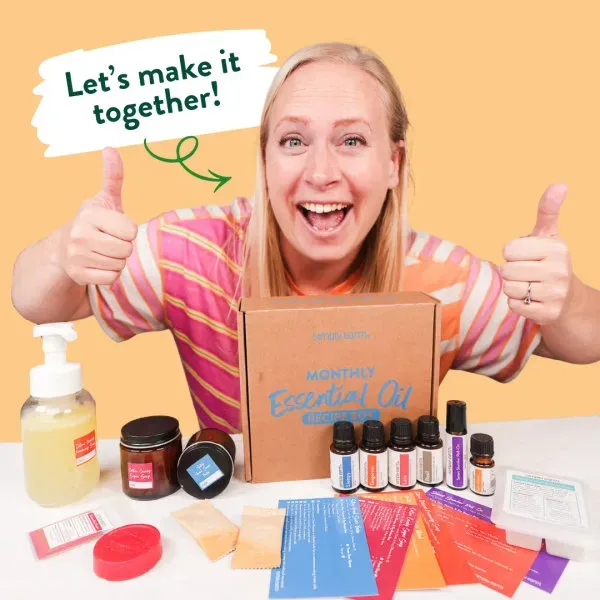
Learn by doing
Make your own natural products every month.
The Simply Earth Recipe Box ships 4 full-size essential oils, 6 natural recipes, and everything you need to make them. No guesswork.
Start My Recipe Box$39.99 for your first box, then $49.99/month. Skip, pause, or cancel anytime.