
Anise Star Essential Oil: Benefits, Uses & Recipes

Katie Veldkamp
Lead Certified Aromatherapist
Fact Checked & Approved
Anise Star is the black-liquorice oil. Open the bottle and there is no mistaking it — warm, sweet, faintly sharp, the smell of an old-fashioned sweet shop. Simply Earth's is steam-distilled from the fruit of Illicium verum grown in Vietnam, and it earns its place on a shelf for reasons that go well past the aroma. It also asks more of you than most oils do: it carries a weak estrogen-like activity, it caps at 2.5% on skin, and there is a list of people who should leave it alone entirely. Below are seven benefits, the seven recipes we actually make with it, how to tell it apart from the two things it gets confused with, and the safety notes worth reading before you open the bottle.
Free Download
Anise Star caps at 2.5%. Get the dilution right.
Get the free Essential Oil Cheat Sheet — dilution rates, safety basics and starter recipes on a single page you can keep beside your oils.
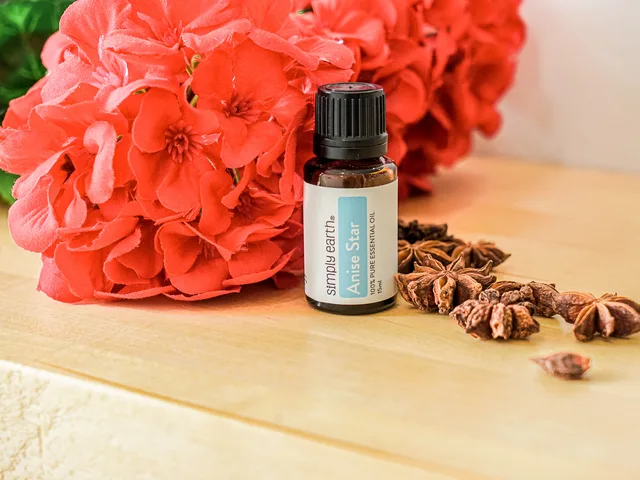
BEST FOR: STALE AIR AND CLOSED-UP ROOMS
Anise Star is a genuinely useful cleaning oil rather than a scent added at the end to cover something. One study of Illicium verum essential oil looked at its antioxidant properties and its antibacterial activity against Acinetobacter baumannii, and a broader review of Illicium verum and trans-anethole covers the same antimicrobial ground. The practical version — it is a good candidate for an air freshener or a room spray, and it is one of the few oils strong enough that a very small amount travels a very long way.
KATIE'S TIP
This is the oil I reach for when a room has been shut up for a week. One or two drops is genuinely enough — anise star is a blending factor 3 oil and it will dominate anything you put it with.


BEST FOR: QUEASY MORNINGS AND LONG CAR JOURNEYS
Star anise has been used as a digestive aid for a very long time, and the research has caught up with the tradition — a review of Illicium verum and trans-anethole covers its value as a medicinal and cosmetic raw material, and a summary of anise's potential health benefits in Nutrition Today reaches similar conclusions. In practice the route that matters here is the one through your nose — many people find simply inhaling it settles an unsettled stomach. Inhaling is not the same as swallowing — this oil is not something to take internally. See the safety section.
KATIE'S TIP
Build it into a roll-on once rather than mixing something fresh when you already feel rough. Keep it in the glove box — the moment you need it is never the moment you want to be measuring drops.
USE IT IN →

BEST FOR: THE MONTHS WHEN EVERYONE AROUND YOU IS ILL
A screening study of isolated compounds from essential oils found antiviral activity among them, which is the research the seasonal-support reputation rests on. Read it as supportive rather than protective — an essential oil is not a defence against illness, and nothing on this page should be taken as one. What it is genuinely good for is making a house feel cared for during the stretch of the year when everyone is run down.
KATIE'S TIP
Diffuse for 30–60 minutes at a time rather than continuously. Your nose adapts fast, and with an oil this strong a long session is mostly wasted on you and irritating for everyone else.
USE IT IN →

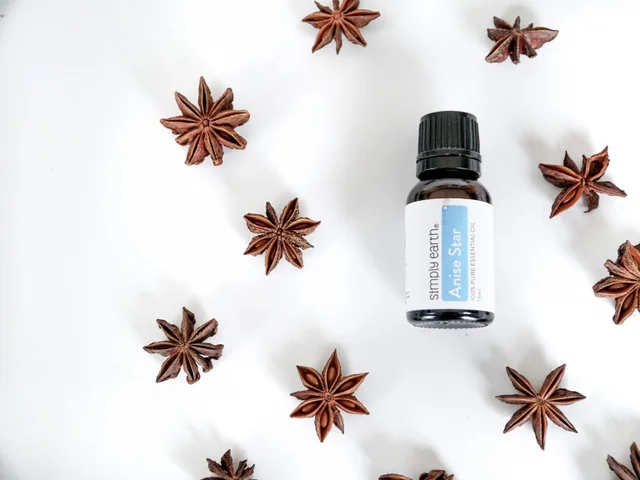
BEST FOR: WELL-DILUTED WASHES AND CLEANSING BARS
An in-vitro study of high levels of Chinese star anise reported antibacterial and antifungal effects, which is why it turns up in cleansing soaps and washes rather than in leave-on skincare. The qualifier matters more than the claim here — Simply Earth publishes a special dilution rate of 2.5% for this oil, and skin is exactly where going over it stops being theoretical. A pre-measured roll-on is the sanest way to use it on skin at all.
KATIE'S TIP
Patch test on the inner arm before you put it anywhere that matters, and keep it off broken or already-irritated skin. If a blend stings rather than tingles, you have gone over 2.5% — add carrier, do not push through.
USE IT IN →

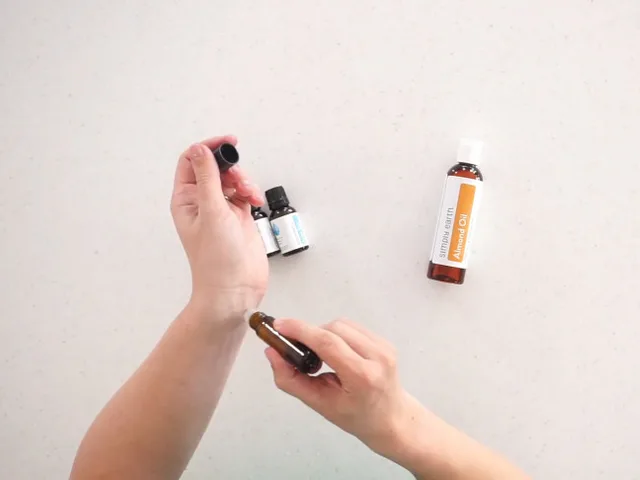
BEST FOR: STIFF HANDS AND ACHY MUSCLES
Research summarised in Nutrition Today covers anise's anti-inflammatory potential, and it is listed among the uses on Simply Earth's own product record. The mechanism people actually feel is simpler than the paper — anise star creates a warming sensation on skin, and warmth is what makes a stiff joint easier to move through. Supportive, not curative, and always inside the 2.5% ceiling. A roll-on is the format to reach for, because it fixes the dilution once and puts the oil exactly where you want it.
KATIE'S TIP
Warmth on skin is not a reason to use more oil. At 2.5% you are measuring a small number of drops into a full roller bottle, and that is much easier to get right in one careful go than in a hurry.
USE IT IN →
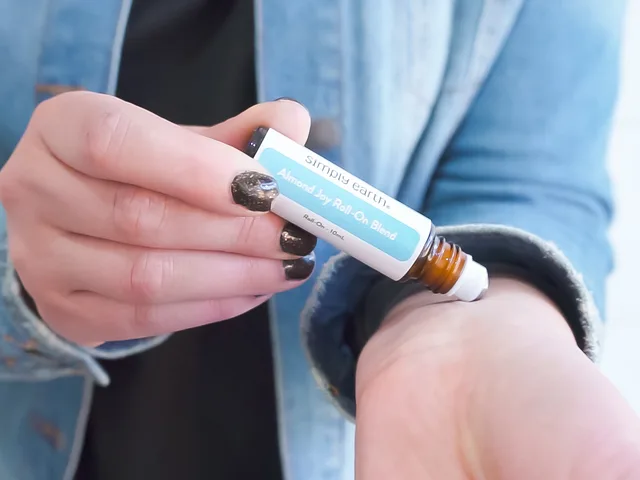
BEST FOR: COLD HANDS AND FEET, AND SLOW MORNINGS
The same warming character that helps a stiff joint is why anise star is a popular choice in massage oils — it creates a comforting, warming feeling on the skin and it smells good doing it. This is the most experiential of the seven benefits and the one with the least research behind it; it is on the product record and it is what customers describe, which is exactly how it is written here.
KATIE'S TIP
A roll-on applied to the wrists and the back of the neck is the easiest way to use this oil topically, and the easiest way to keep the dilution honest.
USE IT IN →
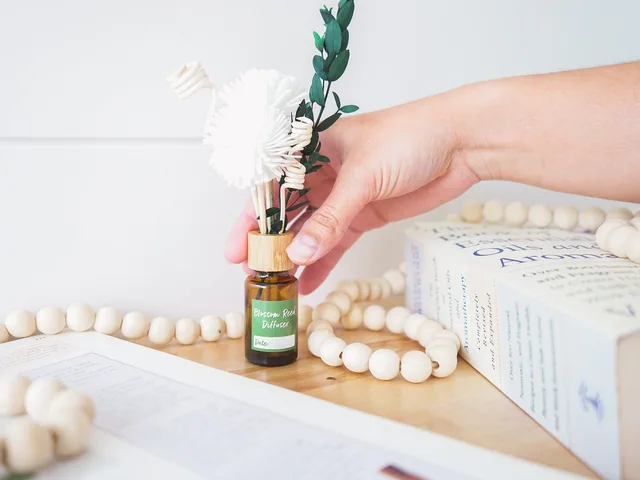
BEST FOR: DESK WORK, READING AND QUIET AFTERNOONS
This one is on Simply Earth's product record and not on the old version of this article, so it is worth saying plainly what it rests on — the aroma. Anise star is sweet and sharp at the same time, which makes it read as alert rather than cosy — a different effect from the warm spice oils it otherwise resembles. A reed diffuser on a desk is the least demanding way to get it, and it keeps working without you thinking about it.
KATIE'S TIP
Pair it with a citrus. Anise star on its own can be a lot, but with sweet orange behind it the liquorice edge softens into something you can sit next to for hours.


Put It to Work
How to Use Anise Star Oil
Diffuser
- • Add 3–4 drops to your diffuser — fewer than you would use of most oils
- • Diffuse 30–60 minutes at a time rather than continuously
- • Pair with sweet orange or fennel to soften the liquorice edge
- • Give pets a way out of the room before you start
Topical (Rollerball)
- • 10 ml roller bottle
- • Fill with fractionated coconut oil or jojoba
- • 5 drops Anise Star — this is roughly 2.5%, the published ceiling
- • Apply to wrists or the back of the neck, never to broken skin
Room & Linen Spray
- • 4 oz glass spray bottle
- • 3 oz distilled water + 1 oz witch hazel
- • 15–20 drops Anise Star
- • Shake before every use and keep it off pale fabrics until you have tested it
Reed Diffuser
- • Small glass bottle with a narrow neck and rattan reeds
- • Fractionated coconut oil or a purpose-made diffuser base
- • 20–25 drops Anise Star
- • Flip the reeds every few days to refresh the scent
Recipes We Actually Make With It
- • Candied Clove Gel Air Freshener
- • Spiced Summer Potpourri Bark
- • Travel Buddy Roll-On
- • Almond Joy Roll-On
- • Sweet Mint Diffuser Blend
- • Summer Day Diffuser Blend
- • Blossom Reed Diffuser
Know the Difference
Star Anise vs. Aniseed
Three different plants get sold under names that sound the same, and one of them genuinely matters. Anise star is Illicium verum, a tree, distilled from its star-shaped fruit — that is what is in our bottle. Aniseed is Pimpinella anisum, a small herbaceous plant distilled from its seed; Simply Earth used to sell it, so the comparison above is our own product data rather than received wisdom, and it is the lighter, thinner, more top-note of the two. Both are driven by trans-anethole, which is why they smell related and why they share the same estrogenic cautions. The third is the one to actually watch for: Illicium anisatum, Japanese star anise, looks very like Illicium verum and is not used in food or aromatherapy. If a label will not tell you the species, it has not told you anything.
Swipe to compare →
Anise Star The one this page is about | Aniseed We used to carry it | Japanese Star Anise Never use it | Star Anise Fragrance Oil Not an essential oil at all | |
|---|---|---|---|---|
| The Actual Plant | Illicium verum — an evergreen tree reaching about 8m (26ft) | Pimpinella anisum — a herbaceous plant about 1m tall | Illicium anisatum — a different Illicium species entirely | None of it — a synthetic aroma compound |
| Part Distilled | Fruit | Seed | Not distilled for aromatherapy use | Nothing is distilled |
| Where Ours Came From | Vietnam | India | Not carried by Simply Earth | Not carried by Simply Earth |
| Lead Compound | trans-Anethole, with estragole and linalool behind it | trans-Anethole | Not an aromatherapy oil — do not use it | No plant compounds at all |
| How It Smells | Spicy, sharp and liquorice-like, with real weight behind it | Strong, sweet and spicy, lighter and thinner than anise star | Similar enough to be mistaken for it, which is the whole problem | Sweet and one-note, closer to a sweet shop than to a tree |
| Note | Middle | Top | Not applicable | Not applicable |
| Organic | Conventional | Conventional | Not applicable | Not applicable |
| Blending Factor | 3 | Not published | Not applicable | Not applicable |
| Max Topical Dilution | 2.5% | 2.4%, with its own estrogenic caution | Not for any use | Not for skin use as an aromatherapy oil |
| How to Spot It on a Label | Says anise star or star anise, and names Illicium verum | Says aniseed or anise seed, and names Pimpinella anisum | Names Illicium anisatum, or gives no species at all | Says fragrance oil or perfume oil — never an essential oil |
| Simply Earth | We carry this | — | — | — |
Perfect Pairs
Anise Star Blends Well With…
Simply Earth's own blending list for anise star. Sweet orange is the easiest place to start and fennel is the most natural — the two share trans-anethole, so they sit together without arguing. It is a middle note with a blending factor of 3 and a medium-to-thick consistency, so use noticeably less of it than of whatever you are pairing it with.
A fun fact about anise star
The Spice That Tells You What It Is
Most spices give you nothing to go on by sight. Anise star is the exception — the fruit dries into a hard, eight-pointed star, and once you have seen one you will never mistake it for anything else in a jar.
It grows on a small-to-medium evergreen tree native to parts of southern and eastern Asia, reaching around eight metres, or twenty-six feet. The fruit is picked before it ripens and then laid out in the sun to dry and harden, which is what produces both the shape and the concentration of aroma it is prized for. Steam distillation of that fruit is where the essential oil comes from.
That distinctive shape is not only a convenience for cooks. It is also the reason the confusion at the heart of this page is dangerous rather than merely annoying: Illicium anisatum, Japanese star anise, produces a fruit that looks very similar and is not something to put in food or a diffuser. Buying from someone who will name the species is the whole of the answer.
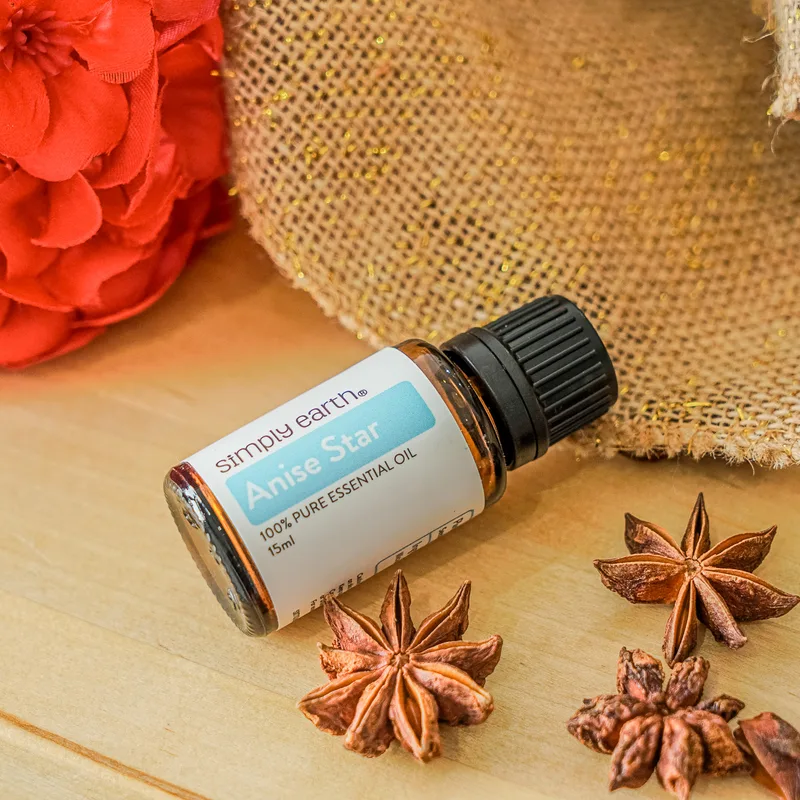
The Chemistry
The Science Behind Anise Star Oil
Three naturally occurring compounds account for anise star's sweet, sharp, liquorice-like character:
trans-Anethole
The lead constituent
The compound that makes anise star smell like anise star, and the one every caution on this page traces back to. It occurs widely in nature and carries a large part of the odour and flavour of anise, fennel, liquorice and star anise. It is also the reason Simply Earth lists a weak estrogen-like activity for this oil — the same molecule is doing the appealing work and the risky work.
Estragole
Also called methyl chavicol
A naturally occurring phenylpropene found across a range of plants — anise, fennel, bay, tarragon and basil among them — and used in the preparation of fragrances. It is a colourless liquid, and it is one of the constituents a GC/MS report will quantify, which is part of why the report matters more on an oil like this one than on a gentler oil.
Linalool
Floral · Faintly spicy
A naturally occurring terpene alcohol found in a great many flowers and spice plants, valued almost everywhere for its pleasant floral scent with a touch of spice. In the plant it works as a volatile oil component and an antimicrobial agent; in the bottle it is part of what keeps anise star from reading as purely sharp.
Simply Earth's Anise Star Essential Oil is steam-distilled from the fruit of Illicium verum, and every bottle ships with a batch-specific GC/MS report. For this oil that matters more than most — Illicium verum has a toxic look-alike in Illicium anisatum, and a constituent profile is the only thing that settles which one is actually in the bottle. See Our Testing →
Support The Source
From Vietnam's Anise Forests
Our anise star comes from Vietnam, where the trees are grown and the fruit is harvested by people who have been working with them for generations.
It is worth being precise about what gets harvested, because it is the part people get wrong. The star is the fruit, not the seed and not the bark, and it is picked while still unripe and dried in the sun before anything is distilled from it. Timing that well is skilled seasonal work, and it is the difference between a fruit that concentrates its aroma and one that does not.
Buying farm-direct is the part that matters most to us. It means the families doing that work are paid properly for it, and it means we can trace a bottle back to their trees rather than to a broker — which is also what makes the GC/MS report worth reading, because a test result only means something when you know which oil, and which species, it belongs to.
Vietnam
Where It's Grown
Fruit
Plant Part
Public
GC/MS Results
Use It Right
Things to Remember When Using Anise Star Oil
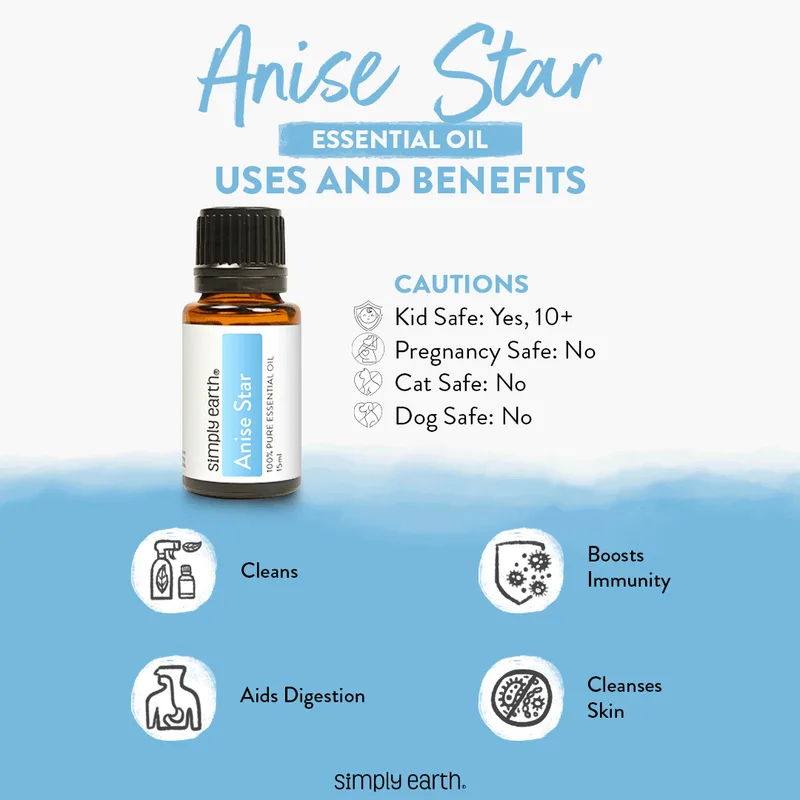
Anise Star has a weak estrogen-like activity, and that rules some people out entirely. Simply Earth lists it as unsuitable if you are pregnant, breastfeeding, have endometriosis, or have any estrogen-related cancer. This is a firm no, not a check-with-your-doctor.
It may interfere with anticoagulant medication. Simply Earth flags a possible interaction with anticoagulants and with bleeding disorders. If that applies to you, speak to your doctor before using it at all rather than adjusting the dose yourself.
Simply Earth caps this oil at 2.5% on skin. That is a published special dilution rate, not a general guideline. See our dilution chart, and never apply it neat.
Never ingest it. Star anise is a kitchen spice in its whole dried form, but anise star essential oil is not a food ingredient and should not go into drinks, food or capsules. Topical and aromatic use only, unless you are under the direction of a doctor certified in aromatherapy.
Children 10 and up only. For a younger child, choose a gentler oil rather than fewer drops of this one.
Not cat safe, and not dog safe. Never apply it to an animal, and give pets a way out of the room before you diffuse.
Buy by species, not by name. Illicium verum is the one you want. Its look-alike, Illicium anisatum, is not used in food or aromatherapy — if a supplier will not name the species and publish a test result, buy elsewhere.
Patch test on the inner arm before wider topical use, and keep it off broken or already-irritated skin. It is sun safe, so no photosensitivity window to plan around.
Oxidised oil is more likely to irritate. Simply Earth lists a 4-year shelf life — keep the cap on, cool and out of direct light, and if the aroma has turned sharp and flat, retire that bottle to cleaning duty.
These statements have not been evaluated by the Food and Drug Administration. Essential oils are not intended to diagnose, treat, cure, or prevent any disease.
Real Results
What Earthies Are Saying
"I dip a few drops of Anise Star EO onto a cotton bud, added a pinch of spa salt bath which has a floral smell, mixed them into a small net pouch. I would hang them to the car aircon vent. Wow the whole family loved the aroma. Loved the Anise Star Aroma."
Asrie A.
Verified Buyer • Anise Star Essential Oil
"I discovered that a little Anise Star did wonders for overcoming garbage pail smell and lasted days, making everyone want some black licorice."
Cherlyn N.
Verified Buyer • Monthly Subscription Box
"I used some Anise Star in a blend with the Bumps and BooBoos oil to help with pain. My daughter takes shots and they are quite painful! It did help, but it wasn't quite enough."
Janece Suarez
Verified Buyer • Anise Star Essential Oil
OUR SIMPLY PURE PROMISE
What Goes Into Your Products Matters
Certified 100% Pure
No fillers, no synthetics. Just pure oil.
GC/MS Third-Party Tested
Every batch independently verified.
Ethically Sourced from Quality Farms
Responsibly harvested. People and planet first.
15mL
Bottle Size
MLM brands: 10mL
Vietnam
Where It's Grown
Fruit-distilled, farm-direct
Public
GC/MS Tests
MLM brands: Rarely
Your Order Changes Lives: 13% of profits fight human trafficking globally.
Anise Star Essential Oil FAQ
The questions people actually ask about anise star — starting with the two that decide whether you should be using it at all.
What is anise star essential oil good for? +
Simply Earth lists seven uses — cleaning, aiding digestion, boosting immunity, cleansing skin, supporting joint function, promoting circulation and aiding focus. In practice its best-loved work is aromatic. It is a powerful cleaning and air-freshening oil, and it is the one people reach for when they want a room to smell warm, sweet and faintly like black liquorice.
Is star anise the same as aniseed? +
No. Star anise is Illicium verum, a tree, and the oil is distilled from its star-shaped fruit. Aniseed is Pimpinella anisum, a small herbaceous plant, and its oil is distilled from the seed. They smell related because both are driven by trans-anethole, but anise star is the heavier, middle-note oil and aniseed is lighter and more of a top note. Simply Earth has sold both, though only Anise Star is currently available.
Is anise star essential oil safe during pregnancy? +
No. Simply Earth lists it as safe for neither pregnancy nor breastfeeding, because trans-anethole gives the oil a weak estrogen-like activity. The same caution rules it out if you have endometriosis or any estrogen-related cancer, and it may interfere with anticoagulant medication. This is one of the firmest safety profiles on our shelf — choose a different oil rather than a smaller dose.
How much should I dilute anise star essential oil? +
Simply Earth publishes a special dilution rate of 2.5% for anise star, which is lower than the general-purpose guidance for most oils. In a 10ml roller bottle that is around 5 drops. Never apply it neat, and patch test on the inner arm before you use it more widely.
Can I put anise star essential oil in food or drinks? +
No. Whole dried star anise is a kitchen spice, but the essential oil is a far more concentrated product and is not a food ingredient. Simply Earth does not recommend ingesting essential oils at all unless you are under the direction of a doctor certified in aromatherapy. Use it topically at 2.5% or aromatically instead.
What does anise star essential oil smell like? +
Spicy, sharp and unmistakably liquorice-like — most people describe it as black liquorice or black jelly beans. It is a middle note with a blending factor of 3 and a medium-to-thick consistency, and it is strong. Use less of it than you think you need, and pair it with sweet orange or fennel if you want to soften the edge.
Is anise star oil safe for kids and pets? +
For children aged 10 and over only, and for neither cats nor dogs. Simply Earth lists it as not cat safe and not dog safe, so never apply it to an animal and always give pets a way out of the room before you diffuse. For a younger child, pick a gentler oil rather than reducing the drops.
Where does Simply Earth's anise star come from? +
Vietnam, where the fruit is harvested before it ripens, sun-dried, and then steam-distilled. We buy farm-direct and publish a batch-specific GC/MS report with every bottle — which for this oil matters more than most, because Illicium verum has a look-alike species and the constituent profile is the only reliable way to confirm what is in the bottle.
About the Author: Katie Veldkamp
Katie Veldkamp
Certified Aromatherapist · Co-Founder, Simply Earth
Katie Veldkamp is a Certified Aromatherapist and co-founder of Simply Earth. She personally formulates and reviews SE's essential oil blends and verifies all benefit claims on Simply Earth content before it goes live.
Join 20,000+ Earthies Making Their Homes Natural
New recipes, usage guides, and DIY tips — delivered free.
No spam. Unsubscribe any time.

Learn by doing
Make your own natural products every month.
The Simply Earth Recipe Box ships 4 full-size essential oils, 6 natural recipes, and everything you need to make them. No guesswork.
Start My Recipe Box$39.99 for your first box, then $49.99/month. Skip, pause, or cancel anytime.