
Natural Clay for Skin: Benefits, Uses & Which One to Use

Katie Veldkamp
Certified Aromatherapist
Fact Checked & Approved
Clay is the oldest skincare ingredient still in everyday use, and it is one of the few that does exactly what it says on the label. It is not a botanical extract or a distilled oil — it is mined mineral powder, and the reason it works on skin is physics rather than pharmacology. Wet clay carries a surface charge, and that charge binds excess oil, dirt and surface residue so they rinse away with the mask instead of staying on your face. That is the whole mechanism. What trips people up is that "clay" is not one ingredient. At Simply Earth we carry two, and they behave differently enough that picking the wrong one is the difference between skin that feels balanced and skin that feels stripped. Below are seven things natural clay does for skin, how to mix it without wasting it, and a straight comparison of the two we sell against the two you have probably read about.
Free Download
Mixing clay with essential oils? Get the dilution right.
Get the free Essential Oil Cheat Sheet — dilution rates, safety basics and starter recipes on a single page you can keep next to your mixing bowl.
Natural Clay Absorbs Excess Oil
The reason clay has been in skincare for thousands of years.
 Shop Natural Clay
BEST FOR: OILY AND COMBINATION SKIN
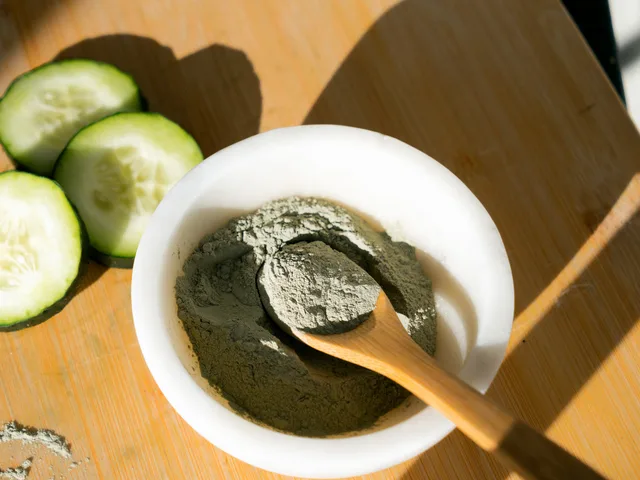
This is clay's headline job and the one it does best. Simply Earth's own ingredient record describes French Green Clay as having natural absorbent properties that help attract and bind excess oil, dirt and surface impurities from the skin — and that binding is what makes the difference between wiping oil around your face and actually lifting it off. When you rinse a clay mask away, the oil it has bound goes with it. If your skin is shiny by mid-afternoon, particularly across the forehead and nose, this is the benefit you are buying clay for. It is also why clay suits combination skin so well — you can mask only the areas that need it and leave the drier patches alone.
KATIE'S TIP
Do not chase this benefit by masking every day. Absorbing oil is the point, but skin that has been stripped of all of it will often produce more to compensate. Once or twice a week is plenty, and Simply Earth's own Pure Renewal Clay Mask is built as a weekly treatment for exactly that reason.


BEST FOR: CONGESTED, TEXTURED SKIN
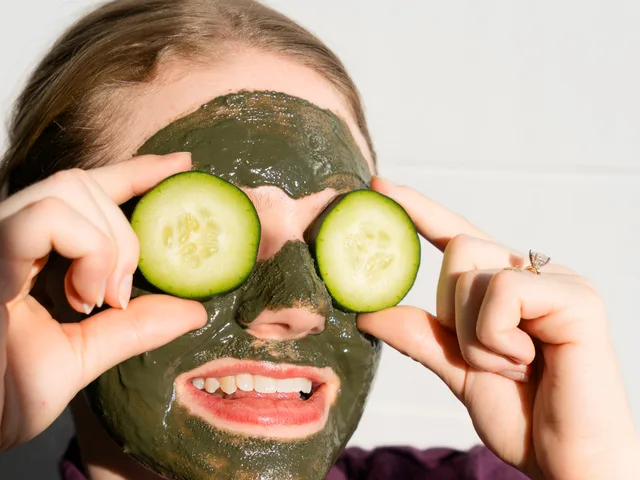
You cannot change the size of a pore, and anything that claims to is overselling. What you can change is how full it is. Simply Earth's record for French Green Clay puts it plainly — it helps minimise pores and leaves skin looking refreshed and more refined. A pore packed with oil and dead surface cells sits open and casts a small shadow, which is what makes it visible; empty the same pore and it reads as smaller and smoother even though nothing structural has changed. This is the benefit people notice in the mirror an hour after rinsing, and it is the most honest version of the "pore-shrinking" promise you will see on a shelf.
KATIE'S TIP
Steam first if you have three spare minutes — a warm damp washcloth held against your face softens what is sitting in the pores so the clay has less work to do. It is a free step and it makes a visible difference.


Natural Clay Exfoliates Gently
Mild enough to use on skin that scrubs are too harsh for.
 Shop Natural Clay
BEST FOR: SENSITIVE SKIN THAT CANNOT TAKE A SCRUB
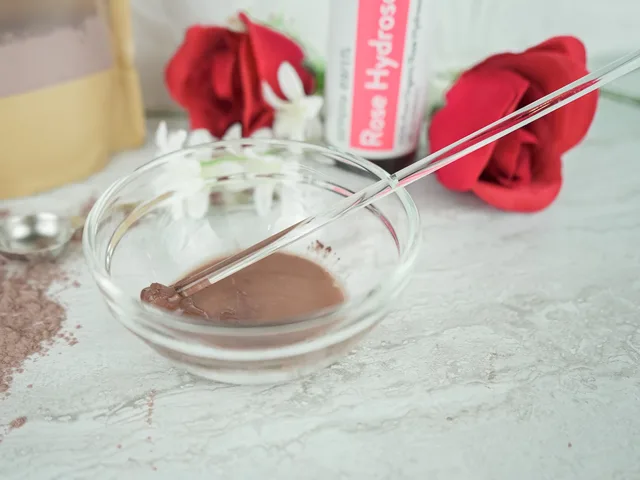
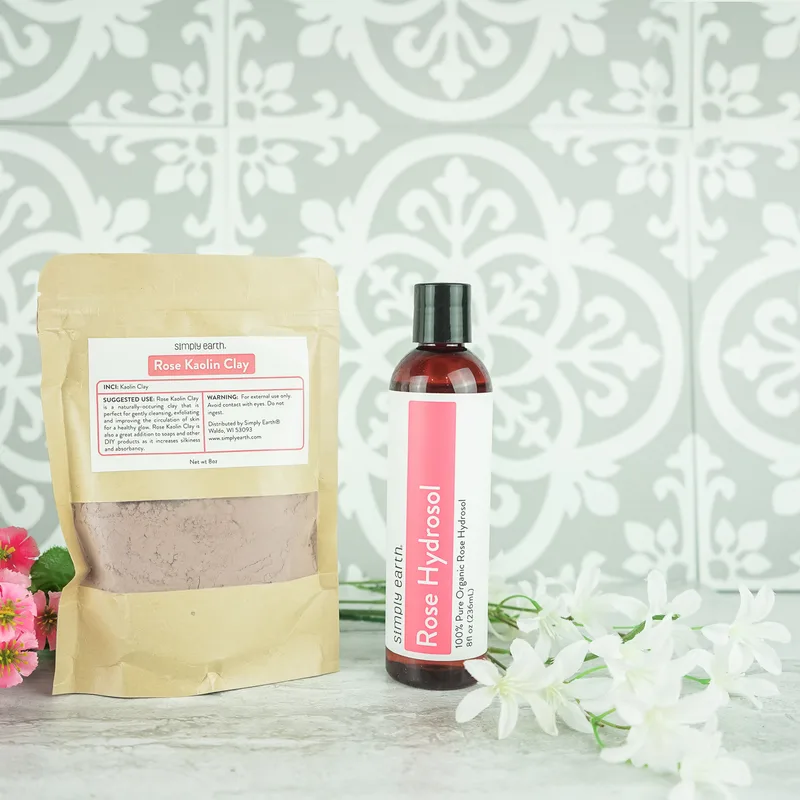
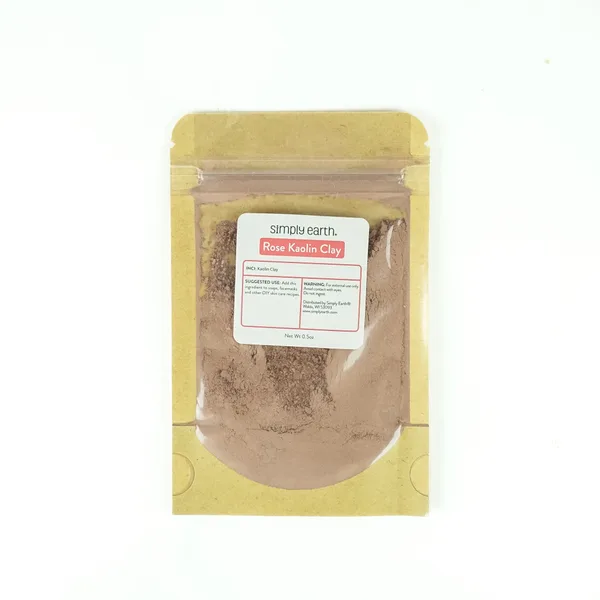
Simply Earth's ingredient record credits French Green Clay with providing mild exfoliation, and the Rose Kaolin Clay label describes it as gently cleansing and exfoliating. The distinction that matters here is mechanical versus mineral. A sugar or salt scrub exfoliates by abrasion — you are physically sanding the surface, and on reactive skin that is often too much. Clay does it by lifting: the particles are extremely fine, and what comes away is loose surface cells and residue rather than anything you have scraped off. That makes clay one of the few exfoliants that works for people whose skin goes red at the sight of a scrub, and it is why clay turns up in Simply Earth's face wash recipes as well as its masks.
KATIE'S TIP
If you want a slightly more active version, do not reach for a grittier clay — mix your clay into a face wash instead of using it as a standalone mask. You get the lift plus a surfactant, which handles more in one step without adding abrasion.

Natural Clay Brightens and Adds Glow
Circulation plus a cleared surface, not bleaching.
 Shop Natural Clay
BEST FOR: DULL, TIRED-LOOKING SKIN
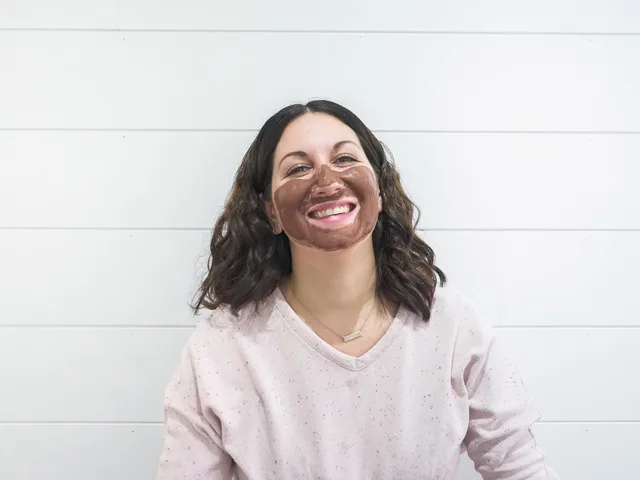
Simply Earth's Rose Kaolin Clay is described on its own product record as gently cleansing, exfoliating and improving the circulation of skin for a natural glow — and it is worth being precise about what that means, because "brightening" is a word that gets stretched. Clay is not a pigment-lightening ingredient and nothing here bleaches anything. Two real things happen instead. Clearing dulling surface build-up lets light reflect off skin more evenly, and the process of applying, wearing and rinsing a mask brings a flush of colour to the surface. The combined effect is the look people describe as having just had a facial, which is exactly how our own French Green Clay copy puts it.
KATIE'S TIP
This is the benefit to time. If you want the glow for something specific, mask the evening before rather than an hour before — the flush settles overnight into something that looks like good skin rather than like you have just scrubbed your face.
USE IT IN →
Natural Clay Soothes and Calms the Look of Redness
Cool, quiet and undemanding on reactive skin.
 Shop Natural Clay
BEST FOR: SKIN THAT REACTS TO EVERYTHING
A clay mask is physically cooling — wet mineral powder sitting on warm skin draws heat as the water evaporates — and for skin that feels hot and irritated that alone is worth something. Beyond the temperature, the more useful point is what clay does not contain. There is no fragrance, no preservative system, no acid and no active botanical in a jar of plain clay powder. The INCI on Simply Earth's Rose Kaolin Clay is a single ingredient: Kaolin Clay. For anyone working out what their skin is objecting to, an ingredient with a one-line INCI is a rare and genuinely useful thing to have in the cupboard.
KATIE'S TIP
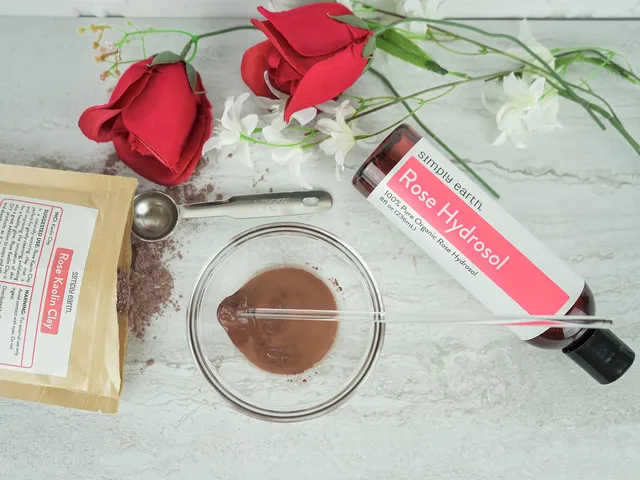
Mix it with a hydrosol rather than tap water if your skin is reactive. Our own ingredient record specifically says to mix clay with water or hydrosol before applying, and a Rose or Lavender Hydrosol brings its own calm to the mix without adding anything harsh.
Natural Clay Helps Clear the Look of Blemishes
It works on the cause it can actually reach.
 Shop Natural Clay
BEST FOR: BLEMISH-PRONE SKIN
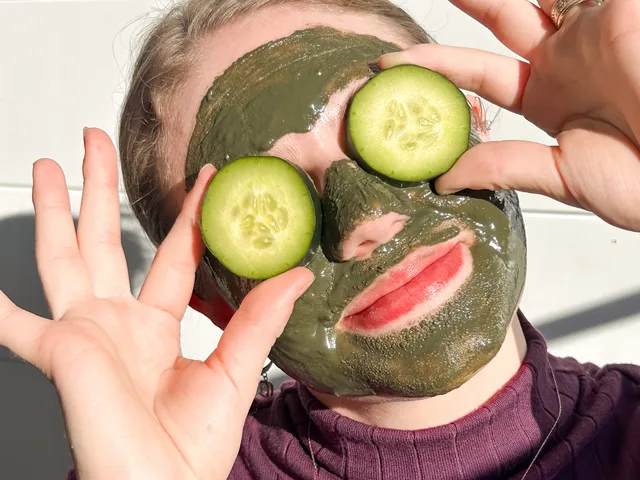
Clay is not an acne medication and we are not going to write it up as one. What it does is reduce the two things sitting on the surface that feed a congested complexion — excess oil and the debris trapped with it. Simply Earth's record for French Green Clay describes it as helping cleanse skin and absorb excess oil, and a surface with less of both is a surface with less for a blemish to form around. That is a genuine, modest, mechanical contribution, and it is the reason a clay mask is in almost every blemish-prone skincare routine. If you have persistent or painful acne, that is a conversation for a dermatologist, not a face mask — and anything promising to treat it in a mixing bowl is selling you something.
KATIE'S TIP
Spot-mask instead of full-face masking. Clay on the areas that are actually congested, left off the areas that are not, gets you the benefit without drying out skin that was fine to begin with.
Natural Clay Works on Hair and Body, Not Just Your Face
The most under-used thing in the bag.
 Shop Natural Clay
BEST FOR: OILY SCALPS, ROUGH SKIN, DIY MAKERS
Most people buy clay for their face and never take it further, which is a waste of a versatile powder. Simply Earth's ingredient record for French Green Clay sets out three separate use categories, not one. On hair and scalp it helps absorb excess scalp oil and leave it feeling clean, and it adds natural-looking volume and texture — which is precisely why clay is the working ingredient in a dry shampoo. On the body it helps smooth the appearance of rough skin and supports a softer feel, and it aids in improving the appearance of temporary puffiness. And in DIY it earns its place structurally: the Rose Kaolin Clay label notes it is a great addition to soaps and other DIY products because it increases silkiness and absorbency. Six of the eleven Simply Earth recipes built on clay are not face masks at all.
KATIE'S TIP
Clay in a soap batch is not just colour. It adds slip and a silkier bar, and it is why Rose Kaolin turns up in our shampoo bar and artisan soap recipes rather than a pigment.


Put It to Work
How to Use Natural Clay
Face masks
- • Mix the powder with water or a hydrosol to a smooth, spreadable paste — our ingredient record specifically says to mix clay with a liquid before it touches skin, never to apply it dry
- • Use a non-metal bowl and a non-metal utensil — glass, ceramic or wood
- • Apply to clean skin and keep it away from the eyes and any broken skin
- • Rinse while the mask is still slightly tacky rather than letting it dry hard and crack — a fully cracked mask is past the point of doing anything useful
- • Once or twice a week is enough. Our Pure Renewal Clay Mask is written as a weekly treatment
Body & bath
- • Helps smooth the appearance of rough skin and supports a softer feel
- • Aids in improving the appearance of temporary puffiness
- • Works into bath soaks, body powders and shaving preparations
- • Our Whipped Menthol Shaving Butter uses both of the clays we carry
Hair & scalp
- • Helps absorb excess scalp oil and leaves the scalp feeling clean
- • Adds natural-looking volume and texture, which is the whole basis of a dry shampoo
- • Clay is the working ingredient in our Revive & Rise Dry Shampoo and our Rosemary & Mint Shampoo Bars
Storage & mixing
- • Keep it dry, sealed and out of humidity — clay that has taken on moisture clumps and will not mix smoothly
- • Shelf life on our French Green Clay is listed at four years, so a bag lasts a long time if you keep water out of it
- • Mix in a well-ventilated spot and do not lean over the bowl while the powder is still dry and airborne
- • Add liquid to clay rather than clay to liquid if you want fewer lumps
Know the Difference
Which Clay Is Which?
Two of these are ours and two are not, and we would rather say so plainly than imply a range we do not stock. If you have read about bentonite or rhassoul elsewhere, this is how they sit against what we actually sell. Note also that Simply Earth's ingredient records do not carry an organic certification for either clay we carry — clay is a mined mineral rather than a crop, so it is not certified the way our oils are.
Swipe to compare →
Rose Kaolin Clay INCI Kaolin Clay | French Green Clay INCI Montmorillonite | Bentonite Clay Not sold by Simply Earth | Rhassoul Clay Not sold by Simply Earth | |
|---|---|---|---|---|
| How absorbent | The gentlest of the four — mild, and the one to pick if you are unsure | Strongly absorbent, built for skin that feels congested | The most aggressive of the group, and easy to overdo | Moderately absorbent, with a notably slippery feel |
| Colour | Soft rose-brown | Light green, from decomposed plant matter and iron oxides | Pale grey to cream | Reddish brown |
| Skin type it suits | Sensitive, dry, normal and first-time clay users | Oily, combination and congested skin | Very oily skin, used sparingly | Dry skin, and hair |
| What we use it in | Face masks, face wash, soap, shampoo bars, deodorant, dry shampoo | Clay masks, cleansing balm, shaving butter | Nothing — we do not carry it | Nothing — we do not carry it |
| Sold by Simply Earth | Yes — Rose Kaolin Clay, in 0.5oz and 8oz | Yes — French Green Clay, in 0.5oz and 8oz | No | No |
| Where to begin | Best place to start | — | — | — |
Perfect Pairs
What to Mix Natural Clay With
Clay has no aroma of its own, so this is not a scent-blending question — it is about what you wet it with and what you add for effect. The first five are liquids and bases; the last five are essential oils that turn up alongside clay in Simply Earth recipes and videos. Our own ingredient record is explicit that clay should be mixed with water or a hydrosol before it goes on skin. If you are adding essential oils, dilute them properly — the clay does not do that for you.
Where It Started
Clay's Long History in Skincare
Clay is one of the very few skincare ingredients with a genuinely ancient record rather than a marketed one. It is mined mineral powder, it is found close to the surface across most of the world, and it needs no processing to work — which meant every culture that lived near a clay deposit found the same use for it independently. Cleansing with mineral earth turns up across the ancient Mediterranean, North Africa and Asia, and the practice never really stopped.
Two of the names on the shelf today are geographic leftovers from that history. Kaolin takes its name from the hill in China where the deposit that supplied the porcelain trade was worked. French Green Clay is named after the French deposits that first made it commercially known in Europe — and this is the part worth correcting, because the name has outlived the fact. Our own ingredient record says so directly: despite the name, French Green Clay is not exclusively from France, and can be sourced from Morocco, Brazil, the United States and Mediterranean regions.
What has changed in the modern era is not the ingredient but the precision around it. The clay in a bag today has a known INCI name, a known mineral identity and a supply chain that can be audited, which is what lets us tell you that one of ours is a kaolinite and the other is a montmorillonite rather than simply calling both of them "clay". The mechanism people were relying on four thousand years ago is the same one working in your mixing bowl tonight.
What's Inside
What's Actually in Natural Clay?
Clay is a mineral, not a botanical, so there is no GC/MS report and no list of aroma constituents to publish — those belong to essential oils. What clay has instead is a mineral identity, and it is the mineral identity that predicts how a clay will behave on skin. These are facts about the minerals, not claims about what they do to a person.
Kaolinite
INCI Kaolin Clay · Rose Kaolin · Gentle
The mineral behind Rose Kaolin Clay, and the reason it is the mildest of the clays on this page. Kaolinite is a tightly bound layer silicate, which in practice means it holds less water and swells far less than the smectite clays do — so it lifts oil without pulling as hard at the skin's own moisture. That structural difference, not marketing, is why kaolin is the clay recommended for sensitive and drier skin.
Montmorillonite
INCI Montmorillonite · French Green · Absorbent
The mineral named on Simply Earth's own record as the INCI for French Green Clay. Montmorillonite is a smectite — an expanding layer clay that takes up water between its sheets and swells as it does. That expansion is what gives it a far larger effective surface area than kaolinite, and a larger surface area is simply more room to bind oil and debris. It is the same mineral family as bentonite, which is why French Green Clay behaves much more like bentonite than it does like kaolin.
Iron oxides and plant matter
The source of the green colour
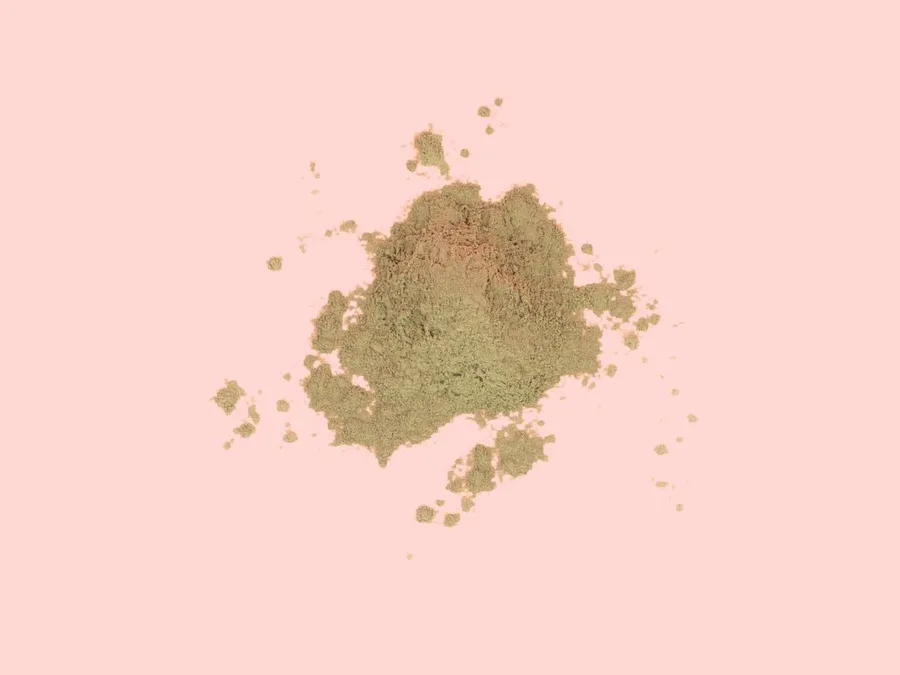
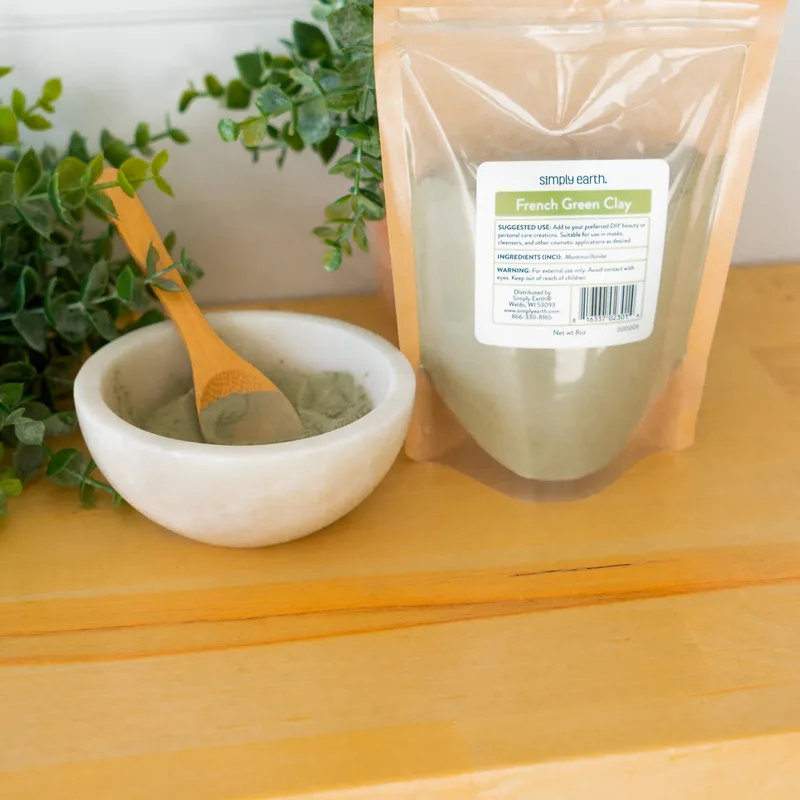
Worth knowing because the colour is not added. Our ingredient record states that French Green Clay's green tint comes from decomposed plant matter and iron oxides present in the deposit itself. There is no dye and no pigment in the bag — the colour is a readout of what the clay is made of, which is also why the exact shade varies between batches and between deposits.
Both clays we carry hold an EWG score of 1 on Simply Earth's ingredient records — the lowest-hazard band on that scale — and both are single-ingredient powders with a one-line INCI. French Green Clay's listed shelf life is four years. If you want the more absorbent of the two for congested skin, that is the French Green; if you are new to clay or your skin is on the sensitive side, start with the Rose Kaolin. Shop French Green Clay →
Where It Comes From
Where Our Clay Comes From
Clay is mined, not farmed, so the sourcing story here looks different from the one on our oil pages — there is no harvest season, no distillery and no grower cooperative. What there is instead is a supplier chain, and we can tell you what our records actually say about it.
Our French Green Clay is supplied through Bulk Apothecary, and the product country on that supplier record is the USA. That supplier has passed Simply Earth's vendor approval process and its product information is marked approved on our side. We would rather give you that — a named supplier and a country, both verifiable in our own system — than a romantic description of a hillside we have never visited.
The honest limit of what we know is worth stating too. Our records name the supplier and the product country, but they do not name the specific deposit or mine the clay is worked from, so we are not going to invent one. And on the geography generally: our ingredient record notes that French Green Clay is not exclusively from France despite the name, and is sourced from Morocco, Brazil, the United States and Mediterranean regions. If a brand tells you their green clay is definitely French, ask them which deposit.
Use It Right
Things to Remember When Using Natural Clay
Patch test first. Our own ingredient record recommends a patch test before using clay on larger areas of skin, and that holds even though clay is a single-ingredient mineral.
Keep it away from your eyes and off broken skin. Our record for French Green Clay says this explicitly — do not use on sensitive areas such as the eyes, or on broken skin.
Never apply clay dry. Mix it with water or a hydrosol first. Dry powder on skin does nothing useful and is far more drying.
Do not let a mask dry to the point of cracking. Once it is hard and splitting it has stopped working and is pulling moisture from your skin — rinse while it is still slightly tacky.
Mind the dust when you are mixing. Dry clay is a very fine airborne powder. One of our own customers put it best in a review of our Face Wash Powder — "the powder is so light that it gets into your throat, so be warned so you don't accidentally inhale." Mix in a ventilated spot and keep your face back from the bowl.
Use non-metal tools. Glass, ceramic or wooden bowls and utensils are the convention for mixing clay, particularly the montmorillonite and bentonite family.
Do not over-mask. Once or twice a week is plenty. Absorbing every trace of oil is not the goal, and stripped skin often compensates by producing more.
Store it dry and sealed. French Green Clay's listed shelf life is four years, but that depends on keeping humidity out of the bag.
For external use only. Our ingredient record states this directly, and we do not recommend ingesting clay.
These statements have not been evaluated by the Food and Drug Administration. This product is not intended to diagnose, treat, cure, or prevent any disease.
Real Results
What Earthies Are Saying About Natural Clay
"I have been loving using the Rose Kaolin Clay! It's not too harsh on my skin and it really helped draw the impurities to the surface! Beyond excited to start using it more frequently."
Summer Wittneben
Rose Clay
"I used the face wash in 2 recipes and I love it! I made one recipe using the face wash and the rose clay and it wonderfully cleansed and exfoliated my face better than the store bought stuff I had."
Lisa West-Harper
Verified Buyer • Face Wash Powder
"I love the face wash powder! I have tried alone and with the Rose Kaolin Clay. I like best with the clay. You only need a small amount. My skin feels clean and without harsh chemicals."
Marna Stoove
Face Wash Powder
OUR SIMPLY PURE PROMISE
What Goes Into Your Products Matters
Single-Ingredient Powder
A one-line INCI. Nothing added, no fillers.
EWG Score of 1
Lowest-hazard band, on both clays we carry.
Approved, Named Suppliers
Every supplier clears our vendor approval process.
EWG 1
Safety Score
Lowest-hazard band on the scale
4 Years
Shelf Life
Stored dry and sealed
2
Clays We Carry
Rose Kaolin and French Green
Your Order Changes Lives: 13% of profits fight human trafficking globally.
Natural Clay FAQ
The questions we get asked most about using clay on skin.
What does natural clay actually do for your skin? +
It binds and lifts. Wet clay carries a surface charge that attracts excess oil, dirt and surface residue, so when you rinse the mask off, what it has bound goes with it. Simply Earth's ingredient record describes French Green Clay as having natural absorbent properties that help attract and bind excess oil, dirt and surface impurities. That mechanism is also what delivers the knock-on benefits — clearer-looking pores, a mild exfoliation and a brighter surface.
Which clay should I use — Rose Kaolin or French Green? +
Rose Kaolin if you are new to clay, or if your skin is sensitive, dry or normal. It is a kaolinite, which swells far less and pulls more gently. French Green if your skin is oily, combination or feels congested — it is a montmorillonite, holds more water, and has a much larger effective surface area to bind oil with. If you genuinely cannot decide, start with the Rose Kaolin; it is the harder one to overdo.
How often should I use a clay mask? +
Once or twice a week for most people. Our own Pure Renewal Clay Mask is written as a weekly treatment. Masking daily is the most common mistake — absorbing oil is the point, but skin stripped of all of it will often produce more to compensate.
How much water do I mix with clay? +
Enough to make a smooth, spreadable paste rather than a fixed ratio — and we would rather say that than print a number we cannot source. Simply Earth's ingredient records do not carry a recommended usage rate for either clay, so the reliable numbers live on the individual recipe cards. Add the liquid to the clay a little at a time; it thickens more than you expect.
Should I let a clay mask dry completely? +
No. Rinse while it is still slightly tacky. A mask that has dried hard and cracked has finished doing anything useful and has moved on to pulling moisture out of your skin, which is where the tight, stripped feeling comes from.
Is French Green Clay actually from France? +
Not necessarily, and our own ingredient record says so. Despite the name, French Green Clay is not exclusively from France — it can be sourced from Morocco, Brazil, the United States and Mediterranean regions. The name comes from the French deposits that first made it commercially known in Europe. Our supplier record lists the product country for ours as the USA.
Does Simply Earth sell bentonite or rhassoul clay? +
No. We carry two clays — Rose Kaolin Clay and French Green Clay — both in 0.5oz and 8oz. French Green Clay is a montmorillonite, the same mineral family as bentonite, so it is the closest match if bentonite is what you were looking for and it is considerably easier on skin.
Can I use clay on my hair and body, or just my face? +
All three. Our ingredient record for French Green Clay lists skincare, hair and scalp care, and body care as separate use categories. On the scalp it absorbs excess oil and adds natural-looking volume, which is the basis of dry shampoo. On the body it helps smooth the appearance of rough skin. Six of the eleven Simply Earth recipes that use clay are not face masks.
About the Author: Katie Veldkamp
Katie Veldkamp
Certified Aromatherapist · Co-Founder, Simply Earth
Katie Veldkamp is a Certified Aromatherapist and co-founder of Simply Earth. She fact-checks every ingredient page we publish — including the parts where the honest answer is that we do not have the number. Everything in this article has been reviewed and approved by Katie.
Get natural recipes in your inbox
New recipes, ingredient guides and honest safety information — no spam, and you can unsubscribe whenever you like.
No spam, ever. Unsubscribe in one click.

Learn by doing
Make your own natural products every month.
The Simply Earth Recipe Box ships 4 full-size essential oils, 6 natural recipes, and everything you need to make them. No guesswork.
Start My Recipe Box$39.99 for your first box, then $49.99/month. Skip, pause, or cancel anytime.