
Apricot Oil: The Carrier That Gets Out of the Way

Katie Veldkamp
Lead Certified Aromatherapist
Fact Checked and Approved
Most of what sits on our ingredient shelf has to be diluted before it touches you. Apricot oil is the thing you dilute into. It is a carrier oil — pressed from the kernel inside the apricot stone, not from the fruit — and its whole job is to carry something else onto your skin without arguing with it. It barely smells of anything, and it sinks in faster than sweet almond does, which is our own absorption data talking rather than our marketing. That combination is why it turns up in facial oils, in hair masks, and in the bottle of a customer who diluted three drops of Wintergreen into half a teaspoon of it and rubbed her sprained ankle. Here is what apricot oil actually does, what Simply Earth's own records say about it, and the one allergy fact that most pages about this oil get exactly backwards.

BEST FOR: DAILY FACE AND BODY MOISTURISING
This is the plain one, and it is the use Simply Earth's own ingredient record leads with — apricot oil hydrates and nourishes skin. It is worth being precise about the name while you are here, because it explains the rest of this page. Apricot oil is not pressed from the apricot. It is pressed from the kernel inside the stone, which is why its INCI name is Prunus armeniaca (apricot) kernel oil, and why you will sometimes see it sold as apricot kernel oil. The fruit is a snack. The kernel is where the oil is.
KATIE'S TIP
Put it on damp skin, not dry. Straight out of the shower, before you towel off properly, is when a light oil like this does the most work — it seals in the water that is already there instead of sitting on top of dry skin.
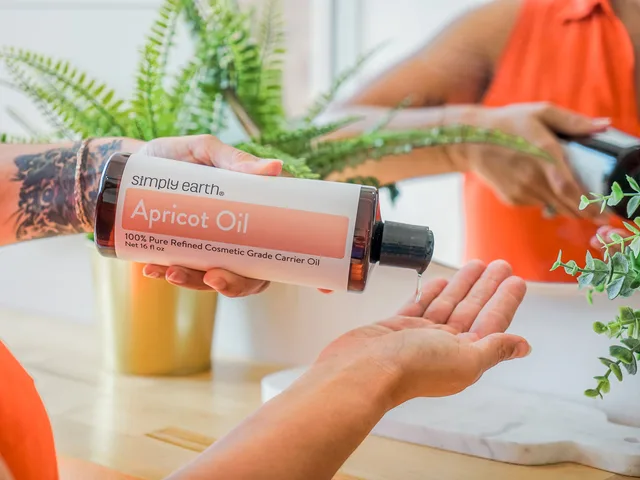
Apricot Oil Absorbs Fast, Without the Greasy Film
Measurably Lighter Than Sweet Almond
 Shop Apricot Oil
BEST FOR: SENSITIVE AND EASILY-OVERWHELMED SKIN
Every carrier oil describes itself as light, so here is a figure that is not ours to spin. Simply Earth grades absorption on one internal scale, and apricot oil is rated Fast Absorption Rate (2). Sweet almond, jojoba and argan are all rated Average Absorption Rate (3). That is the same scale applied by the same people to all four oils, and it is the honest version of "lighter than almond" — apricot sinks in a step faster, which is exactly why it suits faces, sensitive skin, and anything you have to wear out of the house ten minutes later.
KATIE'S TIP
This is the one I hand to people who tell me they hate face oils. Nine times out of ten they have only ever tried a heavy one, and they are not wrong about that oil — they are wrong that every oil behaves that way.
Apricot Oil Brings Antioxidants to a Facial Oil
Written the Way the Evidence Actually Supports
 Shop Apricot Oil
BEST FOR: FACIAL OIL BLENDS
Apricot oil carries antioxidants, vitamin E among them, and Simply Earth's ingredient record connects those to the appearance of fine lines. We are wording that carefully on purpose. An oil that softens and hydrates changes how skin looks, and that is a real and worthwhile thing for a facial oil to do. It is not the same as a claim about ageing, and we are not going to blur the two just because the second one sells better.
KATIE'S TIP
Three or four drops pressed into the face at night is plenty. If it is still sitting on your skin in the morning, you used too much — it is not the wrong oil.
Apricot Oil Calms Skin That Is Easily Irritated
Where the Fast Absorption Actually Pays Off
 Shop Apricot Oil
BEST FOR: REACTIVE AND SENSITIVE SKIN
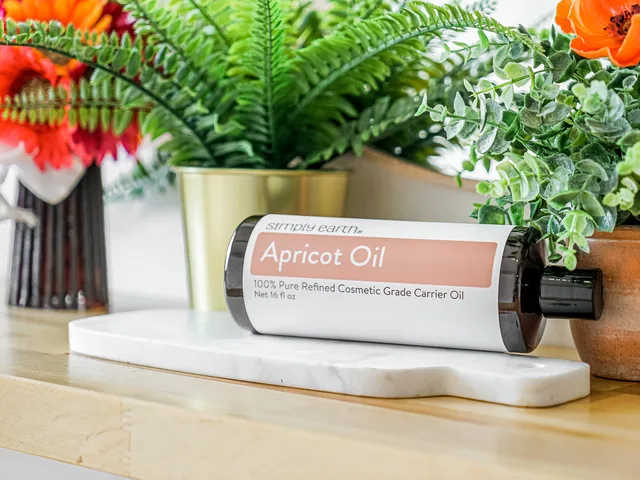
Simply Earth's ingredient record lists soothing and calming irritated skin among apricot oil's uses, and notes that it suits dry to sensitive skin types precisely because it is absorbed easily. Those two facts are really one fact. An oil that sits on the surface has longer to bother reactive skin; one that sinks in has less. If your skin has opinions about most of what you put on it, this is a sensible carrier to test first.
KATIE'S TIP
Patch test on the inside of your elbow and give it a full day before you put anything new on your face. That is not specific to apricot oil, but people skip it most often with the ingredients that sound gentlest.
Apricot Oil Softens Hair Without Weighing It Down
The Same Lightness, Applied to Ends
 Shop Apricot Oil
BEST FOR: HAIR OILS AND MASKS
Apricot oil helps keep hair smooth and moisturised, and the property that makes it good on skin is the property that makes it usable on hair — it is light enough to condition ends without leaving them lank. Simply Earth's internal record also mentions hair growth. We are not carrying that claim here, because a growth claim needs evidence we do not hold, and softness and condition are what this oil can genuinely be relied on for.
KATIE'S TIP
Ends only, and less than you think. Start at the bottom third of your hair and work upward if it needs it. Never start at the roots.
BEST FOR: DILUTING ESSENTIAL OILS
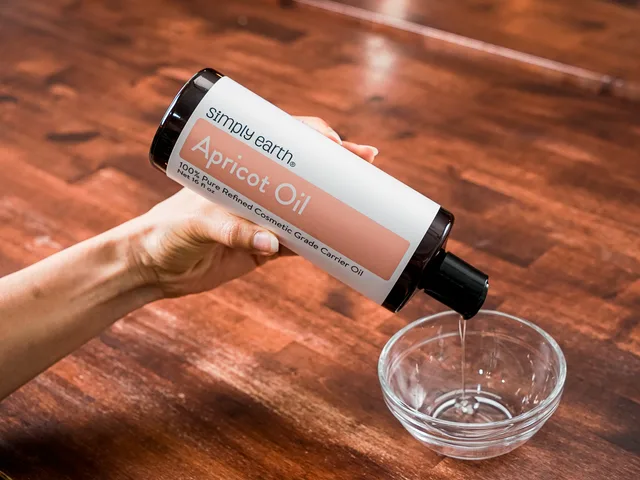
Simply Earth's ingredient record describes the aroma as bland, and says plainly why — the refining process removes most of the odour. For a carrier oil that is not a shortcoming, it is the specification. When you blend an essential oil into a base, you want to smell the essential oil. A carrier with a personality of its own turns every blend into a negotiation, which is why an almost-neutral oil is the one to reach for when the blend has to smell like what you actually put in it.
KATIE'S TIP
If you are building a roll-on or a massage blend and the scent keeps coming out muddier than you intended, change the carrier before you change the essential oils. It is usually the base.
BEST FOR: DIY MAKERS AND CLEAN-INGREDIENT ROUTINES
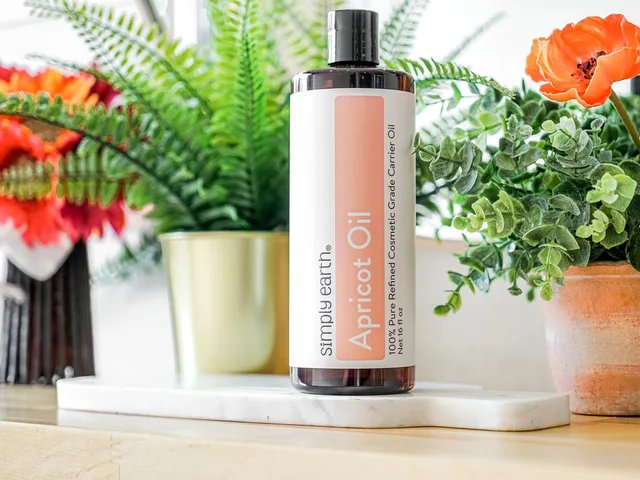
Apricot oil scores 1 on the Environmental Working Group's scale — the lowest hazard band — and Simply Earth's grade for it is Cosmetic, which is what the bottle says too. It is worth knowing how we sell it, because that tells you who it is for. Apricot oil comes in a 16oz bottle and a one-gallon jug, and nothing smaller. This is not a 20mL bottle to try once; it is the base ingredient you buy when you have started making things and you are tired of running out.
KATIE'S TIP
The gallon is not madness if you make body oils or scrubs regularly. Decant what you need into a smaller amber bottle and keep the jug shut and out of the light.
Put It to Work
How to Use Apricot Oil
For Skin
- • Apply a few drops to the face and neck after cleansing, while skin is still damp
- • Add a splash to a bath for an all-over moisturising soak
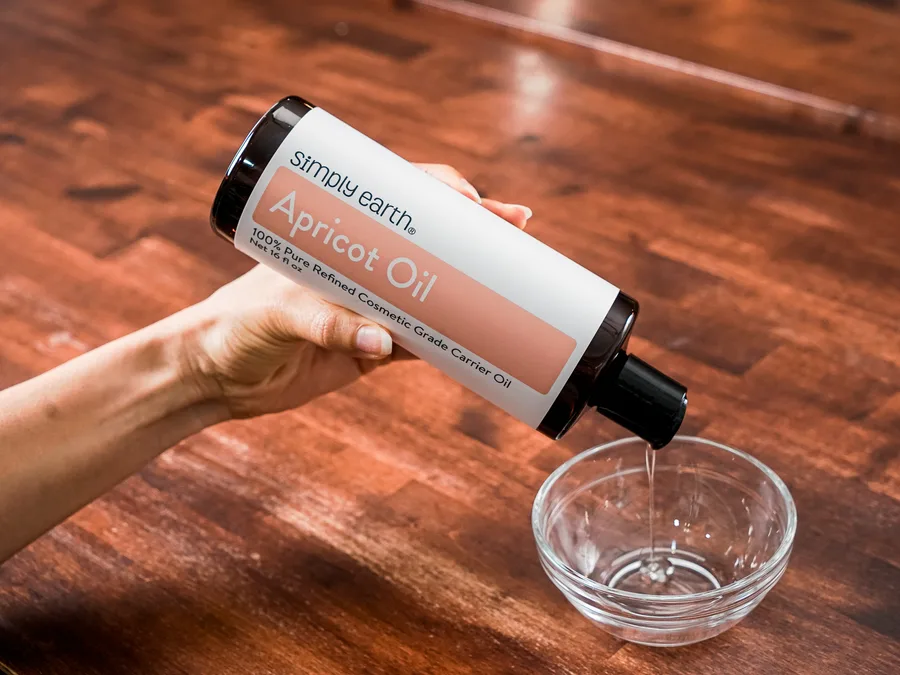
- • Use it neat — apricot oil is the carrier, so there is no dilution rate to work out
For Hair
- • Warm a small amount and massage it through the lengths and ends
- • Leave it for around two hours and wash it out, or leave it overnight as a mask
- • Start at the ends and work upward, never at the roots
As a Carrier for Essential Oils
- • Use it as the base for roll-ons, massage blends and facial oils
- • Its near-neutral aroma lets the essential oil lead the blend
- • Simply Earth publishes no recommended usage rate for apricot oil itself, so follow the dilution guidance for the essential oil you are adding
In Balms, Butters and Scrubs
- • Combine it with shea butter and essential oils for a custom body cream
- • Use it as the liquid oil in a sugar or salt scrub
- • Buy the gallon if you make these often, and decant into smaller bottles
Know the Difference
Apricot vs. Almond, Grapeseed and Jojoba
Every cell in this table comes from Simply Earth's own ingredient records rather than from general reading, and two rows are worth stopping on. The first is absorption: apricot and grapeseed are both graded Fast, while sweet almond and jojoba are graded Average, which is the measured version of the claim that apricot is the lighter oil. The second is the allergy row, and it is the reason this page reads the way it does — apricot kernel and sweet almond are both Prunus stone-fruit kernels, so swapping one for the other is not a way around an almond allergy, whatever else you may have read. If that is what you are shopping for, grapeseed and jojoba are the columns to look at, and the safety section below says the same thing in more detail.
Swipe to compare →
Apricot Oil The subject of this page | Sweet Almond Oil The one it is usually compared to | Grapeseed Oil The other fast, light carrier | Jojoba Oil The long-keeping one | |
|---|---|---|---|---|
| Botanical Name | Prunus armeniaca | Prunus dulcis | Vitis vinifera | Simmondsia chinensis |
| Plant Part | Kernels, from inside the stone | Seeds | Seeds | Seeds |
| Absorption | Fast Absorption Rate (2) | Average Absorption Rate (3) | Fast Absorption Rate (2) | Average Absorption Rate (3) |
| Aroma | Bland — refining removes most of the odour | Characteristic mild oily odour | Odourless | Natural odour |
| Colour | Straw coloured | Pale yellow to yellow | Yellowish to green | Clear bright golden |
| Shelf Life | 2 years | 2 years | 2 years | 3 years |
| Grade at Simply Earth | Cosmetic, refined, cold pressed | Cosmetic, refined, cold pressed | Cosmetic, refined, cold pressed | Cosmetic, cold pressed |
| EWG Score | 1 | 1 | 1 | 1 |
| Stone-Fruit Allergy | A Prunus — not a substitute for almond | A Prunus — the usual concern | Not a Prunus | Not a Prunus |
| Price at Simply Earth | $14.99 / 16oz · $54.99 / gallon | Sold separately | Sold separately | Sold separately |
| Simply Earth | This page's oil | — | — | — |
Perfect Pairs
What Apricot Oil Pairs With
This is not a "blends well with" list in the aroma sense — apricot oil has almost no aroma to blend, which is precisely the point of it. These are the essential oils it carries best: the skin-friendly ones people most often want in a facial oil, a roll-on or a body blend, where a near-neutral base lets the oil on top do the talking. If you are layering carriers rather than essential oils, grapeseed keeps things equally light and jojoba adds slip and a longer shelf life.
From the Stone
Where Apricot Oil Comes From
The apricot tree originated in China and now grows across every temperate region of the world, and particularly around the Mediterranean. It is a small, full tree with pointed oval leaves and clusters of white to pale pink flowers, and its fruit — smaller than a peach, and coloured somewhere between rich yellow and orange — carries a single large stone.
Inside that stone is the kernel, and the kernel is the part this page is about. It makes for a genuinely good origin story, because for most of the history of apricot growing the stone was the bit you threw away. The fruit was the product; the pit was waste. Apricot kernel oil exists because somebody worked out that the discarded half was worth pressing.
That framing still holds at industrial scale. As the earlier version of this page put it, the pits come from apricots already destined for canning — the fruit gets eaten either way, and the kernel that used to go in the bin becomes the oil in the bottle. There is no separate apricot crop grown for oil sitting behind this ingredient, and we would rather tell you that than let you imagine one.
The Chemistry
What Is Actually In Apricot Oil
A carrier oil's chemistry is a fatty-acid profile rather than a constituent list — so this section names compounds and deliberately gives no percentages.
Oleic Acid
Monounsaturated · The dominant fatty acid
The fatty acid that leads apricot kernel oil's profile. Oleic acid is what makes an oil feel cushioning and conditioning on skin, and it is the same compound that dominates olive and sweet almond oil. It is a large part of why apricot oil reads as nourishing rather than merely wet.
Linoleic Acid
Polyunsaturated · The lightness
The second of the two fatty acids that characterise this oil, and the one associated with a lighter, faster-absorbing feel. The balance between oleic and linoleic acid is what separates carriers that sink in from carriers that sit — and it is the plausible explanation for why Simply Earth's own absorption grading puts apricot a step ahead of sweet almond.
Vitamin E
Tocopherol · Naturally present
Naturally present in apricot kernel oil, and the antioxidant most associated with it. Vitamin E is also part of why carrier oils keep as long as they do, since it slows the oxidation that eventually turns any fixed oil rancid.
Refined, and Cold Pressed
Both are true, and they do not contradict each other
Simply Earth's record gives the extraction method as cold pressed and the finished oil as refined — the kernels are pressed without heat, and the oil is filtered afterwards. Refining is what strips out most of the odour and colour, which for a carrier is the desired outcome rather than a compromise. It is also why our apricot oil is straw coloured and almost scentless, where an unrefined one would be darker and nuttier.
Being straight about the limits of this section: Simply Earth publishes no GC/MS report and no batch fatty-acid assay for apricot oil, and the spec sheets attached to this ingredient are packaging documents rather than chemistry. The compounds above are named because they characterise apricot kernel oil, not because we are quoting a tested number — which is why you will not find a percentage anywhere on this page. What we can point you at is our testing programme. See Our Testing →
Where It Comes From
Where We Source Our Apricot Oil
Our supplier record for this oil gives its country of origin as Spain, with the harvest running through July and August, and that supplier relationship is marked approved on our side. Spain sits squarely inside the Mediterranean growing region the apricot spread into from China, so the origin and the botany agree with each other — which is not always the case with an ingredient this widely traded.
The oil is cold pressed from the kernels and then refined, and it is graded Cosmetic. On the EWG scale it scores a 1, the lowest hazard band there is.
What we are not going to do is dress this up any further. We know the country, the plant part, the harvest window and the extraction method, and all four are on the page above. We do not have an orchard to name, a years-partnered figure, or a farm story for this particular ingredient — and rather than write something evocative around that gap, we would rather leave it visible and go and fill it properly.
Spain
Where It's Sourced
Kernels
Plant Part
Cold Pressed
Extraction
Use It Right
Things to Remember When Using Apricot Oil
Apricot oil is photosensitive. Simply Earth's ingredient record states that using it can increase the skin's sensitivity to sunlight when proper sun protection is not followed — so wear sunscreen on skin you have applied it to before you go out.
It is not a safe swap for a sweet almond allergy. Apricot kernel is Prunus armeniaca and sweet almond is Prunus dulcis — the same genus, and both are stone-fruit kernels. If you avoid almond oil for allergy reasons, apricot kernel oil is not the alternative; look at grapeseed or jojoba instead, and talk to your doctor.
Some people react to it, including with breakouts. Allergic reactions are possible, and acne-prone skin in particular may break out. Patch test before you use it widely.
External use only. Swallowing apricot oil can cause digestive problems including nausea, stomach cramps, vomiting and diarrhoea.
Raw apricot kernels are not food. The kernels themselves are poisonous raw and can cause cyanide poisoning. That is about the seed rather than the cosmetic oil pressed from it — but it is the reason the external-use-only line above is not a formality.
There is no dilution rate for apricot oil. It is a carrier — the thing other oils get diluted into — so it is used neat, and it is never diffused.
Shelf life is 2 years. Store it in a cool area out of direct sunlight. Fixed oils go rancid rather than simply fading, so trust your nose: if it smells sharp or waxy, replace it.
These statements have not been evaluated by the Food and Drug Administration. This product is not intended to diagnose, treat, cure, or prevent any disease.
Real Results
What Earthies Are Saying About Apricot Oil
"It was nice. I diluted 3 drops in 1/2 tsp. of apricot oil and rubbed on ankle before soaking in epsom salt bath. Soothing and pain-relieving!"
Lanita T.
Verified Buyer • Wintergreen Essential Oil
OUR SIMPLY PURE PROMISE
What Goes Into Your Products Matters
Pure and Additive-Free
No fillers, no synthetic fragrance, no extenders.
Third-Party Tested
We test our products and publish the results.
Ethically Sourced from Quality Farms
Responsibly harvested. People and planet first.
EWG 1
Hazard Score
The lowest band on the scale
Spain
Country of Origin
Named, not implied
2 Years
Shelf Life
Stored cool and out of sunlight
Your Order Changes Lives: 13% of profits fight human trafficking globally.
Apricot Oil FAQ
The questions Earthies ask most — including the allergy one that most pages about this oil get wrong.
What is apricot oil good for? +
Mostly for putting other things onto your skin. It is a carrier oil, so its main job is being the base for facial oils, massage blends, roll-ons, balms and scrubs. Used on its own it hydrates and nourishes dry skin, soothes skin that irritates easily, softens hair without weighing it down, and brings antioxidants including vitamin E to a facial oil. It also absorbs quickly, which is what makes it comfortable on faces and on sensitive skin.
Is apricot oil the same as apricot kernel oil? +
Yes — two names for one thing, and the longer name is the more accurate one. The oil is pressed from the kernel inside the apricot stone, not from the fruit, and its INCI name is Prunus armeniaca (apricot) kernel oil. Simply Earth labels the bottle Apricot Oil, which is the name most people search for.
Can I use apricot oil if I am allergic to almonds? +
You should not assume so, and this is the single most important thing on this page. Sweet almond is Prunus dulcis and apricot kernel is Prunus armeniaca — the same genus, and both are stone-fruit kernels rather than true nuts. Apricot kernel oil is often recommended as the gentle alternative to almond oil, and for allergy purposes that advice is backwards. If you are avoiding almond oil because of an allergy, speak to your doctor, and look at grapeseed or jojoba, neither of which is a Prunus.
Does apricot oil need to be diluted? +
No. Apricot oil is the diluent — it is what you dilute essential oils into. You use it neat on skin and hair, and you never put it in a diffuser, because a fixed oil does not evaporate. There is no dilution rate for it, and if a page gives you one for a carrier oil, that page has confused it with an essential oil.
Is apricot oil refined or unrefined? +
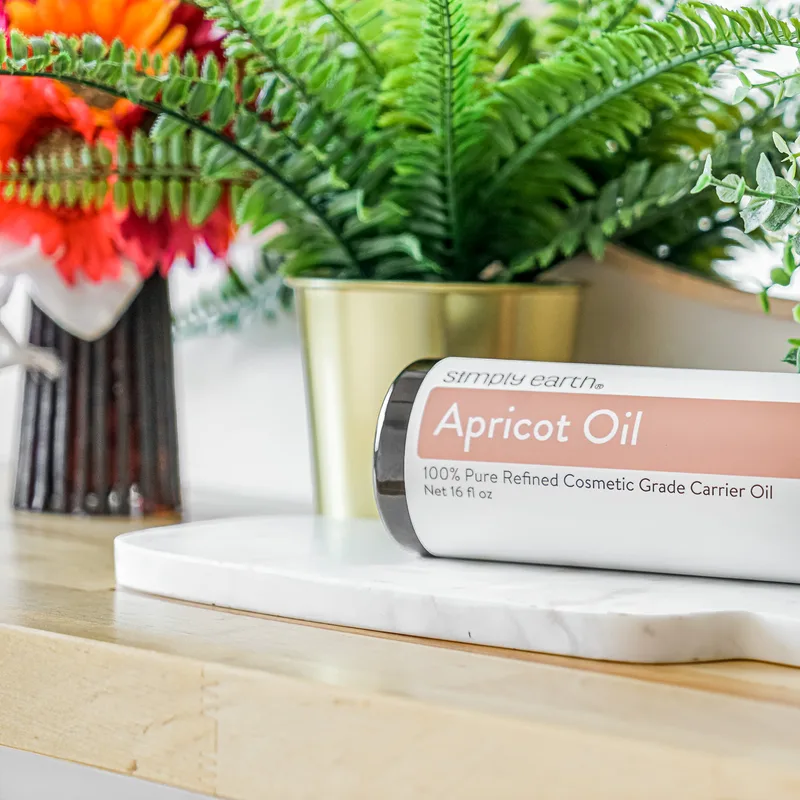
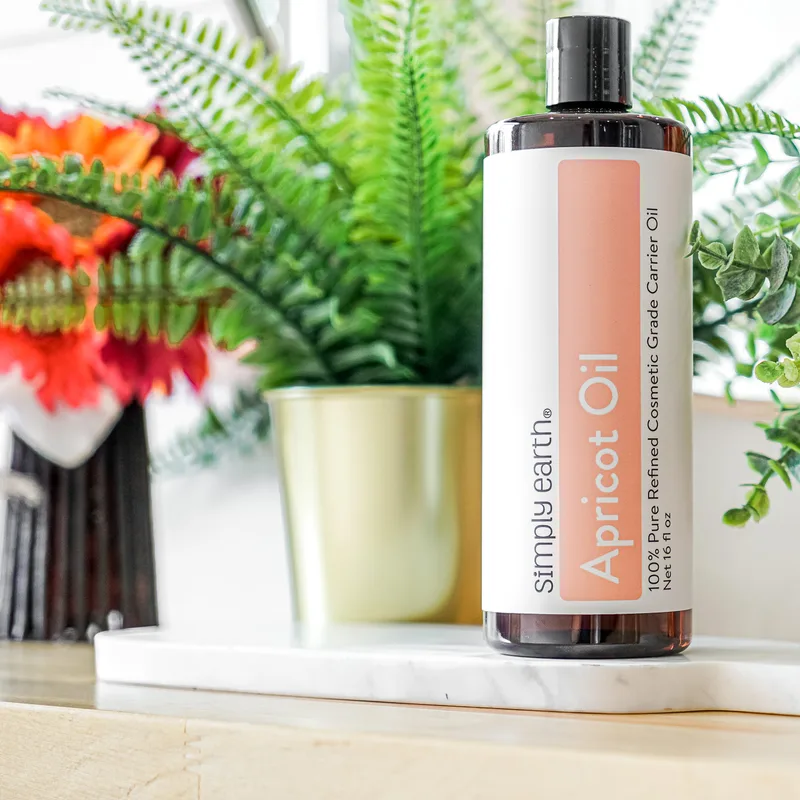
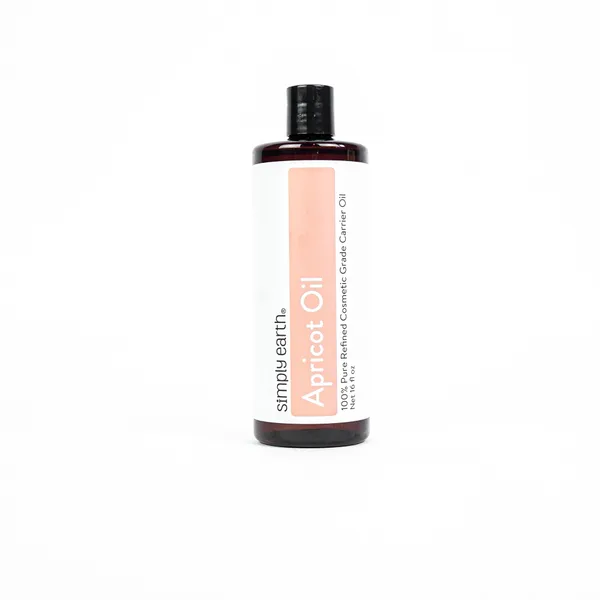
Simply Earth's apricot oil is cold pressed and then refined, and the bottle says so — "100% Pure Refined Cosmetic Grade Carrier Oil". Both halves of that are true at once — the kernels are pressed without heat, and the oil is filtered afterwards. Refining is what removes most of the odour and colour, which for a carrier oil is the point rather than a compromise. An unrefined apricot oil would be darker and would smell more of itself.
How is apricot oil different from sweet almond oil? +
The practical difference is speed. On Simply Earth's own absorption grading apricot oil is Fast where sweet almond is Average, so apricot sinks in noticeably quicker and leaves less of a film. Apricot is also close to odourless, where almond has a mild characteristic smell. What is not different is the allergy picture — both are stone-fruit kernels from the same genus, so apricot is not the hypoallergenic version of almond.
Does apricot oil make you sensitive to the sun? +
Simply Earth's ingredient record says it does — that using apricot oil can increase the skin's sensitivity to sunlight if proper sun protection is not followed. Wear sunscreen on any skin you have applied it to before you go out.
How long does apricot oil last, and how should I store it? +
Two years, stored in a cool place out of direct sunlight. Carrier oils go rancid rather than just fading, so your nose is the real test — a sharp or waxy smell means it is time to replace the bottle. If you have bought the gallon, decant what you are using into a smaller amber bottle and keep the jug closed and dark.
About the Author: Katie Veldkamp
Katie Veldkamp
Certified Aromatherapist · Co-Founder, Simply Earth
Katie Veldkamp is Simply Earth's Lead Certified Aromatherapist and the heart behind every product recommendation, recipe, and safety guide on this blog. With years of hands-on aromatherapy practice and a deep love for plant-based wellness, Katie fact-checks every health claim so that what you read is safe, science-informed, and actually useful.
Join 20,000+ Earthies Making Their Homes Natural
New recipes, usage guides, and DIY tips—delivered free.
No spam. Unsubscribe any time.

Learn by doing
Make your own natural products every month.
The Simply Earth Recipe Box ships 4 full-size essential oils, 6 natural recipes, and everything you need to make them. No guesswork.
Start My Recipe Box$39.99 for your first box, then $49.99/month. Skip, pause, or cancel anytime.